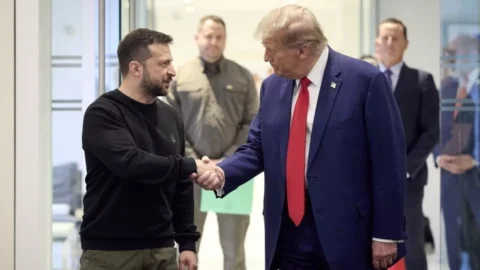
The one seen yesterday in the Oval Office next to the British Prime Minister, Keir Starmer was a Trump who appeared reasonable, almost dialoguing, who claimed to have good relations with both Putin and Zelensky, for whom he took back the definition of "dictator", who announced duties from April 2 but only "for reciprocity with the EU". In short, a Trump who seemed to have "changed course" according to the hot comment released by Starmer himself in Washington to agree on a common line on Ukraine and duties a few hours after the visit to the White House of French President Emmanuel Macron.
Rare Earths in Ukraine, Trump-Zelensky Signs Today
The European activism of the last days led by Paris e London perhaps he advised Trump to adopt a "softer" attitude, aware of the fact that he was no longer the only master of the field capable of dictating conditions to everyone and on everything, counting only on isolated European alliances such as Orban's Hungary or Meloni's Italy. In the background, however, remains Trump's narrative of always and in any case acting in the interests of the Americans but inserted however in a framework of global security and prosperity.
This is also the case with the agreement that Trump will sign today with Ukrainian President Volodymyr Zelensky on the so-called “Rare lands" for a expected value of $500 billion. A visit that was about to be canceled at the last minute but which seems to have been confirmed by direct intervention of French President Macron. It is planned to create a joint Ukrainian and American company of 50% each for the exploitation of the deposits, the proceeds of which would be used for the reconstruction of the country. According to the Ministry of Natural Resources and Environment of Ukraine, the rocks of the country contain "essential" raw materials including graphite, lithium, titanium, beryllium and uranium. The resources needed to produce batteries, radar systems and armor, essential for the defense and technology sectors, and would go some way to reducing US dependence on Chinese minerals.
Although the country has mapped more than 20.000 deposits and mining sites, only about 8.000 of them have been assessed as viable. Of these, less than half were in use before Russia's full-scale invasion of Ukraine three years ago.
Donald Trump has called the minerals deal a “backstop,” a kind of security guarantee for Ukraine. The word is the same one used by some European leaders, including Emmanuel Macron and Keir Starmer, to describe the security guarantee they would like from the United States to support a contingent of European-led troops. But, Trump explained, “you have to make a peace agreement before you send in peacekeepers.” Trump expressed confidence that an agreement between Moscow and Kiev could be reached soon but he considered the hypothesis of Ukraine's entry into NATO is unrealistic. According to the American president, Putin will stick to the agreement and "would not invade Ukraine again". Trump took full credit for having started the negotiation. "If I had not been elected, no one would have spoken to Putin," he said.
Trump, Europe and the tariff issue
With Starmer, the US president also addressed the issue of tariffs. “The EU is tough on us on trade, we don't like how the EU treats our companies. That's why we will have reciprocal tariffs with the EU on April 2,” Trump announced. A few hours earlier he had been much harsher, declaring that the European Union “It was created to screw the United States, that is its purpose, they did a good job, but now I am the president”. The response of the spokesperson of the European Commission was not long in coming: the EU represents a single market of 450 million consumers from which over the years American companies have made huge profits to the point of creating an exchange of 1,5 trillion dollars a year. “We are ready to cooperate if the rules are respected. But we will also protect our consumers and our companies at every step”, said the spokesperson of the Commission.
The fact that the climate between Washington and Brussels is not the best is also demonstrated by the fact that the meeting initially planned between the High Representative for Foreign Policy of the Union Kaja kallas and the secretary of state Marco Rubio was cancelled "for scheduling reasons". The President of the Parliament is also in Washington these days Robert Metsol according to which “tariffs and trade wars only produce losers, while the European Parliament is working for a win-win situation”.
A climate that was also reflected in the meeting of G20 Finance Ministers South African presidency with an echo on the tariff issue. For the first time, no agreement was reached on a text to conclude the meeting. There would have been Differences on how to manage climate finance. Another sticking point is the issue of protectionism. A European official who attended the G20 meetings said that “harsh words” were exchanged between European finance ministers and US officials in light of Trump's threats.
The Paris-London axis overshadows Italy
Activism of France and the United Kingdom towards the new US administration has marginalised the role of the Italian Prime Minister who, in Macron's debriefing on his meeting with Trump, asked the French President bluntly: "I would like to know in what capacity you went to Washington". Macron assured that he had "represented only France" but it is now clear that Paris and London (only two European powers present in the UN Security Council and nuclear powers) they want to lead a peacekeeping force in Ukraine. Italy fears that on Sunday, at the summit with some EU countries called in London, Prime Minister Starmer could announce new initiatives that could open new divisions between member states.
Right now Germany and Poland would support Meloni's line many are cautious about sending troops. Strategic autonomy and increased operational capabilities in the defense sector will be discussed not only in London but also in Brussels. 6 March in the extraordinary summit convened by the President of the EU Council Antonio Costa as a follow-up to the “reatreat” of early February. The President of the EU Commission, Ursula von der Leyen, has already announced a formal proposal for March 19 in the defense sector with a financial instrument to speed up the purchase of weapons systems.
It is now an established fact that in three years since Russia's invasion of Ukraine, the main ones EU defense companies have significantly increased their presence of lobbying in Brussels. The top 10 EU defense companies have increased their lobbying budgets by around 40 percent. The trend is particularly evident for the Swedish defense giant Saab, which has doubled its spending, followed by Airbus e Dassault, both of which have significantly increased their lobbying efforts.