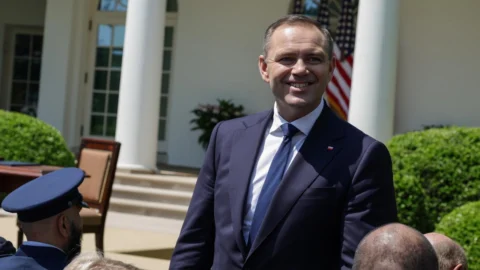
After a high-tension election day, lived on a razor's edge and marked by a back-and-forth between the candidates until the last count, the Poland has chosen its new president. The sovereignistKarol Nawrocki, a representative of the nationalist area and supported by the sovereignist party Law and Justice (PiS), has won the run-off with 50,89% of the votes – equal to 10.606.628 preferences – narrowly beating the liberal-conservative Rafał Trzaskowski, mayor of Warsaw, leading face of the Civic Coalition and political ally of Prime Minister Donald Tusk, stopped at 49,11% (10.237.177 votes). One a gap of just 369.451 votes which certifies a deeply divided country.
The result was announced overnight by the National Election Commission, after the first projections, published around 23 p.m., had initially given Trzaskowski the lead. The latter had even claimed victory, speaking of a victory “on a razor’s edge,” before cautiously awaiting official confirmation.
But Nawrocki, who had shown up with a independent list despite the support of PiS, had never admitted defeat: "Tonight we will win and save Poland", he had declared. In the end, the official data proved him right, also thanks to a very high turnout: 71,63%, the highest ever recorded for a presidential election in Poland and the second highest overall after the 2023 parliamentary elections (where it reached 74,38%).
A country divided between cities and countryside, North-West and South-East
The vote confirmed the political and social fracture which crosses Poland. Trzaskowski dominated in the big cities and in the North-West of the country, Nawrocki instead prevailed in the countryside and in the South-Eastern regions.
According to Ipsos data, Trzaskowski obtained 67,8% in cities with more than 500 thousand inhabitants, 66,2% in those between 201 and 500 thousand, and maintained the advantage even in smaller cities with up to 50 thousand inhabitants. Nawrocki, on the other hand, won by a landslide in rural areas with 63,4% of the votes.
The geography of the vote confirms the historic gap between a More progressive Northwest – where Trzaskowski won in regions such as Pomerania, Masovia and Greater Poland – and a conservative South-East, where Nawrocki gathered large majorities in regions such as Lesser Poland, Lublin and Podkarpackie.
Also interesting is the Distribution of votes by age: among young people (18-29 years), Nawrocki obtained 51,9%, against 48,1% for Trzaskowski. A figure that, added to the rural vote, allowed the sovereignist to prevail despite the defeat in the urban areas.
Who is Karol Nawrocki, the new president of Poland?
Karol Nawrocki, 42 years old, a historian by training and originally from Gdansk, is a well-known face of Polish conservatism. After directing the Museum of the Second World War (2017-2021), he took over the leadership of the Institute of National Remembrance, promoting a revisionist rereading of the role of the Soviet Union in the post-war period and advocating the removal of communist symbols. His positions earned him inclusion in Russia's blacklists.
Nawrocki defines himself as a supporter of the “Europe of Nations” and it is openly critical of European integrationHe promised to oppose Ukraine's entry into NATO, has declared that he wants to avoid tax increases and has committed to greater freedom in citizens' access to guns. His program is in line with the European populist right, with strong references to national identity and political sovereignty.
During the election campaign he had to defend himself from two disputes: one on the alleged facilitated purchase of an apartment from a disabled and elderly person, not initially declared, and another, more serious, linked to a journalistic investigation that allegedly implicated him in a prostitution ring. Nawrocki has always denied all charges.
Donald Tusk Now Has a More Complicated Government
Karol Nawrocki's victory marks the beginning of a phase of potentially conflictual institutional cohabitation for pro-European Prime Minister Donald Tusk. The leader of the Civic Coalition, who returned to power with the parliamentary elections in October 2023, will now find itself governing with a president who is openly hostile to his pro-European and liberal agenda.
If the outgoing president Andrzej Duda, although an expression of PiS, had maintained a more moderate profile in relations with the executive, Nawrocki announces himself as a more assertive figure, ready to challenge the executive on key issues: relations with Brussels, civil rights, migration policy and judicial system.
For Tusk, former President of the European Council, the challenge gets complicated just as he was trying to strengthen Poland's weight on the European chessboard, relaunching the axis with France and Germany and seeking a common line on the Ukrainian dossier. The presence of a president who openly questions his leadership and his vision of Europe risks slow down the reform program and further polarize the country's political life.