
Le publications of the Cgia Research Office of MestrAnd they're like paella, the dish that adds value to previous days' leftovers and transforms a humble dish into a delicacy destined for those who have risen through the social ladder. These periodicals, in fact, almost never present original research, but instead produce—with great communicative impact—brilliant and effective summaries of data released by the relevant institutions (ISTAT, INPS, UPB, RGS, etc.) regarding employment and welfare systems. And so they end up becoming a seemingly novel product, capable of holding center stage for the duration of a weekend and providing commentators with a comprehensive overview at a single glance.
In an analysis released on July 18 and reprinted on August 5 by SMEs, the Research Office addressed the crucial issue of the combined effects of the declining birth rate and ageing on the labor market.
Three million people will retire by 2029 and there will be few young people to replace them.
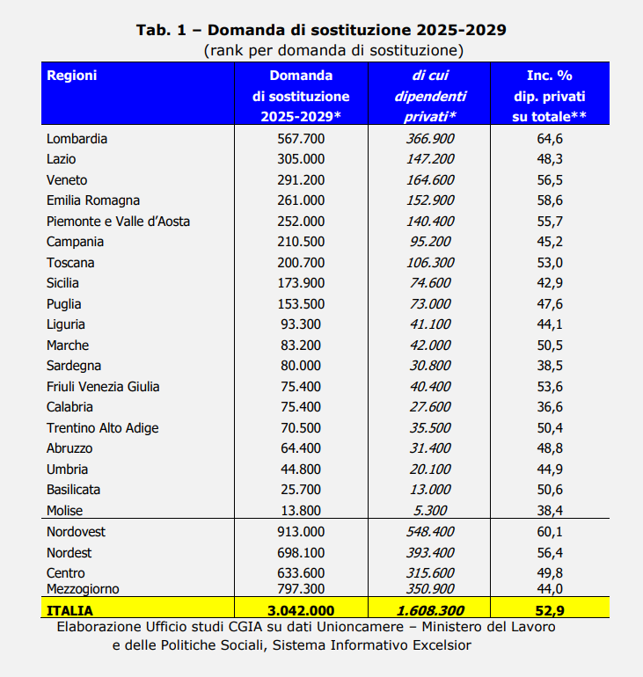
According to a reliable estimate (based on the forecasts of the Excelsior Information System (reworked by the CGIA research office in Mestre) over 3 million people will leave work for retirement by 2029. The largest share of outputs It will impact private sector employment, and the ones that will suffer the most will be the smaller companies, which compete on an unequal basis with the larger groups for qualified profiles in the labor market. And there will not be an adequate number of young people to take their place. As for the target audiences, just over 1,6 million will be private sector employees, 768.200 work in the public administration and 665.500 are self-employed. Lombardia the incidence will reach 64,6%, in Emilia Romagna and Lombardy 58,6% and in Veneto 56,5%: these are the three regions with the highest manufacturing density, where private sector employment accounts for the largest share of total employment and where replacement therefore falls almost entirely on businesses, not on public tenders.
The Italian population
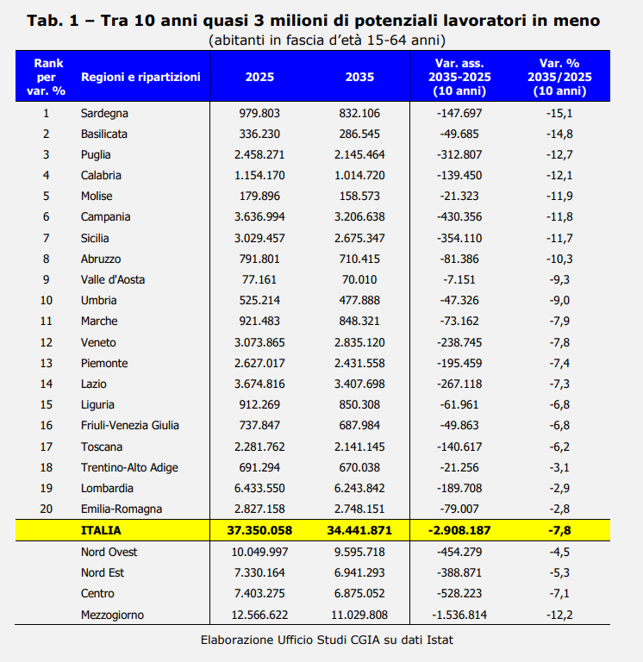
Regarding the consequences for the working-age population (15-64 years), the Research Office recalls an analysis carried out in 2025 which showed a contraction over the following decade.
The youth workforce
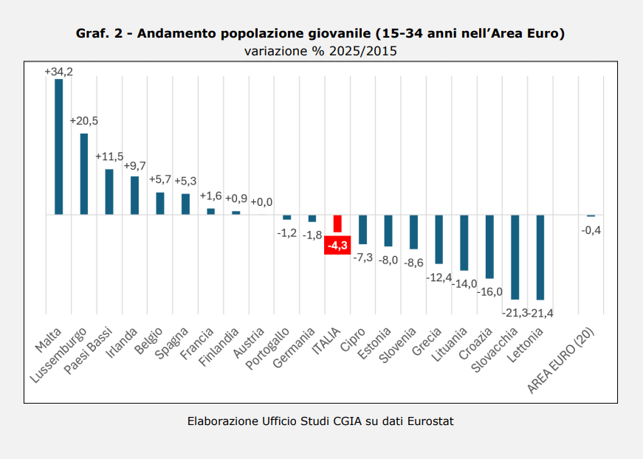
Remarkable is the gap with the EU for the youth workforceIn the decade 2015-2025 in Italy the age group between 15 and 34 years has reduced by 4,3% in Italy, compared to an almost flat Eurozone average of -0,4%. Germany also shows a decline, limited to 1,8%, while the other large economies have reversed the trend thanks above all to migratory flows: the France earns 1,6%, the Spain 5,3%, the Netherlands 11,5%. The resulting competitive gap concerns the availability of candidates, even before their skills.
The loss of young people has a very marked geography, with the Calabria This marks the deepest percentage decline in the last decade, down nearly 85. Southern Italy as a whole lost approximately 690 young people, or 14,1%, while the Northeast gained over 95, or 4,2%, and the Northwest over 122, or 3,9%.
The difficulties of SMEs
Small businesses have a attractiveness towards young people is significantly lower than that of the larger groups, which can offer above-average salaries, flexible hours, company welfare and formalized career paths. The phenomenon is already measured: in 2025 almost a third of the scheduled selections were not held due to a lack of candidates, and failed job interviews have exceeded 1,75 million.
When a senior departing employee has twenty years of experience in a specific process, the cost to the company isn't limited to replacing the position. The part of the company's knowledge that isn't written down anywhere—the acceptable tolerances on a machine, the history of a difficult customer, the shortcuts that only work in that department—leaves the company with the person if it wasn't passed on earlier.
The generational relay
The analysis then moves on to examine the sreplacement tools for SMEs with up to 50 employees. The only measure specifically designed to link the exit of a senior to the entry of a young person is the so-called generational relay introduced by art. 6 of the Law 11 March 2026, n. 34, which came into force on April 7, 2026. An employee approaching retirement age reduces their hours by between 25% and 50%, obtains a total exemption from IVS contributions up to a maximum of €3.000 per year, and maintains notional contributions on hours not worked, while the employer simultaneously hires a full-time, permanent worker who has not yet turned 34.
The requirements are stringent and must be verified individually. The worker must be a full-time, permanent private sector employee in a company with up to 50 employees, and have contributory seniority prior to 1996 and meet the requirements for old age or early retirement by January 1, 2028, even by accumulating non-coinciding insurance periods in INPS management. The trial covers the two-year period 2026-2027 with an overall ceiling of a thousand workers throughout Italy, and the INPS instructions for submitting applications are still awaited.
The young person employed can in turn access the incentives already in force for youth employment, starting fromcontribution exemption for those under 35 never hired on a permanent basis, which allows the benefit of the gradual exit of the senior to be added to that of the entry of the replacement.
Immigration: short- and long-term impact
On this issue, the Mestre-based CGIA teaches the "remigrants" a lesson, taking a reasonable and nuanced position: in the long run, the influx will not fill employment gaps; in the short run, it can contribute, provided that training takes place in the countries of origin. The proposal is to prioritize quota allocations for those who have already attended an Italian language course and obtained a professional qualification, in accordance with the Mattei plan, with businesses committing to ensuring stable employment and support in finding housing. The advice of entrepreneurs who need to see their machines running in their workshops is not to throw money from a helicopter to incentivize legal and trained foreign workers to return to their countries, but to employ locally trained human resources to fill positions that are unavailable to Italians.
Le publications of the Cgia Research Office of MestrAnd they're like paella, the dish that adds value to previous days' leftovers and transforms a humble dish into a delicacy destined for those who have risen through the social ladder. These periodicals, in fact, almost never present original research, but instead produce—with great communicative impact—brilliant and effective summaries of data released by the relevant institutions (ISTAT, INPS, UPB, RGS, etc.) regarding employment and welfare systems. And so they end up becoming a seemingly novel product, capable of holding center stage for the duration of a weekend and providing commentators with a comprehensive overview at a single glance.
In an analysis released on July 18 and reprinted on August 5 by SMEs, the Research Office addressed the crucial issue of the combined effects of the declining birth rate and ageing on the labor market.
Three million people will retire by 2029 and there will be few young people to replace them.
According to a reliable estimate (based on the forecasts of the Excelsior Information System (reworked by the CGIA research office in Mestre) over 3 million people will leave work for retirement by 2029. The largest share of outputs It will impact private sector employment, and the ones that will suffer the most will be the smaller companies, which compete on an unequal basis with the larger groups for qualified profiles in the labor market. And there will not be an adequate number of young people to take their place. As for the target audiences, just over 1,6 million will be private sector employees, 768.200 work in the public administration and 665.500 are self-employed. Lombardia the incidence will reach 64,6%, in Emilia Romagna and Lombardy 58,6% and in Veneto 56,5%: these are the three regions with the highest manufacturing density, where private sector employment accounts for the largest share of total employment and where replacement therefore falls almost entirely on businesses, not on public tenders.
The Italian population
Regarding the consequences for the working-age population (15-64 years), the Research Office recalls an analysis carried out in 2025 which showed a contraction over the following decade.
The youth workforce
Remarkable is the gap with the EU for the youth workforceIn the decade 2015-2025 in Italy the age group between 15 and 34 years has reduced by 4,3% in Italy, compared to an almost flat Eurozone average of -0,4%. Germany also shows a decline, limited to 1,8%, while the other large economies have reversed the trend thanks above all to migratory flows: the France earns 1,6%, the Spain 5,3%, the Netherlands 11,5%. The resulting competitive gap concerns the availability of candidates, even before their skills.
The loss of young people has a very marked geography, with the Calabria This marks the deepest percentage decline in the last decade, down nearly 85. Southern Italy as a whole lost approximately 690 young people, or 14,1%, while the Northeast gained over 95, or 4,2%, and the Northwest over 122, or 3,9%.
The difficulties of SMEs
Small businesses have a attractiveness towards young people is significantly lower than that of the larger groups, which can offer above-average salaries, flexible hours, company welfare and formalized career paths. The phenomenon is already measured: in 2025 almost a third of the scheduled selections were not held due to a lack of candidates, and failed job interviews have exceeded 1,75 million.
When a senior departing employee has twenty years of experience in a specific process, the cost to the company isn't limited to replacing the position. The part of the company's knowledge that isn't written down anywhere—the acceptable tolerances on a machine, the history of a difficult customer, the shortcuts that only work in that department—leaves the company with the person if it wasn't passed on earlier.
The generational relay
The analysis then moves on to examine the sreplacement tools for SMEs with up to 50 employees. The only measure specifically designed to link the exit of a senior to the entry of a young person is the so-called generational relay introduced by art. 6 of the Law 11 March 2026, n. 34, which came into force on April 7, 2026. An employee approaching retirement age reduces their hours by between 25% and 50%, obtains a total exemption from IVS contributions up to a maximum of €3.000 per year, and maintains notional contributions on hours not worked, while the employer simultaneously hires a full-time, permanent worker who has not yet turned 34.
The requirements are stringent and must be verified individually. The worker must be a full-time, permanent private sector employee in a company with up to 50 employees, and have contributory seniority prior to 1996 and meet the requirements for old age or early retirement by January 1, 2028, even by accumulating non-coinciding insurance periods in INPS management. The trial covers the two-year period 2026-2027 with an overall ceiling of a thousand workers throughout Italy, and the INPS instructions for submitting applications are still awaited.
The young person employed can in turn access the incentives already in force for youth employment, starting fromcontribution exemption for those under 35 never hired on a permanent basis, which allows the benefit of the gradual exit of the senior to be added to that of the entry of the replacement.
Immigration: short- and long-term impact
On this issue, the Mestre-based CGIA teaches the "remigrants" a lesson, taking a reasonable and nuanced position: in the long run, the influx will not fill employment gaps; in the short run, it can contribute, provided that training takes place in the countries of origin. The proposal is to prioritize quota allocations for those who have already attended an Italian language course and obtained a professional qualification, in accordance with the Mattei plan, with businesses committing to ensuring stable employment and support in finding housing. The advice of entrepreneurs who need to see their machines running in their workshops is not to throw money from a helicopter to incentivize legal and trained foreign workers to return to their countries, but to employ locally trained human resources to fill positions that are unavailable to Italians.