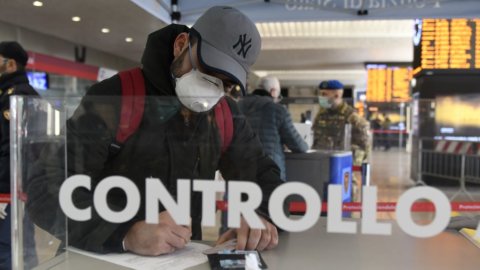
Christmas with yours, Easter with whoever you want. So goes the saying, even if this year due to Covid it's not said that we can really be with each other we want. What are the rules for travel and visits to relatives or friends during the Easter holidays, i.e. from 3 April to Monday 5 April? Meanwhile, from Dpcm of last 2 March, all of Italy will officially be a red zone on April 3-4-5, regardless of the colors of the various Regions decided on the basis of the weekly monitoring of the ISS, and which in any case up to and including 6 April will never be able to "go down" below orange (to date it is already certain that half of Italy will be red even up to April 12). This means that in fact even on Tuesday 6 April it will be impossible to move outside your region (and your municipality) if not for the usual reasons of health, work and necessity, given that this limitation is already part of the measures envisaged for the orange zone. Even if the Dpcm will have to be updated for the days from April 7 onwards, it is certain that for some time yet no Region will be able to return to yellow: at the moment until April 30th. Here are the detailed exceptions for second homes, family meals or trips abroad.
REUNIONS AND VISITS
However, on April 3-4-5, i.e. Easter Eve, Easter Day and Easter Monday, the government has thought of replicating the "Christmas formula": therefore the red zone rules remain, but it will be allowed only once a day to move to another inhabited private house in the same Region (therefore also outside the Municipality), between 5 and 22, at a maximum of two people, in addition to those already living together in the destination home. The person or two people who move will still be able to bring with them children under the age of 14 (or other children under the age of 14 over whom the same people exercise parental authority) and the disabled or non-self-sufficient people who live with them. A nationwide curfew remains from 22pm to 5am.
SECOND HOMES
Spending the Easter holidays in your second home (or rented, as long as the contract was signed before 14 January 2021), even outside your own Region, is possible. At least in theory, given that the government decree allows it, as long as they go to second homes only people belonging to the cohabiting family and the house of destination must not be inhabited by subjects other than these. However, this freedom of movement has not convinced many Regions, which have organized themselves with specific ordinances. Here are the various ordinances:
Sardinia
The island has decided that until 6 April including non-residents can reach second homes from other regions or from abroad only in the event of "proven work needs or situations of necessity and/or documented non-deferability or for health reasons" . The provision also reiterates the obligation to swab for passengers arriving without a vaccination or negativity certificate. Prior to embarkation, carriers and shipowners will have to acquire and verify not only the receipt of registration on the 'Sardegna Sicura' app, but also the documentation certifying the requirements set by the Dpcm of 2 March for travel from the regions of origin and those specified in the new regional ordinance. Those who cannot prove them will not be able to leave. In fact, airlines and shipping companies will be able to prohibit boarding in the event of incomplete documents or if passengers do not meet the necessary requirements.
South Tyrol and Val d'Aosta
Similar provisions have also been made by the governors of mountain areas: in Alto Adige up to and including Easter Monday no one will be able to reach the second home if they are not residents of the autonomous province, while the Aosta Valley has prohibited any incoming and outgoing travel, and therefore also to reach second homes, "except for those motivated by proven work needs or situations of necessity, or for health reasons". To reinforce this rule, the Region has set up checkpoints on the border with Piedmont on weekends and reinforced controls on the borders with France and Switzerland.
Campania and Tuscany
The Campania provision is even tougher, where second homes are prohibited for non-residents but also for residents of the region: the ordinance is valid until April 5, Easter Monday. Instead, it is possible to reach second homes for residents of Tuscany (but only for "maintenance" reasons...), but for non-residents the ban wanted by the governor is extended until 11 April. Those residing outside the region will be able to go to second homes only in the presence of health, work, study or serious situations of need.
Liguria
In Liguria, which is among the very few northern regions that is not a red zone, the ban on reaching second homes and even boats has been triggered, even for residents. "The ordinance prohibits going to second homes both for those arriving from outside the region and for Ligurians who have a second home within the region, outside the municipality of residence", explained the president Giovanni Toti. The Region locks down well in advance: the blockade begins on Wednesday 31 March and is valid until Easter Monday included.
Sicilia
In Sicily, on the other hand, access by citizens of other Regions who have a house owned or rented before January 14 is not prohibited, but the ordinance which provides for the obligation to swab for all those who reach the island. If the tourist does not follow these rules, "he has the obligation to place himself in fiduciary isolation for the duration of ten days at his home, with the burden of informing his general practitioner, the pediatrician of his choice or the Asp pertinent".
FOREIGN TRIPS
A paradox of this Easter is that it will be easier to travel abroad than within your own country. For all European countries, apart from Austria (where you need a negative swab to enter), travel is allowed without the need for justification, both on the outward journey and on the return journey, even if the obligation to complete the form remains when returning to Italy a self-declaration and to undergo, in the forty-eight hours prior to entering the national territory, a molecular or antigenic test, carried out by means of a swab and with a negative result (in the absence of the test, one is subjected to fiduciary isolation and health surveillance). These countries are identified on the Ministry of Health website: Belgium, Bulgaria, Cyprus, Croatia, Denmark (including the Faroe Islands and Greenland), Estonia, Finland, France (including Guadeloupe, Martinique, Guyana, Réunion, Mayotte and excluding other territories located outside the European continent), Germany, Greece, Ireland, Latvia, Lithuania, Luxembourg, Malta, the Netherlands (excluding territories located outside the European continent), Poland, Portugal (including the Azores and Madeira), Czech Republic, Romania , Slovakia, Slovenia, Spain (including territories on the African continent), Sweden, Hungary, Iceland, Norway, Liechtenstein, Switzerland, Andorra, Principality of Monaco.
More restrictive measures are envisaged for those who go into the UK: you can enter/re-enter Italy only if you are resident in Italy before 23 December 2020 or if you are absolutely necessary. There is an obligation for a double negative swab (before departure and upon arrival) and fiduciary isolation. The tightening is justified by the spread of the so-called English variant and was already decided for some time, regardless of Easter. The same goes for the Brazil: entry and transit through the national territory is prohibited for people who have stayed in or transited through Brazil in the previous fourteen days, unless they have been resident in Italy since prior to 13 February 2021; who have to reach the domicile, home or residence of their minor children; or to diplomats, military, police, agents of the European Union or other international organisations.