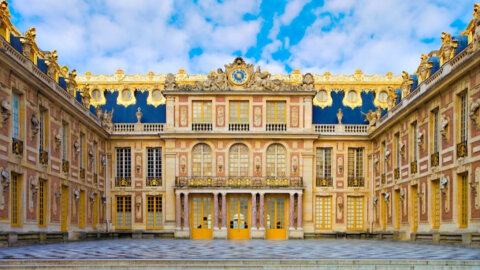
In 2024, the Palace of Versailles announces a rich program of exhibitions in its sector and in Asia. In spring at the Grand Trianon the first exhibition will be dedicated to the sumptuous 1811 order of silks for Napoleon at Versailles. Then, in the orangery and throughout the summer, the castle will invite the artist Eva Jospin to exhibit her monumental work Silk Room. A major exhibition will be dedicated to horses, echoing the equestrian events of Paris 2024. Finally, China will be in the spotlight with an exceptional exhibition in Beijing on the relations between Versailles and China in the XNUMXth century, in collaboration with the Forbidden City and the traveling exhibition Virtually Versailles will stop in Hangzhou again.
From 19 March to 23 June 2024 Grand Trianon In collaboration with National Mobilier In February 1810, Napoleon, who had expressed the desire to redevelop Versailles, granted a special fund of six million francs for this purpose. At the same time, the silk factories of Lyon were experiencing great difficulties. The Emperor wanted to carry out a large order to get them out of this crisis and dedicated two million francs to them. Between 1811 and 1813, no less than 80 km of fabrics were delivered by Lyon silk mills to the Imperial Furniture Guard for Versailles. The exhibition that the Palace of Versailles and the Mobilier national will propose will retrace the history of this important order. The first part of the exhibition will discuss the historical and economic context of this exceptional order. Original samples and archive documents will illustrate the involvement of the different actors, from the silk workers of Lyon to the meticulous imperial administration which on this occasion developed unique verification techniques. Furthermore, progress in the textile field will be discussed through the presentation of a Jacquard mechanical weaving machine or investigations into techniques in the field of chemistry and dyeing. A second part will be dedicated to the architectural developments envisaged by Napoleon for Versailles in the context of the task given to the silk workers of Lyon. The architectural debates and the evolution of taste between the Ancien Régime and the beginning of the nineteenth century will be discussed in particular thanks to the drawings of Jacques Gondoin.
The silks of the Empire
The exhibition will then offer the opportunity to discover the decoration projects for Versailles created by the various Lyonnais silk artisans and the fate of the silks of the great order of Napoleon, in particular under the July Monarchy and the Second Empire. The 80 km of fabrics delivered in 1813 and never used under the First Empire testify to the unexpected originality of the colors and motifs chosen. The silk workers of Lyon, reborn thanks to this conspicuous order, competed in audacity to satisfy the Emperor and his wife. The exhibition will feature a unique set of 120 silks. Thanks to samples of very different silks depending on the colors and designs, the exhibition will retrace the world of Lyonnais manufacturing under the First Empire. Finally, exceptionally, a visit to the Emperor's apartment at the Grand Trianon will be integrated into the exhibition itinerary. Samples of the original Lyon fabrics will be compared with the textile returns.
“Eva Jospin-Versailles” from 18 June to 29 September 2024
Inspired by the Sala del Ricamo of Palazzo Colonna in Rome and the novel "A room all to yourself” by Virginia Woolf, Silk Room it is now a place for embroidery. These 350 m2 landscape walls were produced by the artisans of the Chanakya workshop and the Chanakya School of Craft in Mumbai, in permanent dialogue with Eva Jospin. Each line of the artist's drawing became a thread using more than 400 shades of silk, cotton and jute skeins, creating an installation in the style of nineteenth-century panoramas. Invited by Maria Grazia Chiuri, Eva Jospin presented Chambre de Silk during the fashion show of the Dior autumn-winter 2021-2022 haute couture collection. A unique dialogue with the orangery of the Palace of Versailles To imagine this surprising work, Eva Jospin was inspired by her favorite themes: nature, wandering and architectural folliesAnd. At the Orangerie, Silk Room will be displayed in a linear way and will thus stimulate the walk by involving the visitor in an immersive experience. On the occasion of her exhibition, Eva Jospin will add a new embroidery stripe to her work. This panel will be inspired by the groves of the gardens of Versailles, and in particular that of the Bains d'Apollon, remodeled at the end of the XNUMXth century by the painter and landscape architect Hubert Robert, whose work fuels Eva Jospin's reflection on art Place of gardens . The unique architectural strength of the orangery will stand out as the ideal setting for the artist's monumental embroidery: a correspondence in scale, but also in theme, with that of the promenade. The visit to Versailles is one, from the groves to the waterfalls, the embroidery offers a second, inviting visitors to stroll. The artist was able, as in a mirror, to condense another garden, equally spectacular as those of Versailles.
DIOR “cheval en majestéau cœur d’une civilisation” from 2 July to 3 November 2024 Castle of Versailles
The Palace of Versailles will present a major exhibition dedicated to horses and equestrian civilization in Western culture, from the XNUMXth century to the early XNUMXth century. More than 400 works coming from collections around the world, many of which are presented for the first time in France, they will highlight the long history that links man to horses. Service, pleasure, power: this is the trilogy that governs the equestrian culture of modern times in Europe. At the forefront as a means of expressing power and distinction, the horse will be addressed in its many dimensions: political, military, academic, scientific, artistic, cultural, legendary or imaginary. The exhibition will be set up along a route that will pass through various emblematic spaces of the castle.
“The Palace of Versailles and the Forbidden City exchanges between France and China in the 1th century” from 30 April to 2024 June XNUMX Palace Museum, Forbidden City, Beijing In collaboration with the Palace Museum, Beijing
On the occasion of the sixtieth anniversary of diplomatic relations between France and China, the Palace of Versailles and the Forbidden City will propose an exhibition dedicated to the exchanges established between the two countries starting from the end of the XNUMXth century. The exhibition will illustrate the diplomatic policy initiated by Louis King. This initiative allowed the two countries to establish relationships of mutual trust and esteem, often unknown, which lasted until the end of the XNUMXth century. This particular diplomatic situation and this mutual interest contributed to the birth of modern sinology in France. At the French court, the attraction for China and Chinese art manifested itself in various ways through four main phenomena: the importation of Chinese art objects, the transformation of some imported works, the imitation of Chinese products and the very strong influence of Chinese art in French art. The exhibition will thus illustrate the inexhaustible source of inspiration that the different facets of Chinese art have constituted for French artists and intellectuals, both in the fields of painting, art objects, interior furnishings, architecture , garden art, literature, music or science.
Likewise, at the court of China, many French Jesuits followed the arrival of the king's mathematicians sent by Louis XIV, some of whom served at the court for a long time. With their presence, French culture had an important influence in many fields such as science, art, architecture, medicine and even cartography at the Qing court. Clocks, scientific instruments, prints, porcelain, bronzes, books and other objects from the Palace Museum collection testify to the cultural exchanges between the two countries. The exhibition presented in Beijing will bring together a selection of works from the Palace of Versailles and the Palace Museum which will testify more generally to the true fascination felt by the court of Versailles but also by the great French amateurs for all Chinese productions. It reveals the efforts and achievements of China and France to achieve mutual understanding and cultural exchanges in the XNUMXth century, and vividly captures the cultural and artistic exchanges between the two countries for more than a century.
“Virtually Versailles” from May 2, 2024 Winland Center, Hangzhou, China
After the success of the editions in Shanghai, Hong Kong and Macao, the traveling exhibition Virtually Versailles will stop in the city of Hangzhou, China. This immersive exhibition will allow visitors from all over the world to discover the world of Versailles thanks to the most innovative technologies: augmented reality, virtual reality, connected bicycles or even 360° projections. The Virtually Versailles exhibition is conceived as a first exploration of the castle allowing as many people as possible to discover its history and collections. However, each edition is unique, enriched with new content and its own scenography. In Hangzhou the exhibition will be held at the Winland Center, in the heart of a historic district of the city. On this occasion, 56 musicians from the orchestra of the Royal Opera of Versailles will perform in a concert at the inauguration of the exhibition.