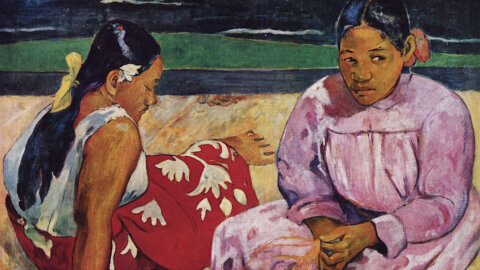
Tahitian women on the beach was painted by Paul Gauguin in the pristine paradise he was looking for. The artist was in fact fleeing from financial problems and a difficult personal situation. The figures present in Gauguin's work are often defined by a thick contour line, elegant and decorative. The artist punctuates the composition according to a mysterious and harmonious geometry, thus creating a genre scene that portrays two women. Gauguin attaches great importance to this composition, so much so that in 1892 he created a replica entitled Parau Bees (Dresden, Staatliche Kunstsammlungen)- Image below. In these figures we can see the influence exerted by Manet's synthetic lines and simplified forms that Gauguin admires.

It was 1891 when Gauguin decided to go to Tahiti due to his increasingly pressing financial difficulties to be "finally free"
This composition is typical of the works painted at the beginning of his first stay. These are canvases that show Tahitian women, imposing hieratic figures each inserted in their own space which makes the succession of arabesques possible. The faces draw a mask or a profile are quite similar but with a strong melancholic expression. Tahitian women on the beach by Paul Gauguin was initially donated by Paul Gauguin to Captain Arnaud of Tahiti. It passed ownership to her daughter Mme Wilmot of Papeete until 1920 and then from 1923 in the collection of Viscount Guy de Cholet. Then it was later donated by Countess Vitali to the French National Museums. In 1923 it was in the collections of the Louvre but until 1929 it was exhibited at the Musée du Luxembourg in Paris. It remained at the Louvre Museum from 1929 to 1947 before being transferred to the Galerie du Jeu de Paume in Paris. Since 1986 it has been kept at the Musée d'Orsay in Paris.
Who was Paul Gauguin
Eugène Henri Paul Gauguin (1848-1903) was a French post-impressionist artist. Unappreciated until after his death, Gauguin is now recognized for his experimental use of color and synthetist style which were distinct from Impressionism. Toward the end of his life he spent ten years in French Polynesia. Paintings from this period depict people or landscapes from that region. His work influenced the French avant-garde and many modern artists, such as Pablo Picasso and Henri Matisse, and he is well known for his relationship with Vincent and Theo van Gogh. Gauguin's art became popular after his death, partly thanks to the efforts of the dealer Ambroise Vollard, who organized exhibitions of his works towards the end of his career and contributed to the organization of two important posthumous exhibitions in Paris. Gauguin was an important figure in the Symbolist movement as a painter, sculptor, printmaker, ceramist and writer. His expression of the intrinsic meaning of the subjects in his paintings, under the influence of the Cloisonnist style, paved the way for primitivism and the return to the pastoral style. He was also an influential advocate of woodcuts and woodcuts as art forms.
Cover image: Paul Gauguin Women of Tahiti 1891
© Musée d'Orsay, Dist. RMN-Grand Palais / Patrice Schmidt