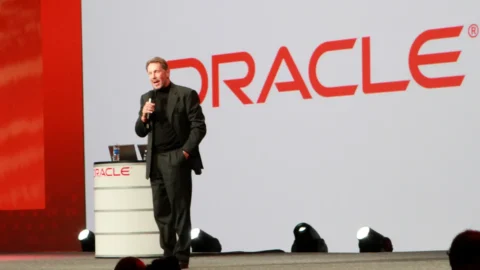
Oracle infrastructures posted results below expectations, causing an immediate and violent reaction from the financial markets. title It fell apart of 11,82% in after-hours trading, marking one of the worst recent declines for the cloud giant. Weighing in are the weaker earnings and revenue forecasts than expected, accompanied by a significant increase in spending on artificial intelligence-related infrastructureThe investments required to support demand for AI services are eroding profitability in the short term.
AI investment is rising, but profits aren't keeping pace.
Analysts have been disappointed with Oracle's ability to convert its huge investments in data center and in cloud dedicated to AI. Capital expenditures continue to grow, while economic returns haven't shown the same acceleration, reopening the debate about when the AI boom will begin to generate sustainable benefits for tech companies and investors.
In detail. In the second fiscal quarter ended November 30, Oracle reported revenues for $16,06 billion, slightly lower than the estimated $16,21 billion, and to evaluate adjusted earnings per share of $2,26, above the $1,64 forecast. TheNet income rose to $6,14 billion, or $2,14 per share, from $3,15 billion in the same period a year earlier.
I cloud revenue reached $7,98 billion, with the cloud infrastructure component growing 68%, thanks to customers such as Airbus, Canon, Deutsche Bank, Lseg, Panasonic and Rubrik. In contrast, the revenues with fell 3% to $5,88 billion, below the estimated $6,06 billion. remaining performance obligations (RPO), a key indicator of future revenue, rose to $523 billion, above the $501,8 billion forecast, thanks to commitments from partners such as Meta e NvidiaOracle expects $4 billion in additional revenue in fiscal 2027.
Spending and Debt: A Huge Commitment to Support AI Growth
Oracle has announced that the Capex for the entire fiscal year will rise to around 50 billion of dollars, compared to the $35 billion estimated in September. Free cash flow for the November quarter was negative by approximately $10 billion, more than double the consensus forecast of $5,2 billion. The CFO Doug Kehring He reassured investors by confirming his goal of maintaining an investment-grade credit rating and leveraging flexible financing strategies, such as using chips supplied by customers or leased from suppliers.
Long-term prospects and ambitions
Oracle has outlined ambitious projections: by 2030, the cloud infrastructure space could generate up to $166 billion in revenue, with total group revenues of around $225 billion and adjusted earnings per share of approximately $21, assuming a significant acceleration in demand for AI services. However, the risks of excess capacity and rising financing costs remain critical, as evidenced by the increase in five-year credit default swaps from 60 to over 117 basis points.
Leadership changes and AI innovations
During the quarter, Oracle appointed Clay Magouyrk e Mike Sicilia as new co-CEOs, succeeding Safra Catz, and introduced AI agents to automate processes in finance, HR, and sales. The company also built a capital gain of 2,7 billion of dollars from the sale of its stake in Ampere, giving up the chip designer acquired by Softbank, and abandoned domestic chip production to pursue a policy of technology neutrality. Larry Ellison, chairman and co-founder, said: “We will continue to use the most advanced chips, such as those from Nvidia, but we will be ready to use any chip that customers request, maintaining flexibility and competitiveness.”
Stifel cuts its target price
Analysts stifel have reduced the target price Oracle's operating profit increased from $350 to $275, highlighting concerns about rising capital spending and near-term earnings pressure. Despite 15% quarter-over-quarter growth in RPOs, IaaS revenues of $4,1 billion barely met expectations, while earnings per share, excluding the benefit from the Ampere sale, were 10-15 cents lower than estimated. Stifel emphasizes that capital spending should support faster OCI growth and stronger EPS growth in the long term in fiscal 2027.
Impact on markets
The Oracle stock crash overshadowed the positive effect of the Fed rate cut, causing the Nikkei to fall by 1%, penalised above all by the SoftBank crash, Oracle's partner in the Stargate data center project. The MSCI Asia-Pacific index also showed growing caution, with investors concerned about slowing profits in the AI sector. The sector's weakness suggests that the euphoria of recent months could give way to a more critical and selective assessment phase.