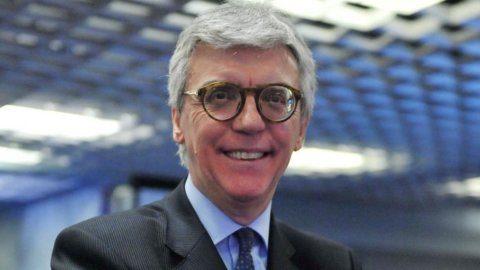
"I believe that prospects for Greece, as well as for the future of Europe itself, are simply devastating”. Don't mince words Mario Noera, professor of economics and financial market law at Bocconi, always critical of the recipes adopted by the Eurozone to face the economic crisis. "A theoretical error now demonstrated by empirical evidence - he comments -, but which the European ruling classes do not call into question because they have linked their political survival to these precepts".
FIRSTonline – Still, mediation after the long night of negotiations avoided the tear. And it has been seen that there is no single thought. Otherwise, how to explain that the German-ventilated Grexit with a strong following was averted?
Noera – “I think it is very serious that, in those conditions, the issue of a possible expulsion of a state has been raised. But the first question is another: will the conditions envisaged in Sunday's agreement facilitate or not the recovery of the Greek economy? I think the situation is bound to get worse."
FIRSTonline – Really…
Noera – “The agreement does not serve to favor the convergence of Greece with the rest of the Community. On the contrary, the very harsh conditions imposed on Athens will lead to a further divergence. Nor could it be otherwise, given the figures. The budget cut asked of Greece, given the proportions, is equivalent to a budget of 160 billion for Italy. And privatizations for 50 billion are equivalent to at least 600 billion for our country. How can you think that Athens can avoid a very hard recession with these premises?”
FIRSTonline – But the Greeks asked for it a bit. Or not?
Noera – "I agree. Negotiation management was weak, as was government action. But there are two mitigating factors. First, the efforts to bring down the legitimate government of the Greeks. Second, the reflections of austerity. Greece has reduced the incidence of public expenditure on GDP by nine points in recent years. It does not surprise me that the workers expelled from the public administration have been early retired”.
FIRSTonline – In short, the iron fist was not to be used. Despite the attitude taken during the negotiations and the law of numbers. Is that it?
Noera – "The point is an other. An agreement makes sense if it produces effects in terms of input, i.e. if it respects the will that emerged from the vote. Or output: the result of the vote is forced, or rather it is subverted, but the conditions are created for distributing well-being”.
FIRSTonline – In this case?
Noera – “Neither input nor output counts. If anything, as Wolfgang Munchau wrote in the Financial Times, the political conditions for coexistence have disappeared. The real tragedy that has emerged in recent days is that all the contenders, starting with Greece and Germany, have privileged internal political concerns over the common theme. We have acknowledged that the choices of Germany, the leading country of this Europe, are substantially conditioned by the political duel between Angela Merkel and Wolfgang Schaeuble”.
FIRSTonline – The result?
Noera – “An agreement that does not take into account common sense, neither from the point of view of the market nor from the point of view of the method. The agreement makes water on all sides in terms of sustainability. It does not solve the debt problem nor does it offer Greece a credible prospect in terms of relaunching income”.
FIRSTonline – Alternatives?
Noera – “The Danish solution. From the outset, Copenhagen claimed freedom of choice with respect to the euro area. A possible exit of Greece, on the free choice of Athens, would certainly have created big problems. Since the end of the indissolubility of the euro area. But an agreed exit, with support from transition partners, would at least have respected the principle of popular will. On the contrary, in the course of the negotiations, the principle of the possibility of the non-negotiated expulsion of a partner was substantially violated".
FIRSTonline – In short, Europe risks screwing up…
Noera – “The risk is tangible. Also because we don't want to acknowledge that the choices made in economic policy don't work. But by now, not only in Germany, the government elites have linked their political survival to an economic recipe which, as demonstrated by the opposite examples in the USA, Great Britain or Japan, does not work. It also applies to Italy, which, from Monti onwards, has followed the same rules. And so the systemic risk increases”.
FIRSTonline – A French political scientist, François Heisbourg, argues that the situation resembles a Siamese birth: it is known that only one of the two will be saved. The same goes for the future of Europe: either the social and democratic ideals of the Old Continent will be saved. Or save the euro, as it was conceived and supported. Agree?
Noera – “It's a happy picture. But I have one fear: the risk is that the choice involves a shock that I don't want to see. The conditions of a century ago are accumulating”.
FIRSTonline – The alternative?
Noera – “We need to create non-traumatic conditions for a free choice of Greeks. And start again from there to drive away the ghost of a great trauma, which can be sent but not exorcised with solutions imposed on peoples and, moreover, harbingers of misery, not well-being".