Italian companies are changing their approach to managing their vehicle logistics. What until a few years ago was considered an internal task, to be entrusted to employees or occasional collaborators, Today it is increasingly being delegated to specialized suppliers.
La vehicle movement includes the physical transfer of company cars between offices, workshops, customers, and logistics hubs. An operational activity that, when analyzed in detail, reveals costs and complexities that are often overlooked.
The limits of internal management
When a company manages its own vehicle movements, it faces real organizational problems. The first one concerns timeAn employee who drives a car to the shop for a service loses half a day going there, waiting, and returning. Multiplied by dozens of vehicles and services per year, the cost in terms of productivity becomes significant.
The second problem concerns the documentation. When the vehicle changes hands without standardized procedures, reconstructing the origin of any damage becomes complicatedWho caused it? The workshop? The parking lot? The employee on the way? Without photographic reports acquired upon delivery, responsibility remains unclear.
The third problem is scalability. A company with five vehicles can manage its travel informally. But when the fleet grows to twenty, fifty, or one hundred vehicles, procedures, dedicated personnel and coordination tools are neededBuilding this infrastructure internally requires investments that are not always justified.
The pay-per-use model
Outsourcing handling works with a different logic. The company pays only for the services actually used, without fixed or minimum guaranteed feesTen trips a month mean ten bills; two trips mean two bills.
This flexibility is particularly useful for companies with variable activityA dealership that sells more in the spring and fall can increase transfers during peak periods without maintaining oversized facilities during the slower months. A rental company can manage end-of-contract returns without hiring temporary staff.
The advantage is directly reflected in the profit and loss statementFixed costs, which weigh on the budget regardless of the activity, are transformed into variable costs that follow business trends. In periods of contraction, spending automatically decreases without the need for extraordinary interventions.
How the service works
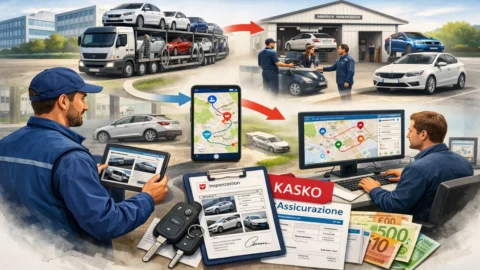
The process is more structured than you might imagine. When a company requests a transfer, the supplier assigns a professional driver who shows up at the indicated location. Before taking charge of the vehicle, perform a documented check: digital report with mileage, fuel level, body condition and photographs certifying the conditions at the time of collection.
During the transfer, a Tracking system allows you to monitor your location and progress in real timeThe company always knows where its vehicle is and can accurately estimate its arrival time.
At the destination, the driver repeats the check and collects the recipient's signatureAll documentation remains accessible through the supplier's platform, creating a searchable history for each individual movement.
The insurance question
One of the issues that most concerns companies is risk coverage. What happens if the vehicle is damaged during transport? Who pays?
Structured suppliers include a comprehensive insurance policy in the service which covers any event during the journey. In the event of an accident, the supplier's insurance intervenes without any impact on company coverage. The same applies to administrative fines: if the driver receives a fine during the transfer, reimbursement is made within twenty-four hours.
This mechanism relieves the company from risks that would otherwise remain its responsibility in internal management.When the employee moves the vehicle, any damage or infringement falls under the company policy or internal administrative management, with the associated costs and complexity.
Who is adopting this model
Outsourcing of material handling finds application in different contexts. Long-term rental companies use it to manage vehicle turnover: returns from customers, transfers to remarketing centers, deliveries of new assignments. With fleets distributed nationwide, the ability to coordinate rapid movements becomes a critical operational factor.
Car dealerships employ these services to supply the salons with vehicles from other locations, to deliver the sold cars to your home of the customer and to support after-sales activities with the collection and return of vehicles undergoing maintenance.
Corporate fleets integrate outsourced handling into their processes to reduce downtime during technical interventionsInstead of having the employee take the car to the repair shop, the service takes care of picking it up and returning it without interrupting work.
The role of technology
The spread of digital platforms for fleet monitoring transformed an internal service into an industrialized process. Today a fleet manager can request a transfer with just a few clicks, receive instant confirmation, track progress, and access final documentation from a single interface.
Integration with company management systems eliminates the need for manual entriesMovement orders can be generated automatically when the system registers a maintenance deadline or a scheduled return. The data collected feeds reports that allow for the analysis of the frequency of movements, costs per vehicle and average transfer times.
This technological infrastructure represents a investment that few companies could sustain for exclusively internal use. Accessing it through a specialized provider means benefiting from advanced tools without having to develop and maintain them.
Market numbers
The costs of a professional moving service start from around twenty-five euros for a short trip, with variations based on distance and vehicle type. A Milan-Rome transfer costs around one hundred and fifty euros, including insurance, documentation, and tracking.
Processing times are rapid: within twenty-four hours for distances up to one hundred kilometers, and within forty-eight hours for longer journeys. Bookings require a minimum of six hours' notice, allowing us to handle even urgent requests.
For the company, These costs must be compared with the internal alternative: employee's working day, fuel, tolls, any overnight stays, and uncovered risks. In most cases, the comparison favors outsourcing, with the added benefit of complete traceability.
A transformation in progress
The Italian vehicle handling market is going through a phase of maturationUntil a few years ago, alternatives to internal management were limited: generic carriers, informal agreements with occasional collaborators, improvised solutions. Today, structured operators exist with networks of professional drivers, digital platforms, and verifiable service standards.
This evolution is lowering the barriers to adoptionCompanies that previously would not have considered outsourcing due to a lack of reliable suppliers now find partners capable of guaranteeing national coverage, traceability, and predictable costs.
The trend appears set to consolidate. As Italian companies seek operational efficiency and flexibility, Delegating non-strategic activities to specialized partners such as Carvoilà is becoming an increasingly popular choiceThe movement of company vehicles fits perfectly into this logic: necessary for operations, but not distinctive for the business.