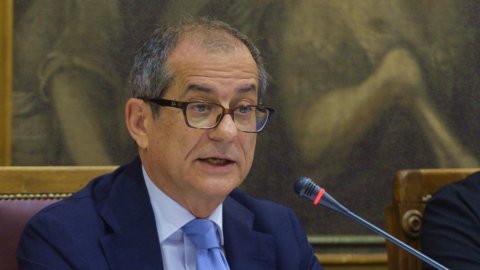
Tria returns to defend the maneuver in view of the appointment of November 13, the day in which Italy will have to present the text containing the revisions requested by the EU to Brussels. And the tug-of-war with the Commission shows no signs of easing: according to the Economy Minister, the economic slowdown "also in the light of international uncertainty, further strengthens the objectives of the maneuver, counter the slowdown in growth and provide a stimulus with public investment”.
These are the words of the number one of the Mef, engaged in the preliminary hearing for the examination of the budget law launched by the parliamentary commissions.
TRIA'S WORDS IN PARLIAMENT
“The 2019 maneuver – continued the minister – was designed” for break out of the low growth trap“. “Our concerns about a slowdown are confirmed” and this makes it even “more necessary to confirm the anti-cyclical effect of the manoeuvre”. The measures contained in the budget law, he continued, "will help the country grow to ensure greater well-being for our fellow citizens".
Words that will certainly not be appreciated by the leaders of Brussels who yesterday, November 8, launched theyet another alarm on the Italian public accounts, again rejecting the budget law of the yellow-green government and contesting, point by point, all the economic forecasts.
Tria confirmed the official pillars of the maneuver starting from income and citizen's pension as measures to combat poverty. "These days - he explained - the government is engaged in preparing a response to the still controversial aspects" of the maneuver, a maneuver "which the government intends to confirm in its fundamental pillars". "We realize - the minister said again - that the problems identified would require a more incisive expansive maneuver but it was necessary to find a correct balance between financial and social stabilityboth are necessary".
The minister then moved on to the taxman. The tax burden "compared to current levels is equivalent to 13,4 billion in 2019, 9,5 billion in 2020 and 8,8 in 2021. The main share of this reduction is represented by the deactivation of the VAT clauses".
Another hot topic is the deficit. Tria reiterated its intention to reach the already announced 2,4%: "the Government is committed to respecting this limit" but the Commission estimates the breakthrough at 2,9%, therefore well beyond the ceiling that the government has set itself.
The number one in via XX Settembre, in answering the questions of the parliamentarians, ruled out the arrival of one patrimonial: "It is obvious that the assets will not be done, it would be a suicidal act". "We are not talking about Greek situations - she added - there are many adjustments that can be made and in a much more punctual way, without involving elements of emergency".
On a possible future corrective maneuver, he instead stated: "It makes no sense to discuss a perspective that does not exist yet". "Corrective measures are taken if something happens", at the same time excluding an intervention to support the banking system: "Interventions on banks must be avoided in every way".
“The debt – confirmed the deputy prime minister later Luigi Di Maio in a conference with the foreign press – it must not be a fault of the Italians. Our goal is to reduce it by making interventions that restore citizens' rights, with maximum dialogue with the EU and never more than the 2,4% deficit that we have set in the budget law”. "The guarantee we give - continued the Minister of Economic Development - is that 2,4 is the maximum deficit term and we will be ready to guarantee it and to intervene when it is needed in the budget law".
BANKITALIA: SIGNORINI'S HEARING
After Tria to confront the parliamentarians has arrived Federico Signorini, deputy general manager of the Bank of Italy who instead focused on the surge in the spread, which today reached 301 basis points. The increase, according to Signorini: “is already cost the taxpayer an additional 1,5 billion in interest in the last six months compared to what would have matured with the rates that the markets were expecting in April. It would cost over 5 billion in 2019 and 9 in 2020, if rates were to remain consistent with current market expectations".
"The increase in the sovereign spread has repercussions on the entire economy" and "the increase in interest rates on public debt has an effect in some way comparable to a monetary tightening", "risk of nullifying all the expansive impulse expected by the policy of the budget”, Signorini said again, emphasizing how "we need to bring down the spread" because the “signals that investors perceive are important”.
Speaking of the growth targets estimated by the Conte government for next year, the deputy general manager of Bank of Italy used the adjective "ambitious".
Tax amnesty measures “could create disincentives to the regular fulfillment of tax obligations; they should therefore be considered very carefully”, added Signorini, in a hearing on the maneuver before the budget commissions of the House and the Senate.
THING AND ANSWER TRIA – CENTENO
In the afternoon comes yet another question and answer with the EU. After the meeting held in Rome with Minister Tria, the president of the Eurogroup, Mario Centeno declared: “I have no doubts about Italy's commitment to the euro and sustainable growth. It is essential that the budget law demonstrates these commitments”, says Centeno.
“We had a discussion on the respective opinions on the Italian budget maneuver which, as you know, worries the member states – said the minister -. We have explained that these concerns are not based on the real content of our budget manoeuvre". And again: “To avoid this debt procedure we should do a very violent fiscal restriction manoeuvre, go to a deficit of 0,8%, which would be suicide for an economy experiencing a sharp slowdown, I don't think the Commission expects a reaction of this type even if it formally respects the budgetary rules”.
(Updated at 16.50 on 9 November).