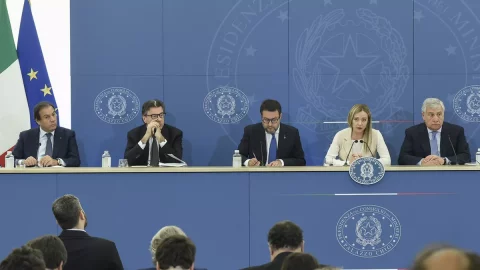
Maneuver 2026: accounts that risk going into the red with possible heavy repercussions on services for citizens. Already yesterday Municipalities and Regions, in hearing on the Budget law In the Senate, they had raised a clear alarm. A concern, expressed by local authorities, linked not only to the cuts but also, and perhaps above all, to the inclusion in the budget law of Lep, the essential levels of performance, for some welfare sectors: in fact an advance of thedifferentiated autonomyMeanwhile, the majority is working on possible corrections to the budget, in view of the text's start in the Senate Budget Committee next week. Today, however, is the last day of hearings at Palazzo Madama. And to settle the score, Budget law they were, among others, Bankitalia, Istat, Upb e Court of Auditors. Here's what they said.
Bankitalia
Budget: large loss in purchasing power
“From 2019 to 2023 there was a wide 10% loss of purchasing power, recovered by only 3 points. In line with decisions already adopted in recent years, the budget includes measures to support household income. These measures, even when temporary, can be useful for supporting purchasing power, which has been hit hard by inflation in recent years." This was stated by the Deputy Head of the Economics and Statistics Department of the Bank of Italy, Fabrizio Balassone, during a hearing on the budget before Parliament's Budget Committees. "The measures for the 2022-25 period have, in fact, more than offset the negative impact of fiscal drag and the erosion of transfers. Recovering family incomes," he added, "however, cannot be achieved through fiscal measures alone; it must be based on an effective bargaining system and, ultimately, on increased productivity."
Budget: focus on pensions
On pensions "It would certainly be better not to touch this adjustment mechanism too much," Balassone added, responding to a question about pensions in the budget. "There's a generational equity issue," he observed, "and we have this increase in spending that could significantly complicate the management of public finances."
Budget: taxes on banks
“The repercussions of the interventions on the financial position of the intermediaries as a whole appear to be limited. Italian banking system It is overall solid, well-capitalized, and currently among the most profitable in Europe. Credit risks remain limited, thanks in part to the good financial condition of companies. In general, it would be appropriate to avoid the frequent recurrence of unexpected changes in taxation“, continued Balassone regarding the “taxation of financial intermediaries and insurance companies”.
Budget: family incomes
It can be estimated that overall the measures of the maneuver to support the household income "They do not lead to significant changes in inequality in the distribution of equivalized disposable income among families," Balassone emphasized. The reduction in the personal income tax rate for the second income bracket favors households in the top two-fifths of the income distribution, but with a modest percentage change in disposable income. The effects of the main social assistance measures, however, are concentrated on the top two-fifths of families and are also modest," he explained.
Istat
Budget and IRPEF cuts: 85% of resources in high brackets
Il personal income tax cut The proposed budget "would involve just over 14 million taxpayers, with an average annual benefit of approximately 230 euros. The beneficiary families would be approximately 11 million (44% of resident families) and the average benefit would be approximately 276 euros (each family can have more than one taxpayer)." This was emphasized by the president of Istat, Francesco Maria Chelli, in the hearing before the Senate and House Budget Committees. “By sorting families based on their equivalent disposable income and dividing them into five groups of equal size,” he continued, “it emerges that over 85% of the resources are allocated to families in the richest fifths of the income distribution: in fact, over 90% of families in the richest fifth and over two-thirds of those in the second-to-last fifth are affected by the measure. The average income ranges from 102 euros for families in the top fifth to 411 euros for families in the bottom fifth. For all income brackets, the benefit results in a change in family income of less than 1%.
Upb
Budget: Italy's GDP below EU level
“The maneuver is part of a context that continues to be rather complex, there is a prospect of a slowdown in the international economy that influences the growth prospects for the Italian economy, which is growing relatively slowly"The third quarter is substantially stable and the outlook for this year is for a 0,5% increase, thus a growth that is below the average level in the EU." This was stated by the president of the UPB. Lilia Cavallari During a hearing on the budget before the joint Budget Committees of the House and Senate, he added, "The growth forecasts on which the budget is based have been validated by the UPB, which emphasized that the risks are predominantly to the downside."
Budget: focus on Irpef cuts
The reduction of two tax rate points Personal income tax “It will affect just over 30% of taxpayers (around 13 million, with an income of over €28.000), resulting in a reduction in IRPEF revenue of around €2,7 billion, a figure slightly lower than that reported in the Technical Report,” Cavallari continued.Approximately 50% of the tax savings go to taxpayers with incomes above 48.000 euros, which represent 8% of the total,” he adds, specifying that “the average benefit is €408 for managers, €123 for employees, and €23 for workers; for self-employed workers it is €124, and for pensioners it is €55.” Regarding the compensation for benefits on high incomes (above €200), “it will affect approximately a third” of the group, 58 taxpayers – he explained – since “the group is already affected by previous provisions: on average, the deduction cut for this bracket is €188, below the €440, which is the maximum benefit of the measure.”
Marginal maneuver on tax evasion, risks of scrapping
“Although the propensity to evade is decreasing, the phenomenon oftax evasion is still very large (approximately €100 billion in 2022) and the budget bill only marginally addresses the issue,” Cavallari highlighted. “The reiteration of measures to facilitate the resolution of pending charges has contributed to making the enforced debt collection system increasingly varied and complex, with uncertain outcomes in terms of collections. Furthermore, it does not appear that they have significantly impacted the inefficiencies of forced collection."There is a risk," the UPB warned, "that the repeated introduction of simplified tax settlement forms will negatively impact tax compliance, fueling expectations of future tax relief and ultimately leading to a reduction in ordinary tax collections."
Budget: Risks for regional healthcare budgets
The maneuver "increases the financing of the national health needs standard of 7,7 billion in the three-year period, going from a value equal to 6,1 percent of GDP in 2026 to 5,9 in 2028. Current healthcare expenditure in the national accounts, in relation to GDP, is expected to be 6,6 percent in 2026 and would fall to 6,5 from 2027. The different dynamics of ordinary financing and expenditure, although not directly attributable to the deficit of the National Health Service (NHS), could signal growing difficulties for the budgets of the regional health services", stated Cavallari.
Budget: elements of inequity on ISEE, priority for homeownership
The modification of the first home deductible in the calculation of theIsee, "in the absence of a corresponding modification of the exemption provided for rented households, it appears as a well-defined policy choice in favour of specific households and leads to an unequal treatment to the detriment of those families who have suffered most from the price growth in the real estate market. This introduces elements of inequity by granting priority access to services and greater benefits in terms of payments, where applicable, to households living in owner-occupied homes, given the same economic status and family size,” Cavallari noted.
Budget: Critical issues regarding tax relief on wage increases
“The tax relief on salary increases from renewal of contracts"Although it addresses the need to limit the tax on income increases, it presents some critical issues," Cavallari added. "The measure," he explained, "defers the higher tax burden, without structurally resolving it. On the other hand, reintroducing the measure throughout a person's working life would be difficult to implement, and would require additional coverage. The measure creates significant disparities in treatment because it excludes taxpayers with similar income situations from the eligible beneficiaries."
“These critical issues – he added – raise doubts about the appropriateness of entrusting interventions "The temporary correction of structural weaknesses in the income tax system resulting from the assignment of income support objectives to the tax system that would be more effectively pursued with other institutions." "According to the UPB's simulations, those who would benefit from the 5 percent substitute tax would be approximately 2,1 million workers, with an average tax saving per taxpayer of approximately 208 euros," he concludes.
Budget: Dividend targets unclear
“The objectives of the change to the taxation regime are not clear” dividends "neither in terms of rationalizing the taxation of dividends and intra-company capital gains, nor in terms of competitiveness in the international system. Furthermore, the Budget Bill has neither renewed nor replaced the premium IRES introduced only for the current year by the 2025 Budget Law. Following the repeal of the ACE (Energy and Capital Gains Tax) effective from 2024, a revision of the corporate tax structure that incorporates the new investment incentives envisaged in the enabling law and re-establishes the neutrality of financing sources does not yet appear to be forthcoming," Cavallari continued. Overall, the UPB notes that the measures for businesses "are mostly transitional in nature." while those "of a permanent nature do not appear to reflect an organic and coherent design with the enabling law on tax reform"Regarding incentives, with the return of increased depreciation, "companies, given easier access to the incentive compared to the tax credit, will be able to benefit from the relief gradually and only if they have adequate tax capacity and profitability. This reduces the effectiveness of the incentive," the UPB highlights.
Court of Auditors
Budget: Short-term rental rules threaten to increase undeclared work
“The difference in tax regime could have a negative impact encouraging the phenomenon of undeclared short-term rentals“. This was stated by Mauro Orefice, president of the coordination of the Joint Sections in the control body of the Court of Auditors during the hearing on the budget, commenting on the measures of the budget law relating to short rentals, which raise the flat-rate tax rate from 21 to 26 percent.