The dazzle of the coming recession
The US economy is in the process of slowdown, desirable and desired. Will it end in recession? Being the largest economy in the world and taking place in a less than brilliant global context (European industry in decline, China in a fragile recovery...), the question interests us all, also for any repercussions on the financial markets (rates, exchange rates, stock markets...). The answer to the question is divided into: a consideration general and in a look targeted.
La considerazione. As with cars, reverse is not the most frequent direction of travel, so recession is not the usual condition of movement of the economy. The mechanisms that have governed it for more than two centuries (competition, profit, technical progress, emulation, desire to grow, adaptation, finance, public intervention...) push inexorably forward. Recession, therefore, is an exception, an unnatural posture. Therefore it is like this difficult to predict. In fact, most analysts avoid doing so and it has never happened that the large international research centers (IMF, OECD etc) saw it coming. So much so that the same Regina Elisabetta II in 2008, just after the outbreak of the Great Financial Crisis, he asked the economists: «It's awful – why did nobody see it coming?». Paraphrasing a phrase from another realm, we might conclude that there is some rotten in econometric models. But it would be pure ingratitude seasoned with perfidy.
And it's not that practical men of the financial markets they do better at predicting reductions in economic activity and employment. As Paul Samuelson stated in 1982, the Stock markets have predicted nine of the last five recessions. That is, the fall in prices does not necessarily herald a descent into recessionary hell, nor even the inversion of the yield curve.
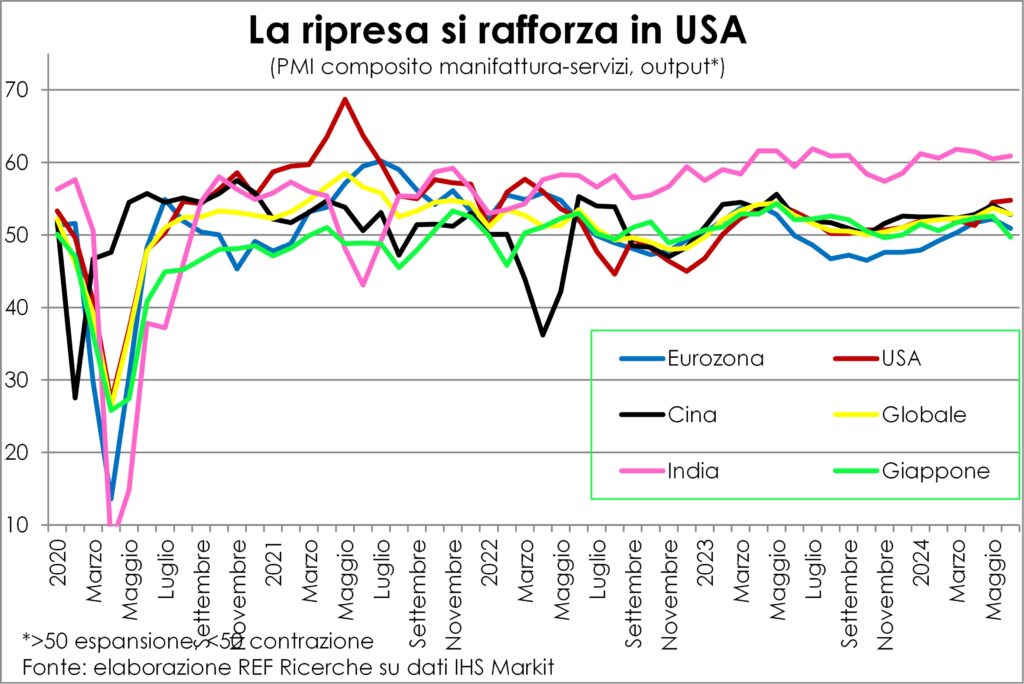
Lo focused gaze. The economic indicators continue to show signs good weather in the US economy. The Composite PMI of June says that the recovery is underway even strengthening across the Atlantic, while loses sharply in the Eurozone and Japan (but for different reasons: car crisis here, lack of tertiary demand there). Production and orders increase.
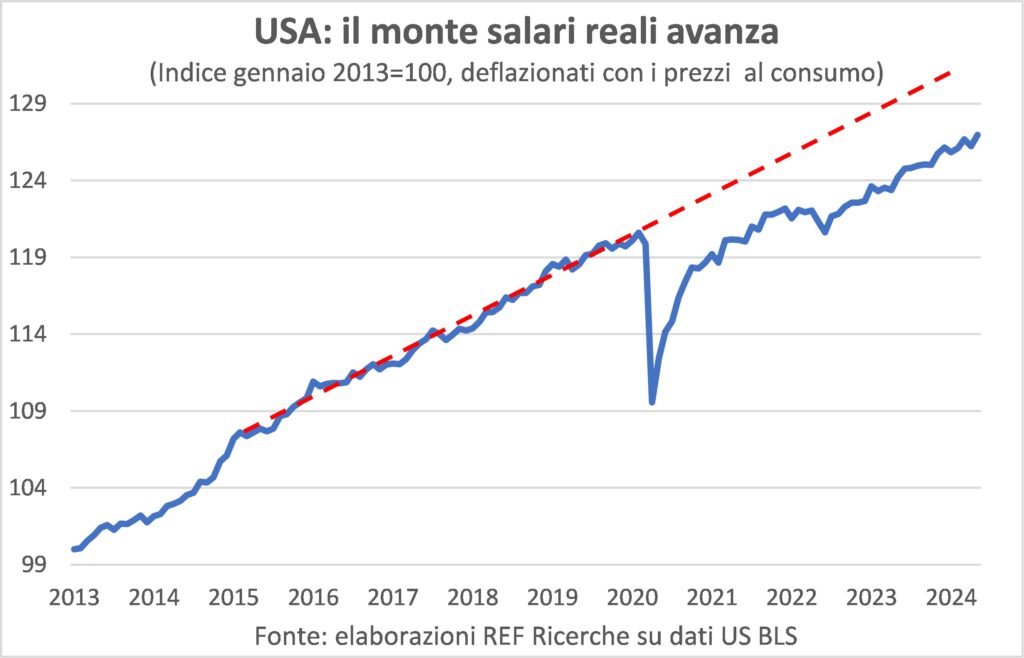
E employment continues to rise at an enviable rate, albeit more gradually than before, as was intended to cool inflationary pressures. Which have actually cooled down. So that the real wage bill It is progressing more or less at the same rate as in the past two years. And this fuels the consumer spending and the desire to shop of consumers.
In addition, theexcess savings, accumulated during the hard months of the lockdowns thanks to the generous federal subsidies, allows us not to have to immediately and suddenly start putting money away for lean times (according to the calculations of the Lancets, at the current rates of increase in income and spending that excess will not will sell out before the end of 2026, at the earliest). Nor are there too many signs private sector debt, which is actually lower today than it was in 2019 (mirror image of the increased public debt).
Finally, it is interesting that BCA, an economic research center specializing in advice on financial investment management, despite having long been convinced that there will be a recession in the USA by 2025, has recently compiled a checklist of ten reporters of imminent economic stumble and had to note that only two flash today, both of dubious significance (unemployment of 3,83% or above and few bearish positions on the stock market).
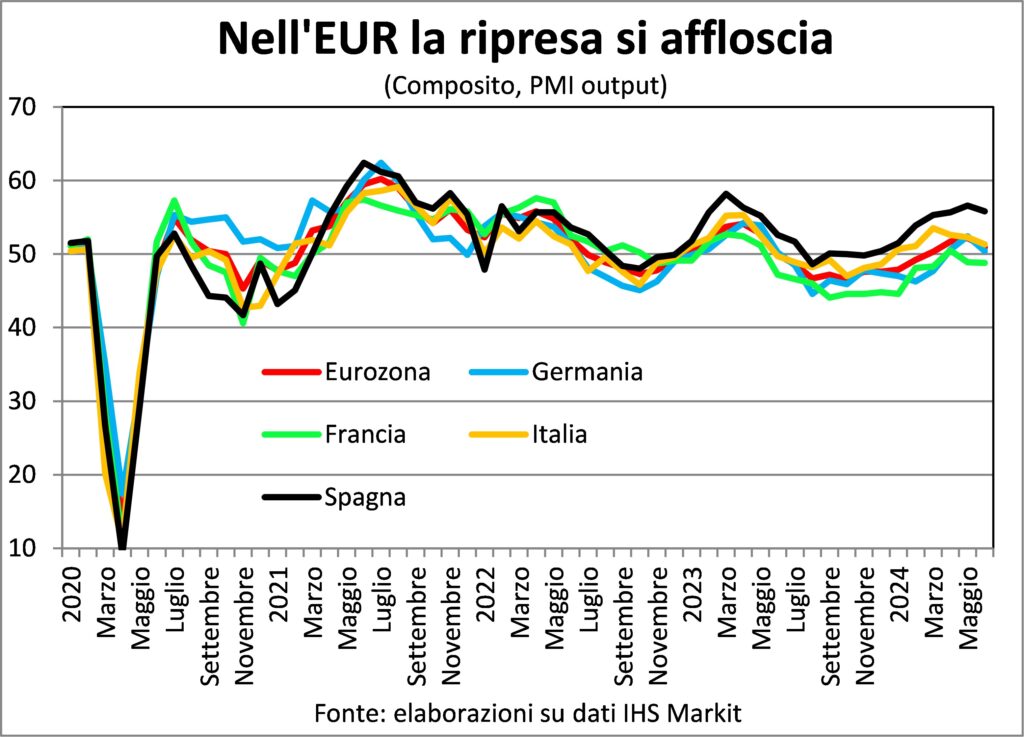
If the US ship goes well, the same cannot be said of theEurozone. Where is the manufacturing continues to contract. The German model focused onautomotive and on the bazaar economy (importing semi-finished products and re-exporting finished products all over the world) is in serious trouble, due to the transition to electric mobility and deglobalization due to geopolitical tensions. There France it also suffers from the two structural changes. Neither Spain and Italy suffer less, where however the end of the super bonus is starting to leave its mark on manufactured goods too, while the strong industrial ties with Germany are making themselves felt. Not a small consolation at all is that employment rises, and this creates a safety net that cushions the economic downturn, as well as reducing social exclusion and inequality.
And what about theASIA, the third major global hub, now the largest? India continues to gallop and is starting to become a global factory, China is struggling in services and is dynamic in manufacturing, and the same goes for Japan.
Inflation is falling and will fall
The cooling of consumer prices in the United States It's good news, even if it's sometimes taken as bad. AND a good news for various reasons: it confirms what the Lancets predicted, namely that the interruption of the journey towards the 2% target in the first four months of 2024 was not to be taken at face value, because it was influenced by the change in behavior that modified seasonality; also confirms that thelast mile the descent would have been more gradual; dissipates i residual doubts of the Fed, which can now start cutting rates as early as September; replenish the household purchasing power and gives new impetus to consumption, which is the majority of demand; reassures the financial markets, than by waiting for the realization of expectations of reducing rates could have put bullish desires on hold; helps other central banks to also believe that the inflation experienced in 2021-22 is a minor episode that will never appear in economic history books, and therefore they too will take courage in cutting.
It is a bad news when the glass of the question that has emptied a little is read as, in fact, half empty. Disinflation is perhaps not sign of weakening of growth? And is this weakening the precursor to recession? We have already answered this point above.
On the other hand, and to strengthen the contrary thesis that it is not the antechamber of the recession, there is another confirmation: the Global inflationary pressures have not returned to where they were before of the pandemic, but they remain a step above, as shown by the price component of the global PMI. In other words, we are not in danger of falling back from the inflationary frying pan into the embers of deflation. A point reiterated several times by Lancette in recent months.
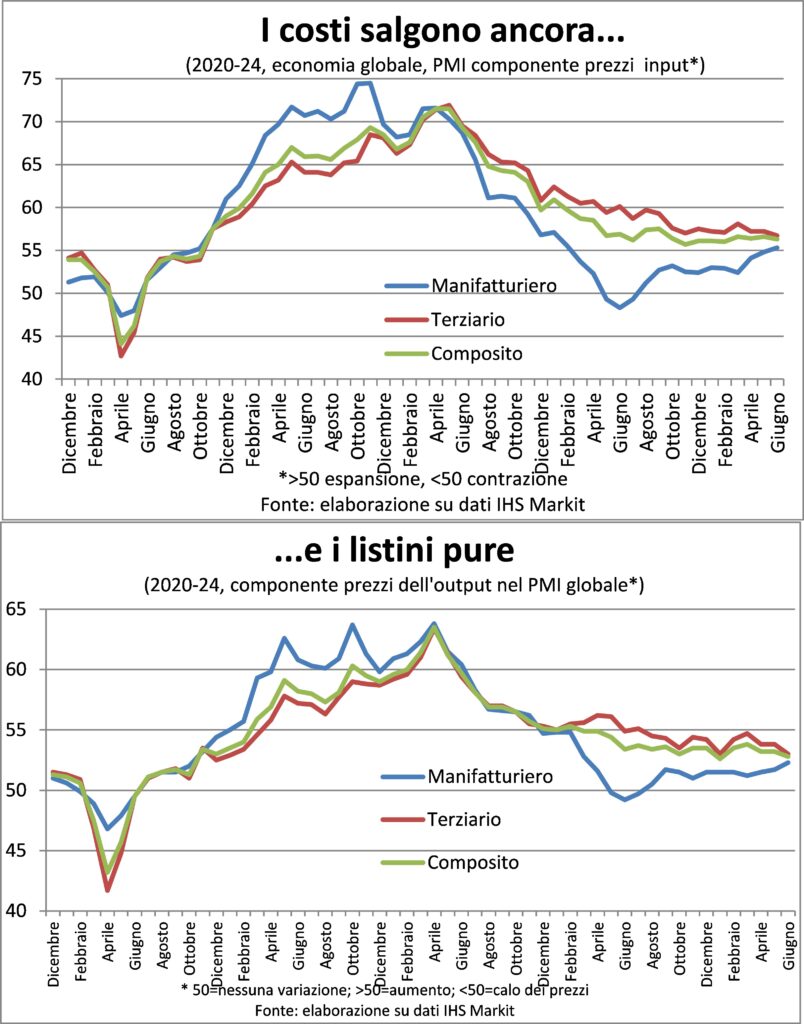
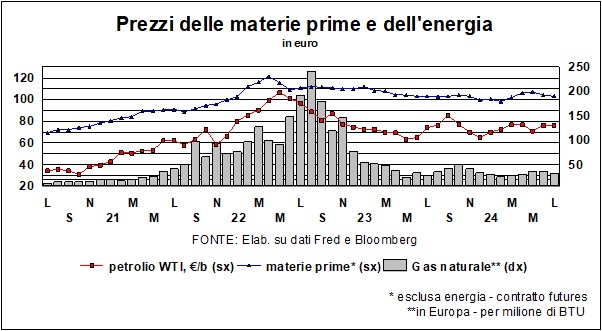
If anything, we notice what some have begun to underline more forcefully: with wages still increasing discreetly, those who bear this higher cost and that of the raw materials (also rather calm) are the corporate profit margins.
The same raw material they are not in particular tension, if anything they are marking time due to the lower strength compared to expectations of the recovery in Asia and in the Eurozone.
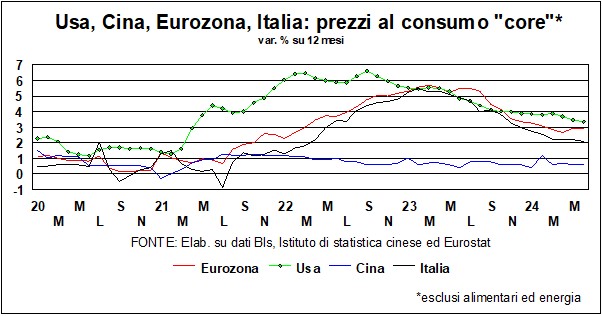
The slower the more bizarre discontinuity in braking of consumer prices in the Eurozone can be read above all well in the components core (i.e., without energy and food supplies). On the other hand, the prices of such components are more intensively influenced by cost of labor (being the production of labor intensive services).
And just the determination mechanisms of labor costs are slower to make wages react to prices than what is observed in the USA. This has the advantage of avoiding the rapid triggering of price-wage spirals, and the disadvantage of prolong the inflationary echo, as collective agreements recover lost purchasing power.
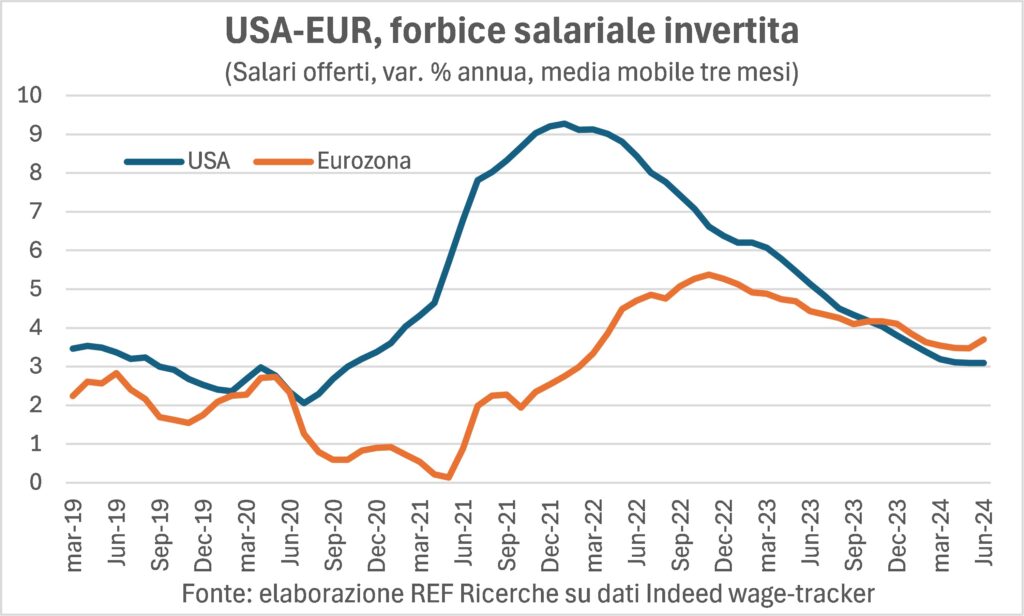
So, while the dynamics of the wages offered in the USA it has returned to pre-pandemic values for three months,
in the Eurozone it is still a good percentage point higher. All countries are keeping the average high in this last area, with very wide ranges: the Netherlands +7,7%, Ireland +4,3%, Spain +4,1%, Italy +3,9%, Germany +3,5% and France +2,1%. If the latter two are also the countries that fare the worst, as well as those that record the lowest wage dynamics, there will be some correlation. However, the cooling of inflation is set to continue in the Eurozone too.
Rates, currencies and stock exchanges
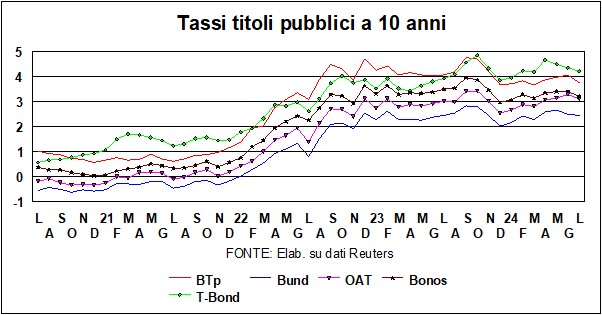
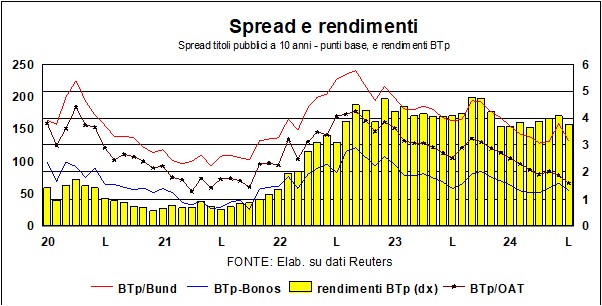
The growing ones signs of retreating inflation have led to one retreat of rates, especially pronounced for i btp. Now that the 'sick people of Europe' are Germany and France, the Italy enjoys relative stability and best picture in what Dante called "the great sea of being" (according to some calculations, Italy is now the leading tennis power on the third planet - see table - to console the footballing disappointments; but today, Saturday, we are rooting for Lorenzo Musetti and Jasmine Paolini). The Italian spreads are clearly improving, both in relation to the Bunds and the Bonos and the French OATs (ça va sans dire…).
| ATP Ranking – 6 July 2024 | ||
| among the top one hundred tennis players, by nation | ||
| Cumulative score | number of tennis players | |
| Italy | 18092 | 9 |
| Usa | 17063 | 11 |
| Russia | 15198 | 6 |
| Spain | 12006 | 5 |
| France | 10934 | 10 |
| Germany | 10284 | 5 |
| Serbia | 10221 | 3 |
| Argentina | 8099 | 7 |
| Australia | 7987 | 6 |
| SOURCE: elaborate. on ATP data | ||
On the foreign exchange markets, the dollar has weakened, following the now proven certainty that in September the Fed will proceed with the desired decrease in the key rate in September. The weakening of the greenback has worked against both euro what against yuan. For the sake of yen Japanese, the ups and downs signal a structural fact – the strong yield gap to the detriment of the yen - and a cyclical fact - the interventions of the Bank of Japan to discourage those who think that the bets on the yen are one-way.
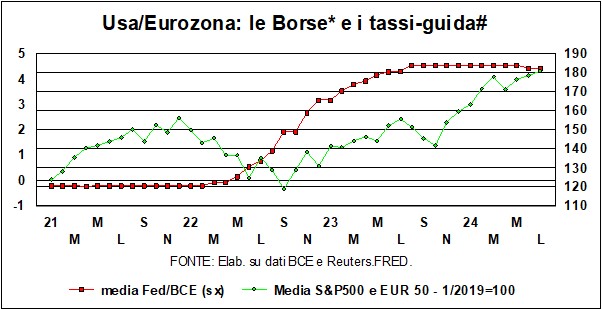
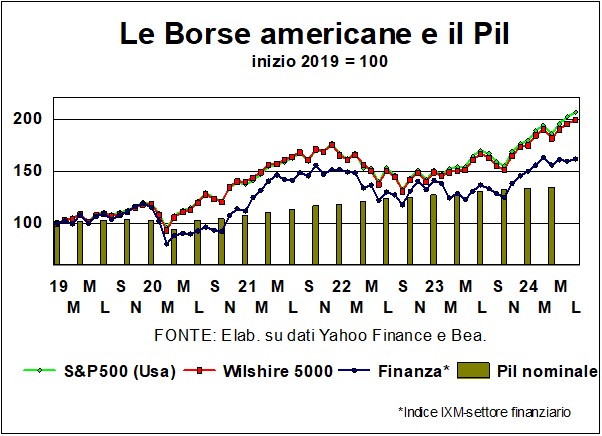
We come to stock markets, which deserve some more in-depth analysis. Since the start of the year Wall Street set 37 historic records, on average one every 5 days... Bertoldo's saying usually applies to these rapid climbs: "what comes up comes down". It is therefore legitimate to ask whether the stock markets (and not just the American one) they smell of correction. The stock market feats were all the more surprising as they occurred despite a monetary policy which, starting from 2022, raised interest rates with a restrictive maneuver which is unprecedented in intensity. The graph shows how, on both sides of the Atlantic, the tightening of monetary policy was accompanied by a anomalous gallop of stock markets.
To explain the failure of stock markets to respond to monetary restriction we need to go beyond rates and look at financial conditions in a broad sense. The Chicago FRB index shows how, in the same period in which key rates rose relentlessly, credit markets and risk and leverage indicators, they have never risen beyond the value corresponding to restrictive conditions; and indeed, in the last six months - those which saw the 37 records mentioned above - financial conditions have become more permissive. In the Eurozone the ECB publishes a systemic risk index (which mainly concerns sovereign risks, which naturally worry the markets), but also this indicator gives signs of benevolent nonchalance.
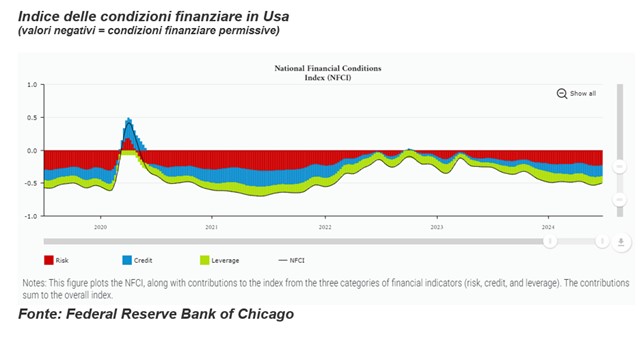
Source: Federal Reserve Bank of Chicago
Let's go back to the queen stock exchange, Wall Street: since the beginning of 2019, prices have more than doubled, exceeding - and by a lot - the growth of nominal GDP. As can be seen, there is not much difference between the performance of the 500 companies that make up the S & P500, and those that are contained in Wilshire 5000. Perhaps because even in the second they play a preponderant role 'Magnificent Seven' (Nvidia, Meta, Tesla, Amazon, Microsoft, Alphabet, Apple) which, with their immense capitalizations and stratospheric profit margins, did the US stock markets take off?
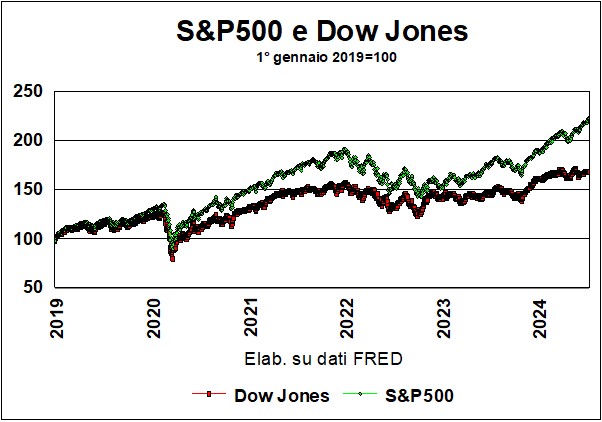
Certainly, the 'Seven Wonders' played a big role, as can be seen from a simple comparison between them S&P500 (index is weighted) and Dow Jones (unweighted). The latter has increased (since the beginning of 2029) much less than the former, but in any case much more than nominal GDP. However, prices follow company profits more than GDP, and Wall Street's performance may simply mean that profits have increased faster than GDP. Thesis that is subject to a control over national accounts data (CN).
The American CN gives estimates of corporate profits before and after tax, with or without adjustments (CCA and VAT) to bring depreciation and inventories from historical cost to replacement cost. The definition of CN profits closest to company accounts is that of profits after tax and without CCA and VAT. These estimates, developed by the Bureau of Economic Analysis, have the only flaw of being not very timely (the latest concern the 1st quarter of 2024), but they are useful because allow us to compare the 'wisdom of crowds' (which is sometimes, in fact, not wise but 'crazy'), as represented by stock market prices, with the sober calculations of the CN. The two variables should go together, apart from short-term shocks, coming from swans and black swans. The comparison between Wall Street and other cold numbers (which, someone said, are like pins on balloons) would help to understand.
Of course, there are differences between the two universes. The universe of stock prices is, admittedly, not very universal, while national accounting profits cover all American companies, both listed and unlisted. The comparison in the graph uses the index for quotes Wilshire 5000 (which, over the course of its history, has reduced the companies that compose it from the approximately 5000 original ones - in 1974 - to the 3403 registered as of 31 December 2023); however, although not exhaustive, given its numerousness, the Wilshire index can be considered representative of the corporate universe. Profits made abroad by listed companies are not a problem, because they are included in national accounting profits (and, for listed companies, they are a large slice – around 40% – of Wall Street profits).
The three quantities (Wilshire 5000, and net profits with or without adjustments) have been transformed into index numbers starting from 1995, or rather, to be more precise, from the third quarter of 1995 (one year before Alan Greenspan gave the famous speech on the “irrational exuberance” of the American stock market). A distant base year was chosen because the relationship between the stock market and profits can be disturbed by a thousand factors that obscure the parallelism in the short term.
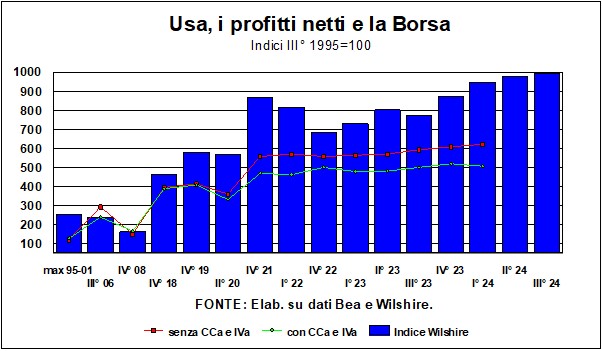
As you can see, Stock prices have risen more than earnings and suggest caution, given the growing possibility of a correction of the recent euphoria. An euphoria that does not, however, concern all latitudes and longitudes. The graph of world indices puts the markets of advanced countries (WSCI World) and the markets of all countries (MSCI ACWI) in first place, which are also driven by the former. But, if we isolate the index of 23 emerging countries (MSCI Emerging Markets) we see no signs of particular boldness.
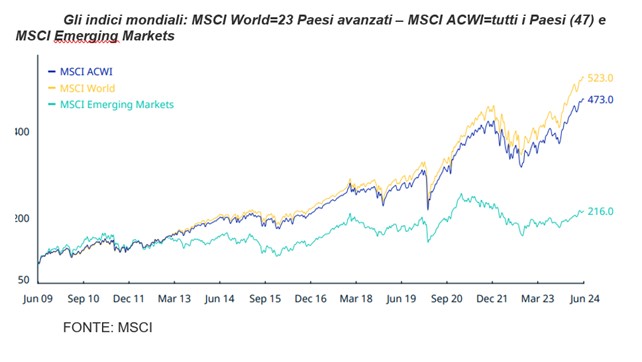
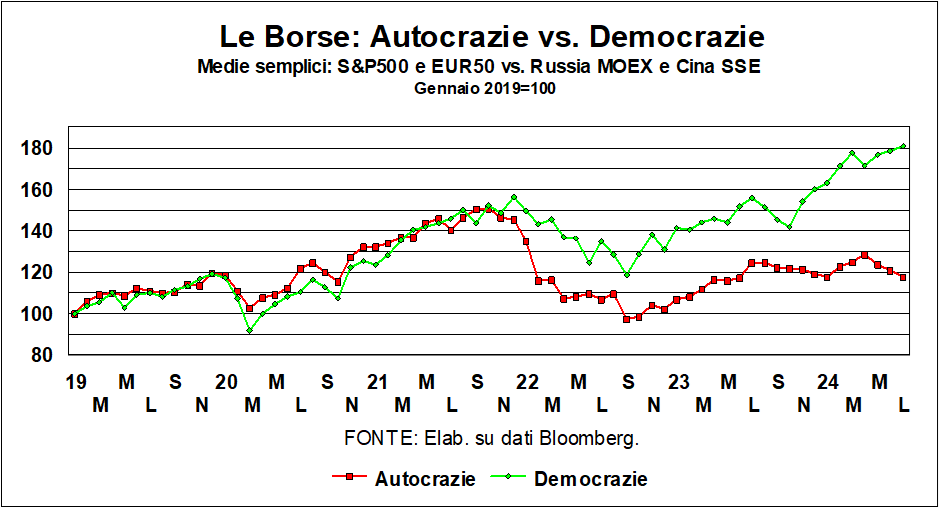
Among the emerging markets there are the Russian and Chinese markets: in these times of heated antagonism between West and East, between North and South, between autocracies and democracies, at least the stock markets indicate who is ahead in the comparison.