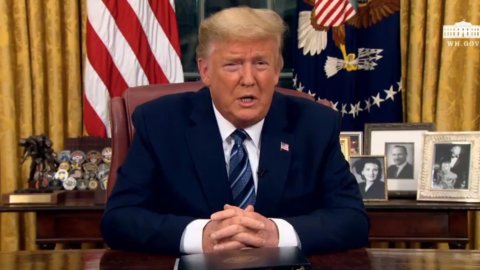
Less than three months before the presidential elections, Donald Trump, plays a surprise card: “Abraham's agreement”. The number one in the White House announced it first via Twitter, then at a press conference. This is a huge turning point for the Middle Eastern scenario: an historic one peace agreement between Israel and the United Arab Emirates. It was the American President who acted as mediator in the negotiations and the pact could be signed in the weeks in Washington.
The text of the agreement reads that the normalization of relations between the two countries will "advance peace in the Middle East" and that Israel renounces the controversial annexation of parts of the West Bank, suspending the declaration of sovereignty over the areas previously outlined by the Trump plan and concentrating its efforts on improving relations with other countries in the Arab and Muslim world.
However, the Israeli premier Benjamin Netanyahu, while admitting that the agreement marks an important diplomatic turning point for his country, he specified that the Israeli plan to annex the West Bank has not been cancelled, but only frozen, as requested by the United States.
As for the United Arab Emirates, with this agreement they become the third Arab country to maintain diplomatic relations with Israel after Egypt (the peace agreement dates back to 1979) and Jordan (1994). But above all, Abu Dhabi is the first state in the Persian Gulf to normalize relations with Israel, thus acquiring the status of key country in the anti-Iran Sunni bloc, led by Saudi Arabia.
From the point of view of United StatesIndeed, the agreement is important above all because it contributes to weaken Tehran, to which Trump did not fail to renew the challenge: “If I were re-elected – he said – in 30 days I would also make an agreement with Iran. Biden the sleeper would never achieve these results ”.
However, it is not obvious that the Israel-Emirates agreement will actually go through. A harsh condemnation has come from the Palestinian front: normalizing relations with Israel means undermining the Arab peace initiative and betraying the aspiration for an independent Palestinian state. This is supported by the PNA, which has asked to bring together the Arab League in an urgent session to reject the agreement and, in protest, has recalled its ambassador to Abu Dhabi. According to Abu Mazen, leader of the Authority, "the United Arab Emirates do not have the right to speak on behalf of the Palestinians".