Real indicators
"They come, they come, every now and then they stop." The clouds «black as crows» are gathering again in the low sky ofglobal economy. Low for the “secular stagnation” creeping and for the black swans that follow one another, so much so that it almost seems that the white ones have now become the exception. And in fact, in the song De André adds that the black clouds "seem to look at you with an evil eye".
The last inauspicious swan in color is the awakening of always active volcano of the Jewish-Palestinian war, with a violence equal to the gruesome horror of the methods of extermination, on both fronts. Which consequences will have on the global economy, it is premature to predict it, depending on the fate of the new episode of a series that lasts so long that, if it had been on television, it would have had a global success. It certainly doesn't push consumers to spend and businesses to expand capacity by injecting more doses than that toxin for expectations which is called uncertainty.
However, before October XNUMXth and XNUMXrd the world economy was sliding towards economic stagnation. Even if patchy.
The component production of the PMI survey positioned itself in September at "slow progress, almost at a standstill", while orders have already crossed the threshold of contraction. Orders=future production.
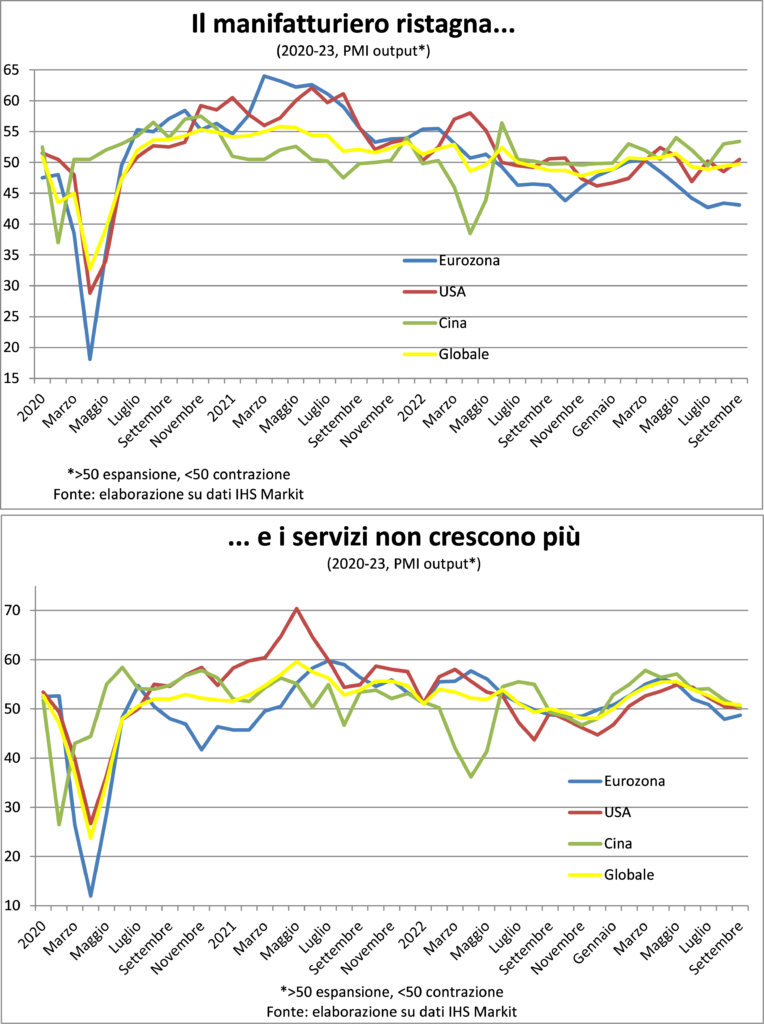
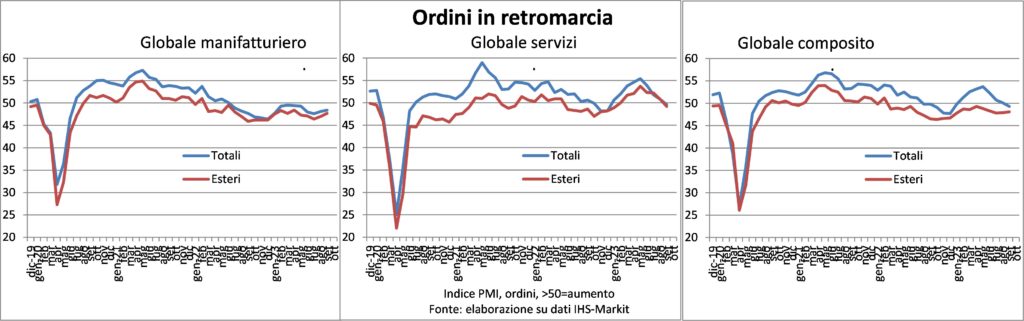
Breaking down by area, the picture is not at all uniform. The gap in dynamics is greatest in manufacturing, with the China in moderate expansion and theEurozone in deep recession, and the USA stagnant. While in the tertiary the slide into stunting is so unison that it seems synchronized. Which is salt on the wound of worsening, because the weakness of one calls for the weakness of the other, in a hug between lame people which when added together don't make for a good one.
In this panorama from Spoon River Anthology il job market constitutes a bright spot. Is it just a clever Caravaggio game? Or a safety net on which economies can rebound? Usually, employment that increases in a context of strong cyclical slowdown is like the light that comes from dead stars. The data says that employment continues to rise. In the USA with surprising strength: theincrease in new positions it has accelerated to over 2% annualized in the last three months, after traveling from June to 1,5% (sorry if that's low). What is even more extraordinary is that the number of vacancies (i.e. the need for companies to hire) is very high, a sign that many more jobs will be made. And this supports desire and spending ability of families: the increase in real wages "guarantees" fuel to increase consumption, which is the backbone of the American economy, but its profile has flattened.
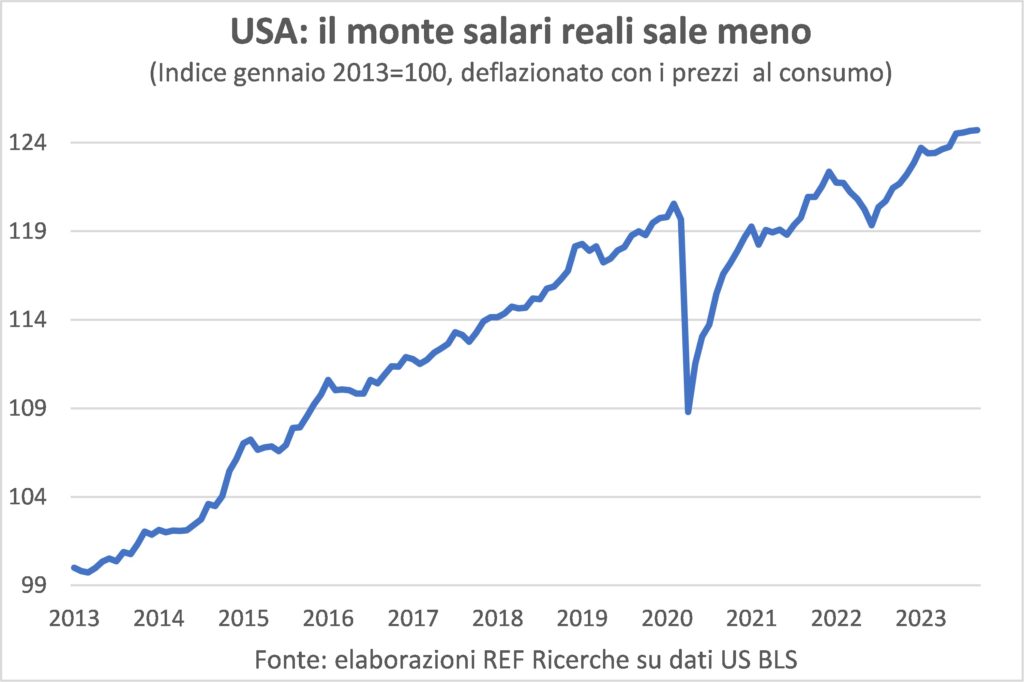
In Europe, as already complained in past Lancettes, the statistics on the labor market are very incomplete. At the area level, there is the unemployment but little is known about the occupation. However, even the percentage of jobless, to the minimum and falling again, it signals strength in demand and scarcity of supply of workers. The difference with the USA, in terms of repercussions on the future economic situation, is that theerosion of real wages due to the inflationary flare-up was greater in the EU+UK, so that the latter in the USA decreased less: 3,3 percentage points less (-3,6% versus -6,9%) between the last quarter of 2020 and the second quarter 2023. And this reverberates in the different perspectives of growth in consumption on both sides of the Atlantic.
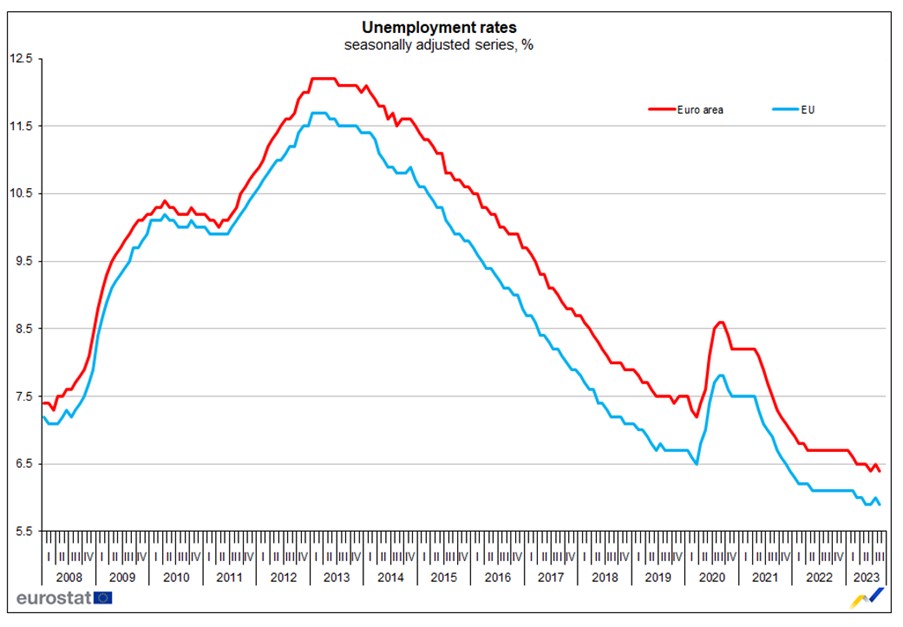
In Italy employment is at historic highs and compared to the last quarter of 2019, pre-pandemic, there has been an increase of over half a million (+2,3%). However, economic activity is slowing down and a comparison with other Euro countries shows that it is doing less worse than France in the tertiary sector and Germany in manufacturing. But it is precisely one race to see who falls back the least, rather than who advances the most. The IMF forecasts give for the Italian GDP a +0,7% in 2023 and 2024, i.e. the return to growth from area code. Implement the PNRR it is the only life preserver and who knows if the centralization of decision-making power by the Meloni Government will be a help or a hindrance: the public administrative machine is not an efficient corporate organisation, because it must not only protect the interests of the owners of shift.
Inflation
The path of drop in inflation it resembles that of a mountain climb: the easy part is the furthest from the summit, and the steep part steepens in the last more difficult metres. Every good climber knows that get distracted from the near-victory it can be fatal.
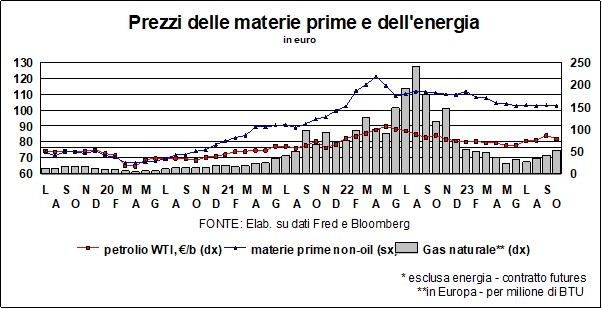
The lowering of the temperature of consumer prices has so far been made quick and apparently painless by the decrease in prices of many raw materials, especially energetic, and from the untying of knots global value chains.
But these beneficial effects are behind us. And indeed there are sporadic, but not very reassuring, signs of new tensions on the front of gas and oil, for the policies of the OPEC+ cartel, on the one hand, and of consumers aiming to become more "green". Which makes him favor gas to be delivered from everywhere. So a strike in an Australian mining company is enough for the European bill to rise again. He's right Isabel Schnabel, the only woman with serious and high skills on the ECB Council, that it is better not to count on the fact that there will be no other supply shocks.
Above all, it is there an input that couldn't be more primary, made of flesh and blood, intelligence and passion, without whom nothing can be done, and who is determined to make the most of the current market conditions so favorable to him, also to recover some purchasing power and restore a bit of distributional balance.
Yes sir, let's talk about His Majesty work. Whose hourly cost it travels, on both sides of the Atlantic, at rates that are completely incompatible with the return of inflation to that 2% which is identified with monetary stability. There is no point in debating at this moment whether this target is stupid or even just poorly calculated: the credibility of the institutional construction that we have all applauded as the origin of the great moderation, i.e. economic growth amidst moderately rising prices, is at stake. Construction based on the credibility of the central banks.
The growth in labor costs explains why it is now more challenging to conquer new progress in disinflation. As can be clearly seen in the US economy, where consumer prices surprisingly accelerated again towards the end of the summer. But the same will happen in Europe.
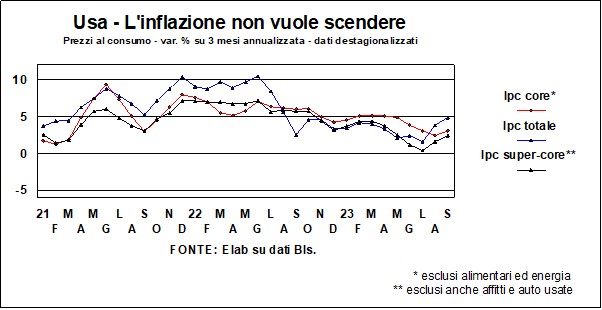
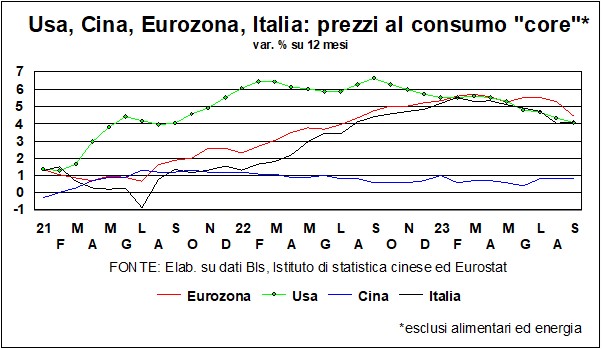
Normally, at this point, the disinflation path involves the following sequence: the rise in rates causes weakening of demand, companies try to revive it with discounts, profit margins are reduced and jobs begin to be cut, until the cost of the latter calms down.
Process here simplified and laid bare like the body Doctor Nicolaes Tulp's Anatomy lesson (Rembrandt's masterpiece) but without ignoring the suffering and difficulties that this entails. And just as Tulp shows his colleagues the bundle of tendons extracted from the corpse's arm, here we indicate a passage that escapes many: the reduction of profit margins. Which is exactly what is happening now and which is the precursor to job cuts. In fact, both in manufacturing and in the tertiary sector, input prices continue to increase very rapidly, while output prices are kept at bay by companies' desire to stimulate sales. And the gap in the dynamics of the former and latter has been widening since July.
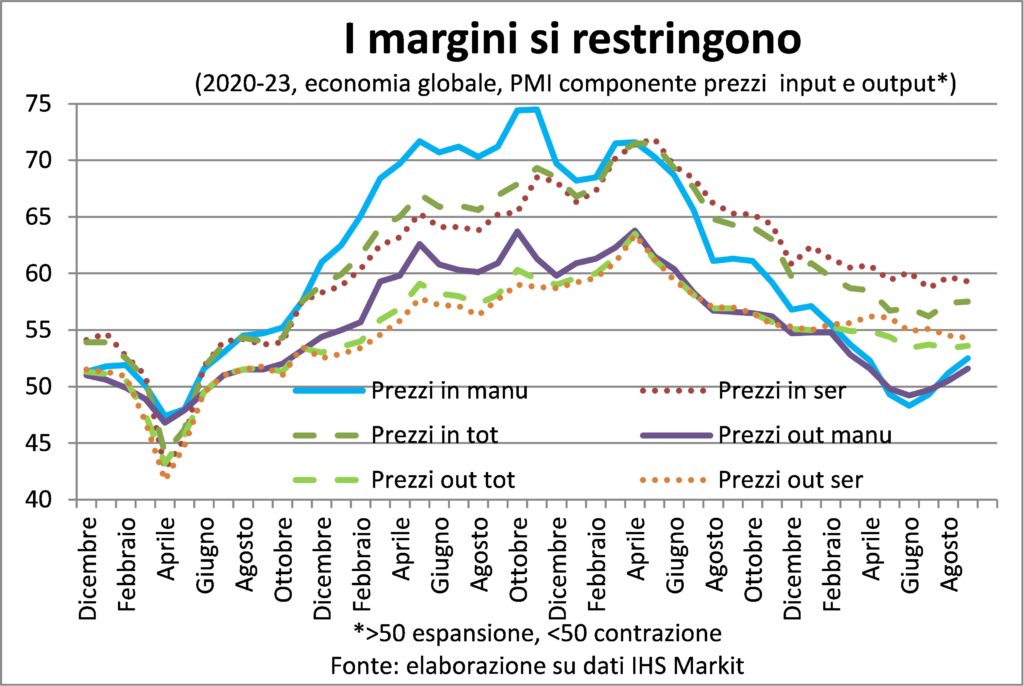
Another warning: the descriptive summary should not deceive. The process is long and it can take a few months if not quarters before labor costs cool down. Especially in the current conditions of excess demand for workers and shortage of supply of them. And to demand higher wages that compensate for the reduction in purchasing power suffered in paychecks due to the past increase in consumer prices, while so far companies have well protected their margins thanks to the strong post-pandemic demand.
The debate, apparently only political, on the minimum wage in Italy. The resistance of companies to its introduction is understandable: the bar for bargaining is raised. It is understood less from a different yet more strategic point of view: as Italy is the only European country without a minimum wage (and let it not be said that this is the contractual minimum, because there is bargaining everywhere), this absence contributes to the feeling of less protection for workers, a very widespread feeling among workers young people, who in fact emigrate looking for better living and working conditions. Strange that an experienced and intelligent person like the President of CNEL has not grasped this aspect of vital importance for the fate of Italian economic growth.
Rates and currencies
La war in Israel it also affected the markets, but the Pavlovian reactions – oil and rates up, then oil and rates down – were short-lived. The dangers, however, are still around the corner, and that war it can still do damage to the markets (not to mention human lives). However, between increases and retracements, the underlying trend in the cost of money is rising, but not throughout the world. If in America and Europe we are close to the peaks of the rise, Japan still has room to increase, while in other countries - such as China, Brazil and Chile - the decline has begun. But the fact that on both sides of the Atlantic we have reached - or almost - the peak of the key rates, it does not mean that we will then begin to descend from the peak. We may have reached the plateau, and then stay there for quite some time. This is what many expect, reciting the new consensus of the 'high and long-term rates'.
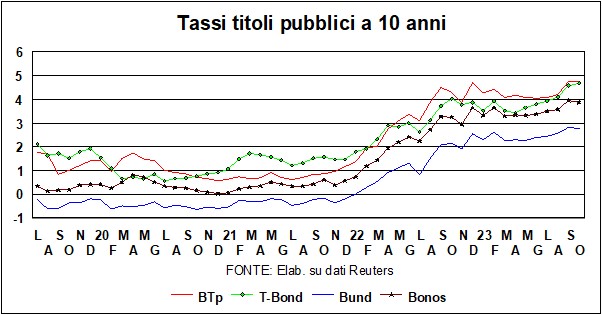
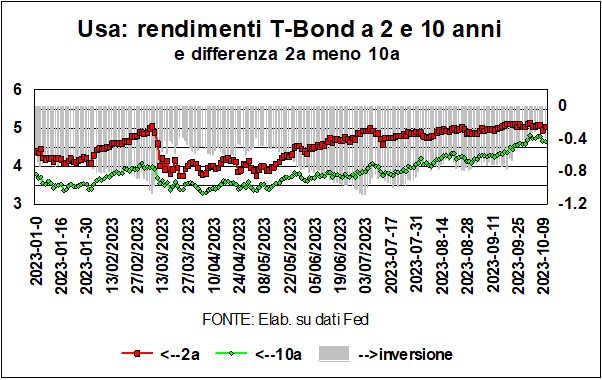
There are three reasons that explain the possible stay on the plateau. On one side, inflation, even if it is falling, it does not give up, and energy prices, in this agitated world, could rekindle it, advising central banks against giving up the battle and prematurely widening the meshes of monetary policy. On the other side, the economy, at least in America, shows no signs of slowing down and stands up to rising rates, giving the Fed another 'excuse' to keep rates high. The third reason, which concerns long rates, is simple: according to theory and common sense, a long-term rate is nothing more than a short-term rate repeated over time. If then Fed e ECB they say that short-term rates – over which they exercise direct control – will remain where they are, while long-term rates will also climb towards that level. There yield curve therefore, up to now inverted (with two-year rates higher than ten-year rates) tends to normalize (see graph, for the USA). Then there is a fourth reason, which concerns America. As we wrote in last month's "Lancette", i public deficits they are – the EU Commission would say – 'excessive', and spread into the future as far as the eye can see; while the debt, which this year exceeds 120% of GDP, is set to be higher than the Italian one by 2028, according to IMF estimates.
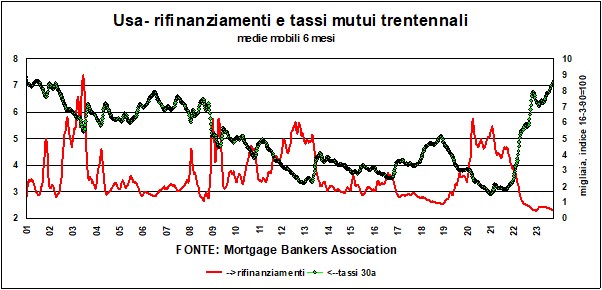
There are also reasons that lead to doubts about staying on the plateau and to bring closer the longed-for moment of the descent into the valley? Yes, and there are at least two. First, inflation could fall faster than expected. Second, the economy still has to discount the effects of past monetary restriction. These effects are, like Gaul, divided into three parts: the credit restriction, which is starting to bite, especially for American SMEs (and the bankruptcies, which reverberate, in a vicious circle that leads to other restrictions, on the bad debts of the banks); the devastation that high rates have inflicted on bond markets, resulting negative wealth effect; the business loans which, as they expire, must be renewed at higher rates; and, as a subcategory, the lack of possibilities to refinance mortgages (i refinancing are at their lowest levels in twenty years). In short, the current stability of the economy - evident at least in America - could reveal sudden fractures, such as to recommend a descent from the plateau.
For what concerns Italy, the Pavlovian reflexes mentioned above led to widening the spread towards 200, triggering uneducated fears of a 2011-type crisis. But the situation today is very different, and Italian public finance deserves quota 200 if and only if, incapable of using the PNRR well, we condemn ourselves to that slow growth antechamber of the unsustainability of public debt.
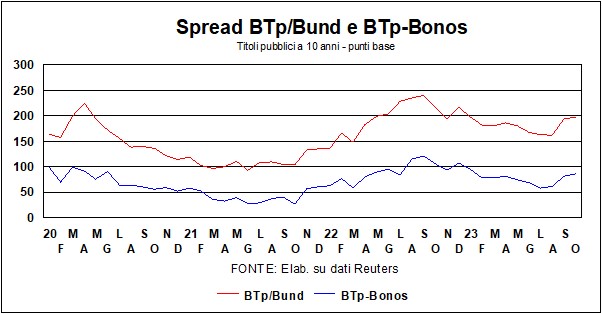
So, what will happen to rates in the US and Europe? Given the accumulation of geopolitical risks, one might venture that 'high and long rates' will not last very long. But, when extra-economic variables are involved, any forecast can fail.
Il dollar, which already had the advantage of a rate differential and a growth differential, also benefited from the risk aversion which enhances its role as a safe haven asset (and the same thing happened with their).
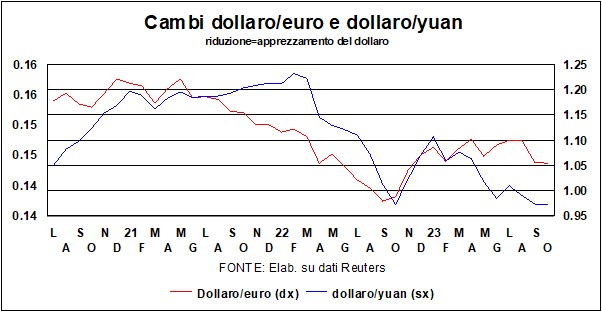
I stock markets, starting in July, seem to have downshifted and probably they have not yet incorporated both i economic risks (slowdown, rates and margins) than those political (for the USA, the saga of Congress and the debt limit) e geopolitical (war in Ukraine, war in Israel, China-USA-Taiwan tensions…). If we were investment fund managers, we would change the 60-40 (60 in stocks, 40 in bonds) to 40-60.