In his latest final remarks to the Bank of Italy's meeting, Governor Draghi dedicated ample space to the theme of the country's infrastructure, highlighting how, in the absence of a relaunch, there will increasingly move away from the main European countries, and not only. The Governor also underlined how a problem of priorities must be addressed especially in a regime of scarce financial resources; to this end he suggested the use of Cost-Benefit Analysis as a system for directing choices.
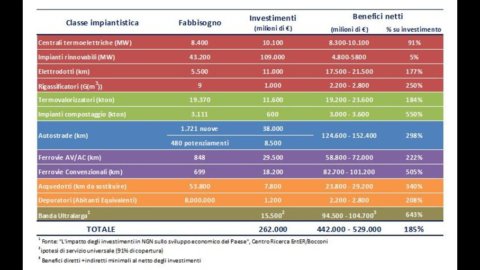
The Observatory on "The Costs of Not Doing", which fully shares these notations, estimates investments at over 260 billion euros over the next 15 years to implement trend plans in the energy, motorways, railways, waste , water and telecommunications. ++ The data are shown in table 1. It shows how investments in renewables absorb a large part of the needs (about 110 billion euros). Overall, the railways require about 50 billion euros, followed by motorways for 45 billion and then broadband, waste and water for 10/15 billion each.
Based on the Cost-Benefit Analysis, we estimated the benefits of the investments in absolute value (penultimate column) and as a percentage of the investment (last column). This incidence basically measures the expected social utility (or the return on the resources used) from the investment in the supply chain.
From the analysis it would seem to emerge that the benefits for the community of investments in renewables are very modest, while those in other sectors are important. In the lead is ultra-broadband, with a return of 640%; in logistics (railways and motorways) the utility is around 300%, values similar to those of water. Waste is a little more contained (200%). In all these cases, a very large net benefit is generated, while it would not seem so for investments in electricity production, especially in renewables, where they are marginal.
I would like to underline how these data should be taken with caution: the Cost-Benefit Analysis method, even if it has many advantages, is based on sometimes subjective and random hypotheses and assumptions. It should not be understood at face value, but it certainly serves to give life to an informed and balanced debate. In any case, the values shown here are conservative and partial and appear useful for a series of reflections.
1) The application of the Cost-Benefit Analysis, proposed by the Government and forcefully reaffirmed by Governor Draghi, highlights highly differentiated attractiveness in the various sectors considered: the social benefit would seem to be far greater in those sectors which, paradoxically, have direct or very modest indirects.
2) It also emerges that vertical analysis, ie by sector, appears inadequate today. For example, the development of ultra-broadband has an impact on logistics infrastructures (being able to reduce the need for mobility), as well as distributed electricity generation or Smart Cities. E-mobility (the electric car) is reflected in logistics and electricity production and also in energy efficiency. Today we need a horizontal, i.e. inter-sector perspective, which measures effectiveness in the pursuit of socio-political objectives.
3) Even with the limitations and subjectivity of the method, the marked differences that emerge require an overall reflection on where to actually direct investments in our country. The theme then appears to be of absolute importance in a context of scarce public resources.
4) Regarding infrastructure financing, a distinction must be made between those able and those unable to raise resources. Among the first are the sectors where the tariff system allows the entire cost of the infrastructures to be passed on to the consumer. Consider, for example, the electricity sector (both production and transport) or the motorways, where the regulatory mechanisms guarantee the return on investment. Here, and it is no coincidence, there are almost unlimited financial resources.
5) It is different if the tariff mechanism does not work, as for example in the water sector: here the willingness to invest is very limited and can only increase with clearer rules deemed reliable by investors.
6) Finally, there are situations where the tariff does not historically cover investments. Typical is the construction of infrastructure in the railway sector or ultra-broadband. Here, non-repayable public contributions would seem necessary, without which the works will not take off; contributions which, in the current and prospective conditions of public finance, are destined to be significantly reduced.
7) Essentially, the financeability of works today does not depend on their merits, but on the regulatory structures which, in one way or another, have developed over time. Renewables are a clear example: on the one hand, European policies have led our country, like others, to provide substantial incentives to achieve the 20-20-20 objectives; on the other hand, the supports are grafted into a serious situation of production overcapacity (estimated at around 20.000 MW) which is leading to the serious underutilization of many combined cycle plants (see Stefano Agnoli in CorriereEconomia of 30 May).
8) This requires thinking about innovative forms of financing. For example, Switzerland invests in railway infrastructure through the FTP fund, fueled by taxes on heavy vehicles and mineral oils (the so-called cross modal financing). The Gotthard tunnel was partly financed through this fund. In our case, would it make sense to develop the high-speed Corridor 5 from Lyon to Ljubljana by increasing the tariffs on the related motorways? After all, one must look at the ultimate goal of the Corridor. And again, would it make sense to finance ultra-broadband, if it really affects consumption and energy efficiency, through the electricity bill, correspondingly reducing charges for renewables? There are many ways to pursue the 20-20-20 goals; Minister Romani declared at the recent Assoelettrica meeting that a good energy efficiency program can replace 4 or 5 nuclear power plants; so why is so little done to this end? In short, support for too expensive renewables is certainly not the best way.
Then there is the whole question of the realization of the works on which we have already written in these pages. (see on FIRSTonline "Infrastructures, 2010 was a bad year but an intelligent law could mark the turning point"). It is our belief that the time is ripe for a new framework legislation that will unblock the main obstacles to building infrastructure. This legislation could provide for the obligation of the Cost-Benefit Analysis and innovative formulas for the financing of the same.
*President of the Observatory on "The costs of not doing"