The inflation goes down. Or not yet? The financial markets celebrated the minor increase in US consumer prices as if it were the comet star announcing the advent of the Messiah or at least, more prosaically, the end of the monetary tightening, which in the eyes of investors closely resembles the Last Judgement.
Hopes well placed? The doubt is more than legitimate and brings to mind a much more edifying historical episode. The young Augustine (not yet a Saint) asked the Lord: "Give me, I told you, chastity and continence, but not now". And the "not now" was justified by the "fear that, by granting me soon, you would soon have cured me of the disease of concupiscence, which I preferred to satiate rather than extinguish" - (The Confessions, VIII, 17). In the same way, in fact, one could say that inflation is going down, but not yet. Moreover, the central banks, like a single man (Powell) or a single woman (Lagarde), that disease of inflation, far from satiating it, want to "extinguish" it.
There are certainly signs of recovery from those supply barriers which are responsible for a large part of the inflationary pressures. And, of course, the weakness of demand final, which is more pronounced in Europe than in the United States, plays its part in smoothing inflation.
Weak demand itself due to the increase in prices, higher than that of wages. In that sense, theinflationary epidemic has a course similar to that of any other epidemic, which it eliminates itself im Over time, over time, by immunizing the surviving population. For inflation, too, the crucial question is the same: to what extent time and with which ones Costs?
To limit the time and costs of extinguishing the inflation epidemic, central banks intervene by imposing a sort of lockdown on demand: the increase in the cost of money makes the purchase of housing, machinery, cars and other durable goods less convenient (similarly to higher consumer prices). It is not an absolute prohibition on spending, just as it was not an absolute prohibition on leaving the house to fight the spread of the virus, but it certainly dissuades a lot.
I mean, is inflation coming down, isn't it? Certainly the temperature of prices is decreasing. From upstream to downstream, there are many price drops raw material, energy and non-energy, of sea freight and other inputs. These declines, however, occur with respect to stratospheric highs reached a few months ago, and for many commodities they have stopped or even reversed the trend.
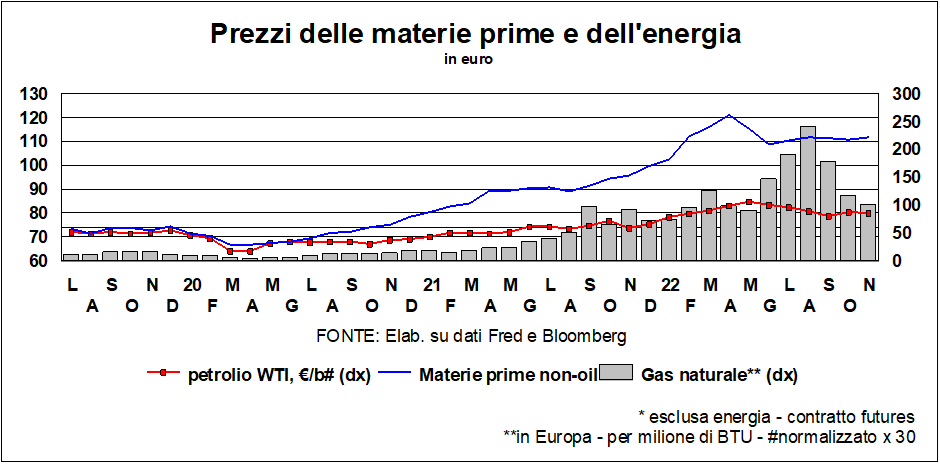
To better pinpoint where we really are on the price cooling path, we need to consider not only the changes but also the quotation levels of commodities, because it is likely that many of the past increases have not yet finished their journey to the final goods lists. Let's try to list a few, indicating the difference compared to pre-pandemic and pre-war period: oil +100%, gas +200% in USA and +550% in Europe, wheat +75%, wheat +50%, copper +30%, oats +33%, soy +50%, rice +50%, coffee +75%, sugar +50%. While cotton, tin and zinc have returned to pre-2020 values.
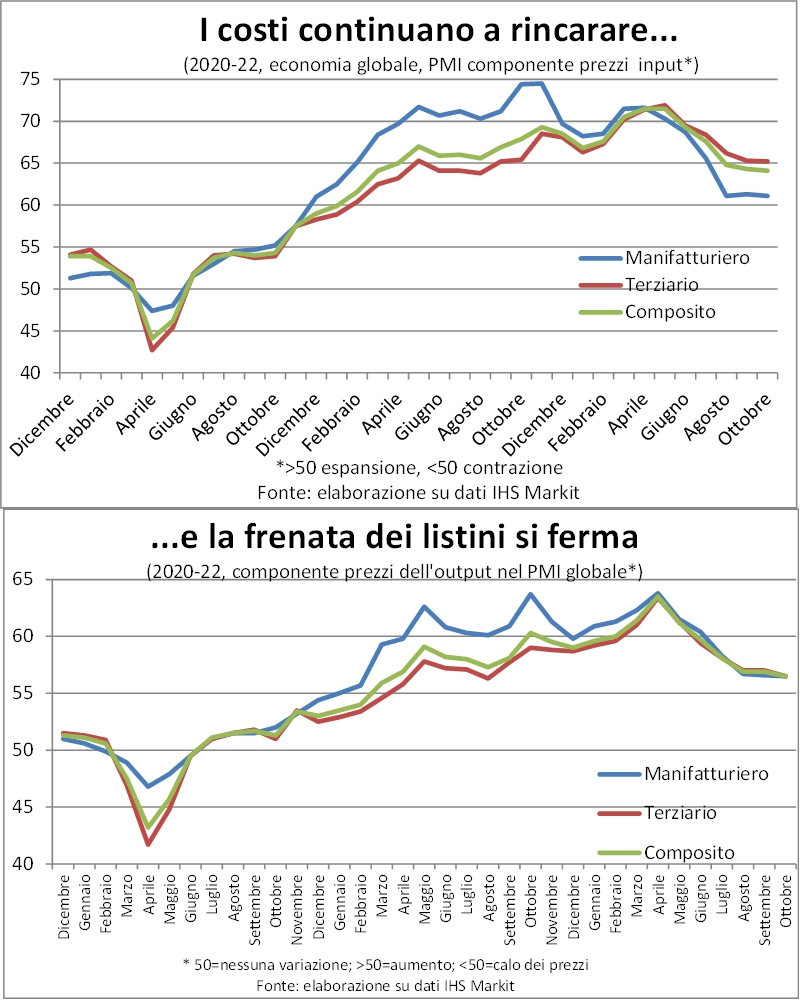
Another indication of resistance to diminishing inflationary pressures comes from price component of the PMI. Which has fallen well from the peaks in the diffusion of increases observed last spring, but remains well above the level of neutrality prevailing before the pandemic and has shown a halt in the descent in the last two months.
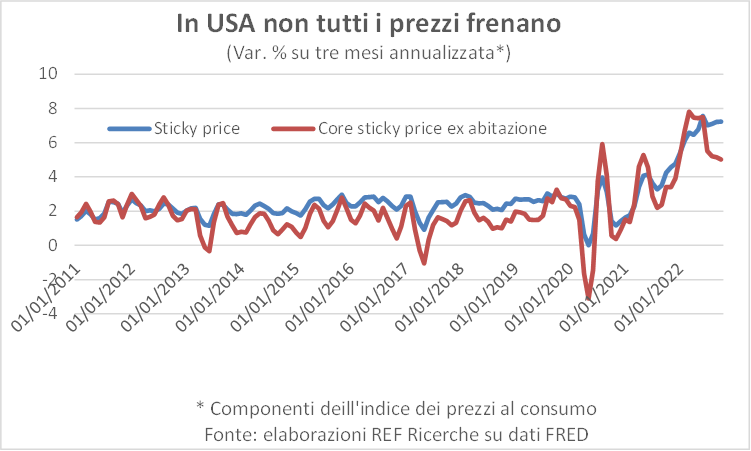
Furthermore, in the same price data American consumers, who have so favorably impressed the markets, are still experiencing upward tensions alongside the suggestions of a slowdown. For example, i "strict" prices (sticky) recorded an annualized three-month increase of 7,2% in October, the same as in September and higher than their trend (6,5%).
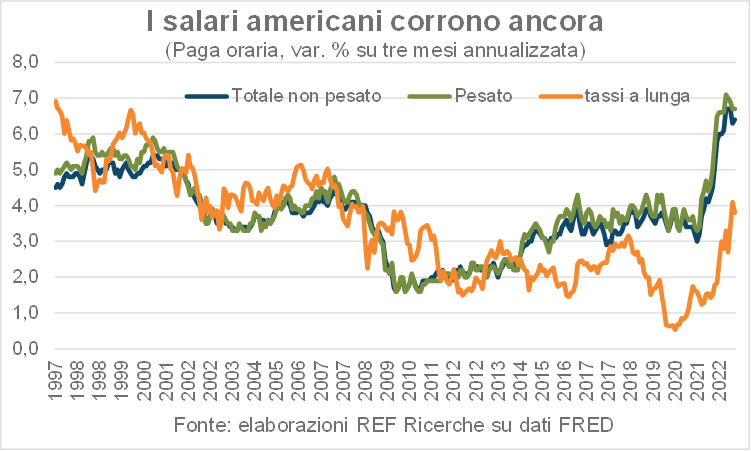
Finally, there is the mother of all causes of inflation: wage dynamics. Both in the USA both in Europe, this is not compatible with the return of inflation below 2%. In the former it travels at 6,7% (three months annualized) still in October, ei wages are pulled from a job demand that is equal to 1,75 times the number of unemployed. Certainly this demand will decrease, and the workforce will increase, rejoining a new point of equilibrium that does not push wages up, but that point still appears very far away. The impression, based on the Phillips curve, is that unemployment must rise by at least half a percentage point: not exactly within reach.
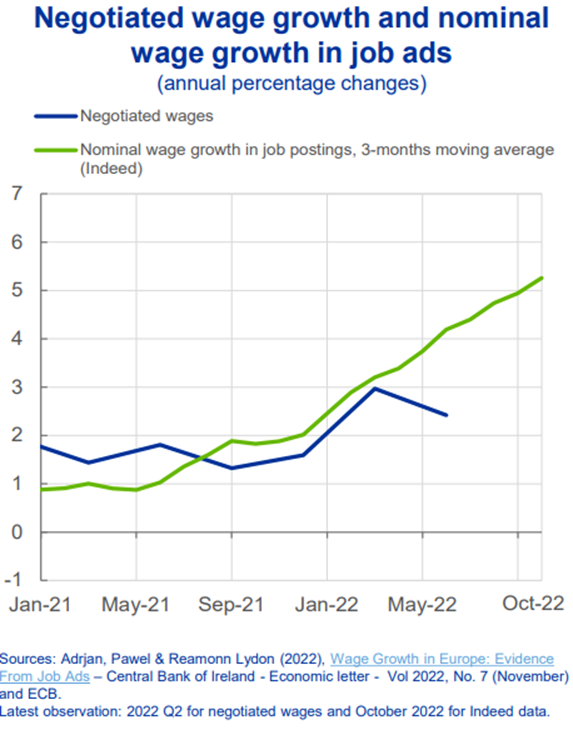
In Europe labor cost statistics are very incomplete and late (yet it shouldn't be difficult to construct them on the basis of administrative data...), but the ingenuity of economists has devised a new source: the Indeed job brokerage web platform. According to a recent study based on requests and offers that appeared on this platform, in October wages rose by 5,2% per annum in the main countries of the Eurozone, with a maximum of +7,1% in Germany and a minimum of 3,5% in Italy, Spain and the Netherlands. Not to mention the claims underway in large companies and in key sectors, such as the German metalworker (+8% the union request). The government aid to families to face the expensive bills also aim to mitigate these requests, but they cannot cancel them.
So, the reduction in inflation is there, but it is by far premature organize party and uncork champagne (sorry, sparkling wine!); you risk ending up in a rave party… It would be a joke in bad taste even at Carnival.
The real indicators
The trend of conjuncture, today and even more tomorrow, follows inflation directly. In the sense that the faster inflation falls, the lower would be the brake on demand, spontaneous or imposed by central banks, necessary to contain it. Obviously inflation is not the only one conditioning factor the economic cycle, keeping both SARS-Cov2 and war events on the horizon. In a positive sense, then, they play the ongoing green and digital transformations, which lead to intensive and extensive investments, with strong multiplier effects on aggregate demand.
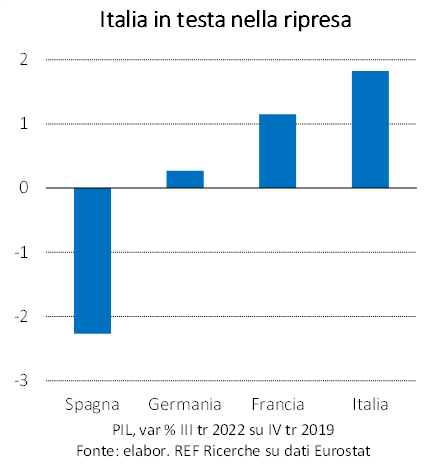
There are three pieces of news that deserve to be reported, waiting for the fate of inflation to take place in the next twelve months or more. The first is the Italian performance, clearly better than that of the European partners: in the third quarter of 2022, Italian GDP exceeds the value at the end of 2019 by 1,8%, against 1,2% in France, 0,2% in Germany and -2,3 .XNUMX% of Spain. It had never happened in the last quarter of a century and is the tangible sign of vitality of the entrepreneurial fabric and validity of the policies followed.
Beyond the announcements (can someone explain to the Minister of Infrastructure and Transport that he has so many resources to spend, if he just dedicated himself to them?) and some improvident measures (such as the cash payment of 5 euros: it's good for economies founded on illegality and in any case backward), the Meloni government seems to follow the path traced by the Draghi government. Both the aid-quater decree (even in name) and the 2023 programmatic deficit go in this direction.
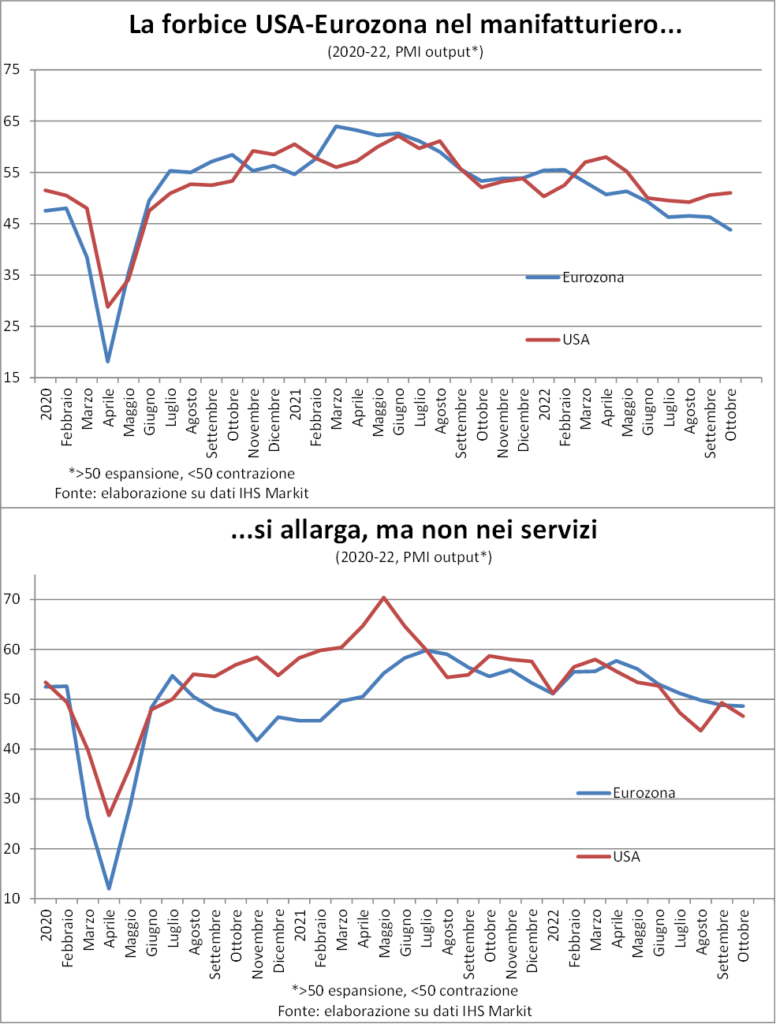
The second news is that the gap between Europe and the USA it is expanding, as expected, because the energy crisis has hit the former dramatically, while the latter have benefited, as net exporters, from the increases in energy and food prices. This gap could widen if the ECB pursues a deep recession (word by Isabel Schnabel) necessary to eradicate the persistence of wage inflation. While in the US a tepid recession could be enough.
The third piece of news, and it is the freshest of all, is that the China is attempting to inaugurate a new course in anti-Covid policy: once firmly confirmed in power, Xi Jinping is very clear that he still needs to keep the bicycle of economic growth on its feet, which zero tolerance towards the virus is risking ruining. And the world economy also needs the great Asian locomotive to start moving again.
Rates and currencies
The markets they yearn for the oasis: A break from bad news for stocks and bonds. And the data on US inflation brought this refreshment, with the joy of stocks and bonds. A perhaps premature contentment, as discussed above. But so be it. A few days before the Fed chairman he had given one blow to the circle and one to the barrel, externalizing with respect to the hopes of a slowdown in the pace of rising interest rates ("Don't stop but study the pace" the markets seemed to say - with the Poet). Yes, Powell hinted, 75 basis points each month isn't set in stone, but the point of arrival will be higher than the market expected. Something similar had said the governor of Bank of England and also the South Korean central bank has leaked that he is "studying the passage" (la Reserve Bank of Australia has already "studied" it, with a smaller increase than expected).
In practice, what does it mean? It means everything will depend on the data. And, although it is true that the restrictive monetary policy exerts its effects with a delay of a few quarters (so that said negative impacts are not yet visible), it is also true that there are, in pipeline of inflation, effects yet to be manifested. The Fed, like other central banks, navigate by sight, and rightly so. It had never happened that, in a much shorter period of time than a normal cyclical movement, an economy was brought to its knees by the slap from Covid, then rose again as one spring and was then hit by a peculiar combination: pressure on prices from the pandemic offer restrictions on the one hand, and unexpected demand pressures on the other (not to mention the other slap of the war in Ukraine).
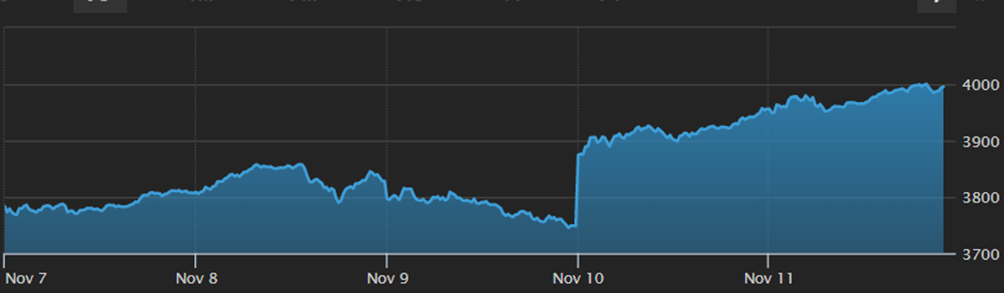
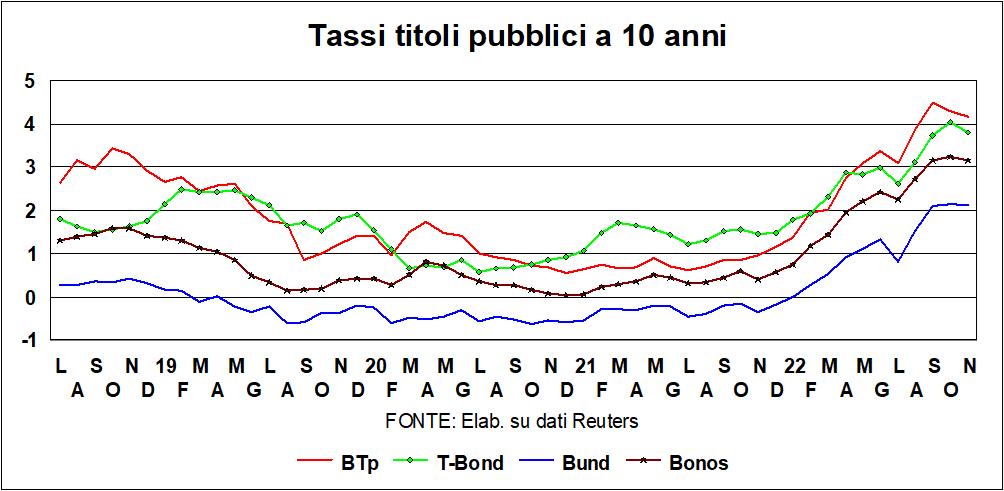
In this surf sight i market rates, who climbed without ceasing, they stopped thanks to October consumer prices in America (see graph). L'Italy deserves a separate discussion: the yields on BTPs had risen more than the others, given the uncertainties linked to the new government, only to then fall again when the market ascertained that no head-turns were coming, and the spread both compared to the Bunds and compared to the Bonos.
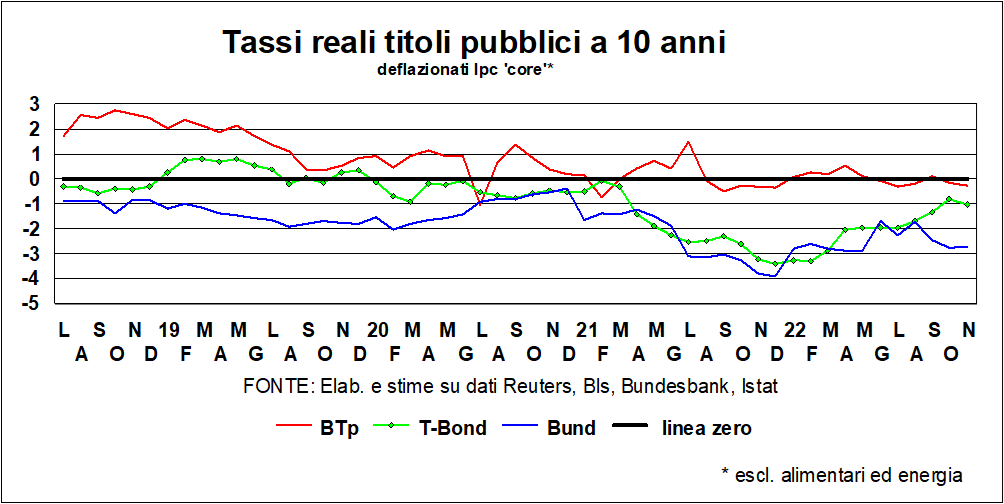
I real rates, even if deflated by core inflation, continue to be negative, also in Italy, and in theory they should be of support to the economy. To temper the theoretical support, however, two considerations are needed. First, right now spending decisions are dominated by uncertainty and from distrust, and the cost of debt carries less weight. According to the inflation rates that matter for spending decisions are not the current ones, but the ones expected, and here the data on expectations, for what they are worth, reveal much lower inflation than the current one, and therefore higher real rates: the 30-year mortgages in America – the main vehicle for home purchases – they reached 7%, which is much more than the inflation expected by US households.
Mistrust and uncertainty also dominate the prices of stock markets who, to quote last month's “Hands”, continue to stagger “like a crew of drunken sailors”: hopes (last goddesses) alternate with disappointments (at this moment the crew leans towards hopes). Delusions to which the downward revisions of corporate profits, who do not escape the rule that a weakened economy is associated with weaker profits. There are the public markets – where the securities are traded – but there are also i private markets, a magmatic and innovative financial system, which escapes the embrace of regulation and loves to play with risk sticks. And there are those who say that the problems of private markets could spill over into public ones.
In the field of currencyeuro, despite adverse fundamentals – growth differential with America, real long-term interest rate differential, proximity to the theater of war… – regained and surpassed parity with the dollar, probably due to geopolitical factors (mid-term US elections, more European activism in foreign policy…). Never they continue to be adverse.
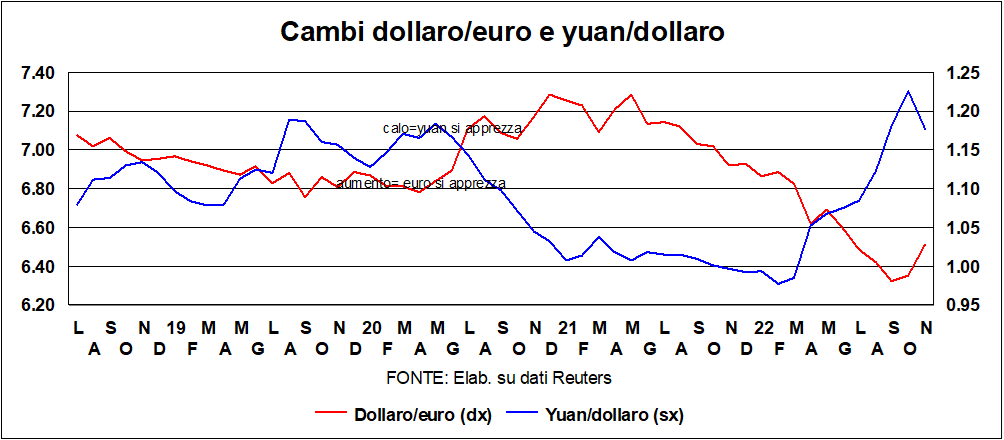
Lo yuan, which had reached 7.30 against the dollar at the end of October, has sharply retraced (dollar unter alles): after all, there is a new – so to speak – President…), but it remains about 13% weaker than the levels of the past spring; and it has depreciated since then, even against the single currency. THE Chinese producers they cannot but be satisfied, especially since the Chinese inflation rates (overall and core, consumption and production) are much lower than the European ones.