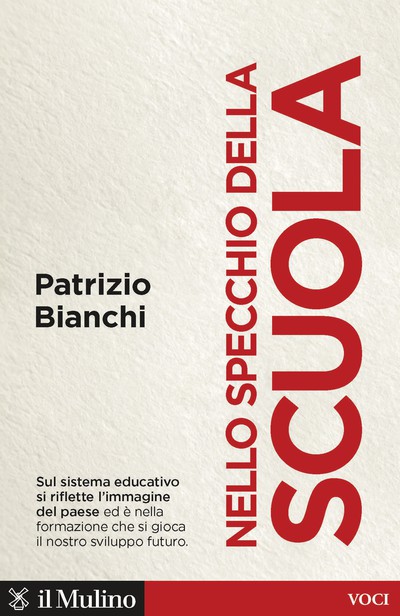
How much does school affect growth and the economy? “In the mirror of the school”, Patrizio Bianchi explains that Italy is the country in Europe with the lower levels of education, the highest dropout rates and the highest number of NEETs. Italy is also the country that has grown the least in the last twenty years and has presented itself at theappointment with the pandemic at an annual growth rate of 0,3 percent on a national basis.
Reasons why, for Patricio Bianchi, a return to normality pre-covid can't and shouldn't be enough anymore. “We cannot be satisfied with going back to the previous situation, but it is now becoming undeferrable to start a real constituent phase for the school, to open a new season in which the school returns to being, or rather becomes, the growth engine of a country that too much time is blocked”.
Bianchi underlines in the text how, while a profound structural change was taking shape at an international level, which paved the way for one new economy based on digitalisation of production and trade, our country was sinking into fiscal crisis of the State, with a deficit and a debt whose weight subtracted resources from education and research and, therefore, from that innovation necessary to understand and face the transformation of the economy and society.
It is in this phase that it emerges strongly the need for new skills, new skills, new critical capacities to understand these "extraordinary processes of reorganization of the economy" and of society and, at the same time, of "new ways of organization of educational processes” not only for children but also for adults themselves.
La new school therefore it must prepare skills and abilities aimed at understanding these new complex realities and preparing people to face continuous change. The risk, Bianchi clearly reiterates, is that the pandemic becomes the "blanket under which to hide all the problems accumulated over time", problems and inefficiencies that have hindered the possibility of reaping the benefits offered by new technologies.
The European Union had considered the presence of at least 40 per cent of young people aged between 30 and 34 to have a university degree as a fundamental objective for a "knowledge society". In 2019, in Italy, the share of young graduates it does not grow and remains stuck at 27,6 per cent, or almost 13 percentage points below the target set. The European Union has already surpassed this milestone while Italy lags behind and is ahead only of Romania.
Very low and absolutely unacceptable values are also found in the very delicate moment of the transition from school to work.
Patrizio Bianchi also underlines the fact that the level of education of today's emigrants is much higher than that of those who remain in Italy, so much so that the emigration rate it is double among graduates and diploma holders compared to those without a qualification, highlighting how the new Italian emigration drains above all among those who have the most necessary skills for development.
Alto still remains, unfortunately, the school dropout rate. Even if it has decreased over time, it remains – 13,3 percent – nevertheless above the limit set as a target by the European Union (10 percent by 2020). It should also be emphasized that this is the explicit dispersion rate, i.e. the visible and countable one. Implicit dispersion must also be considered, i.e. those who, despite obtaining a title or diploma, still do not possess the adequate skills.
On 19 June 2020, the European Commission publishes the Digital Economy and Society Index (DESI) that is, the composite index that measures the capabilities and skills a country has in the digital field.
If Italy ranks just below the European average in terms of connectivity, it is precisely in the availability of skills and adequate human capital that it definitively ranks last among European countries.
And therefore, for Bianchi, it is no coincidence that our country, “with the lowest education rates in Europe”, both the country that in the last twenty years, i.e. the years of theknowledge economy, is the one who grew up least of all.
While in Germany the crisis and the recovery of the economy were faced by investing in education, in Italy they were carried out cuts to educationas well as health and welfare. And it is in these cuts that, for the author, lies the root of the Italian delay.
The reduction in spending on education precisely at the time of the relaunch and the transition to digitization has had an impact on the development of technologies and above all on skills.
Therefore, Bianchi underlines, it is not a question of rediscovering the daily life of the school after the suspension due to the pandemic, but "of redesigning a school that is a factor of development for the whole country”.
A new school whose fields of competence can be summarized with the acronym CAMPUS (Computer/Coding, Art, Music, Polis, Sport), to underline how "the new school must be a field in which to train together with a life in which the fundamental objective is to build supportive and cohesive communities”.
The idea behind the Community educational pacts, indicated in the Final Report as the main road to follow, is that of opening real spaces for educational enrichment to the school and making the community co-responsible for the education of young people, giving full activation to the law on autonomy. The relationship with universities and research centers also becomes crucial, as they must have the possibility of building closer relationships with schools.
Improving knowledge and skills in scientific-technological subjects, ie STEM (Science, Technology, Engineering, Mathematics).
Stop chasing the school / work alternation but go towards forms of integration in which companies, schools and research institutions mutually complement each other.
There are already numerous initiatives referred to as "school-out-of-school" but, in order for the change to make sense, there must be their widespread diffusion.
One is also needed re-evaluation of the teacher figure and its centrality in the education and training of pupils as their reference adult.
Thus, the long-delayed issue of adjusting the number of teachers and technical staff has also re-emerged. However, once again, Patrizio Bianchi bitterly underlines, a subject that should have been the center of long-term planning has been tackled in emergency terms.
Many of the proposals put forward by the Committee were then adopted by the administration in various successive decrees. However, "having chosen to activate the various measures from time to time has made the overall vision disappear".
This is therefore the moment to choose whether to implement a real change or let this become yet another missed opportunity.
The publication of Patrizio Bianchi's book con il Mulino in October 2020, three months after the delivery of the Final Report of the Commission coordinated by him, a book in which he lists the same critical issues and proposes the same solutions indicated in the aforementioned report, and above all the way which he exposes them, allows the reader to understand that the train of change, alas, may have already passed and that, once again, Italy has been found unprepared, or distracted.
Reference Bibliography
Patrizio Bianchi, In the mirror of the school. Which development for Italy, ilMulino, Bologna, 2020
The author
Patrizio Bianchi: Professor of Economics at the University of Ferrara, rector and lecturer for the UNESCO Chair in Education, growth and equality, councilor for the Emilia-Romagna region for school, education, university, research, training and work. Coordinator of the Committee for the relaunch of the school after the COVID-19.