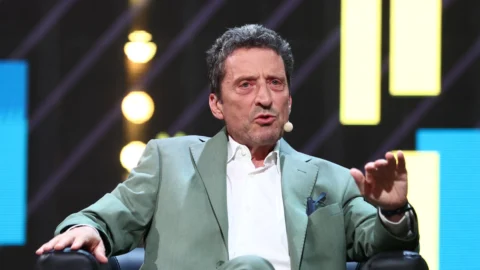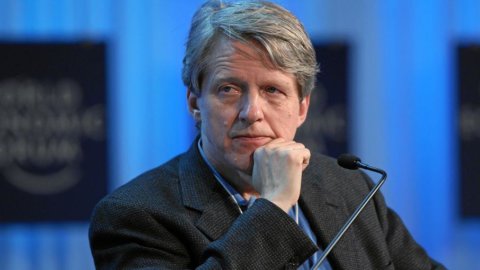
“History tends to repeat itself. Unfortunately…". Nobel laureate Robert J Shiller, a guest at the Kairos Partners convention in Milan, smiles when he talks about bubbles and the recession (“we had it in 2000, then seven years later, in 2007. Now another seven years have just gone by” ). But he does not hide that the price dynamics, both on the stock and bond markets, inspire him with a certain caution.
“Prices are very high, I've seen this dynamic before and it worries me. It is not a forecast, the present state can go on for who knows how long. But in the USA, despite the economic recovery, a certain nervousness reigns: the interest rate levels, which are too low, affect the "instinct nature of investments" to the detriment of the animal spirits of the markets, victims of the persistence of too low interest rates. Meanwhile, market indicators advise a certain caution, even if the Cape at 26 is well below the levels reached in the years of euphoria (up to 43).
An anomalous situation, a sort of new normal investigated by the Yale professor who was the first to identify, in the XNUMXs, “The irrational exuberance” (title of his best seller) which was behind the stock market race. It is no coincidence that the title of the report presented in Milan was: “What is unusual about today's markets”, or how to move in a world drugged by low interest rates which affect the search for opportunities.
It is the latest development of the studies that Shiller has dedicated to understanding the dynamics of the markets, culminating in the models dedicated to understanding the trend in price lists (today tending upwards) and the real estate market. Mathematical models developed by a scholar who distrusts mechanical and technical solutions.
“My academic colleagues – he explains – tend to overestimate the value of market efficiency theory. In reality, there is no perfect market”. Psychology influences the choices of investors and the direction of the markets, in turn the result of complex interactions that develop over time: the bubble of 2000 pushed up the stock markets, but the same current then caused the real estate bubble. And so on.
And today? The situation, in many ways, appears satisfactory. The American economy is in full recovery and the markets, after the reforms of the rules, offer better guarantees. After Quantitative Easing, Europe can face and win its battle against deflation. Nor is the different orientation between the Fed, which will have to raise rates (better sooner than later), and the ECB worrying. “Despite last year's announcements, US rates have fallen to very low levels. And then a stronger Europe is an advantage for everyone”.
But what complicates the situation is the "growth of inequality, now a fact that is a central problem for American society" which is being reflected in the dynamics of investments, far beyond the immediate effects on the markets. “Some think the only risk is what we measure in the stock market. Forget about it: there are many others. Something big is going to happen, I don't know what and I don't know when it will happen, but it will be revolutionary for society. We face enormous uncertainty." “Inequalities have always been there, but in recent years they have grown in a dangerous way”.
To which the scholar tries to give concrete answers. He came up with the idea of compulsory living insurance, which protects the individual from the risks associated with job loss or serious financial setbacks.
In essence, the world of 2015 appears to be a healthier place than in the past. But the bubbles that have enriched 1 percent of the population are causing disturbing side effects that must be defused in time. A difficult mission that will fall above all on the shoulders of Barack Obama's successor. But who will it be? "I can indicate my favorite candidate: Marco Rubio, the most sensitive to green issues". And it matters little that Rubio, a Republican from Florida, is little more than an outsider.