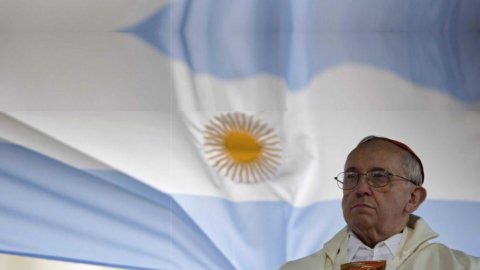
“What, we have Papa”. The Huffington Post opens with the version of Habemus Papam readapted into Argentine slang, but the Daily Mirror, who with the usual British humor manages to bring up even Maradona: "The New Hand of God", headlines the tabloid in the aftermath of the election of Pope Francis, the Argentine cardinal Jorge Bergoglio. And the French Libération does not want to be outdone: “Habemus Pampa”.
The first Latin American pontiff (of Piedmontese origins), the first Jesuit pontiff, Bergoglio is described by the international press as a simple man, close to the needy and with a conservative tendency. Perhaps, beyond the very human and popular impression he gave off during his first speech (pleasing to many), he was too conservative. It is mainly South American newspapers, such as the Argentine himself, who report it Clarin which under the triumphalistic opening title (“Un día histórico: the Church named Pope to the Argentinean Jorge Bergoglio”) also reports on the analyzes of the Brazilian O Globo and the Spanish El Paìs, which recall the strong tensions with the government of Cristina Kirchner, with whom the cardinal of Buenos Aires has a "cold and distant relationship", in particular on the issues "of gay marriage, of which he was a strong opponent, and the use of the condom".
The president of Argentina for her part, from Venezuela where she was for a last farewell to Chavez (who, according to the new interim president Nicolas Maduro "influenced God's choice"), let the other newspaper know principal of the country, La Naciòn, of welcome Bergoglio's appointment, considering it "important for the region", and has already written to his compatriot Pontiff that he will be present at his investiture.
The geopolitical aspect mentioned by Kirchner is the one most emphasized by the New York Times, which writes: "The Pope said that the future of the Church is in the Southern hemisphere". Instead, the French goes into technical details Le Figaro, who first recalls that the chosen name is "Francesco, and not Francis I", then speaks of "revolution in the Catholic Church", judging the appointment of Bergoglio "an absolute break with the previous papacies", and finally indicates the three main challenges of the new Pope: "restore order in the Curia, relaunch the great building site of evangelization in the world and reconnect with the faithful".
“Argentinian, but not gaucho”, Libération writes again, which recalls the modest origins of Cardinal Bergoglio and underlines how he was the "great forgotten bookmaker": in fact, he was listed at 30, very far from the favorites Scola, Scherer or Ouellet. For the transalpine newspaper, however, his appointment is not seen very well by the Curia, "within which he could clean up".
And then there is the usual delirium on Twitter, where the comments on the new Pontiff tend to be positive (certainly much more than those regarding his predecessor…). One of the first is precisely that of the Argentine soccer star, four-time Ballon d'Or winner Lionel Messi: “An Argentine Pope! How happy! Francisco me encantaria poder dedicarte el Mundial 2014” Pulga tweeted, while Maradona himself commented on the “mano de Diòs”: “The Argentine Pope is a pride and honor for all Argentines. As soon as I come to Italy I hope to be able to have an audience with him”.
Finally, the inevitable tribute on the official website of Saint Lawrence of Almagro, historic Argentine football team of which Bergoglio has always been a huge fan: “The fanaticism of Francisco por San Lorenzo from the vuelta al mundo”, proudly headlines the club's official page, where Cardinal Jorge Mario Bergoglio's membership card also appears.