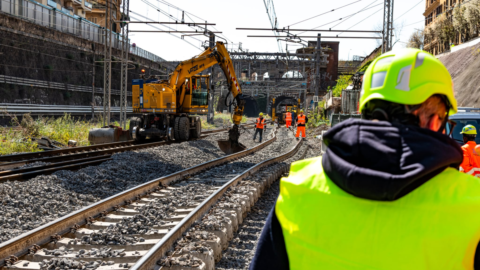
There are 1.300 active construction sites every day on the railway network, including major works, ordinary and extraordinary maintenance interventions and technological updates, for a total of 11,6 billion euros of investments in 2025These are among the key figures presented today by Aldo Isi, CEO and General Manager of Rete Ferroviaria Italiana, during a press conference at the FS Group headquarters in Rome, dedicated to the progress of railway construction sites and upcoming activations on the national network.
For Rete Ferroviaria Italiana (FS Group) this is the highest level ever recorded, a result achieved thanks to the operation of the PNRR and the acceleration of network upgrade and maintenance programs. This investment plan has had significant impacts on the national economy and employment levels. The interventions implemented in 2025 have generated an impact of €20,5 billion in production value and €8,6 billion in GDP, with 112 jobs in the affected supply chains.
The implementation of strategic works is progressing at a rapid pace: some of the main infrastructures have been completed in the last three years Numerous technological upgrades have been completed across the network. The work currently underway involves the main European rail corridors, the development of new high-speed/high-capacity lines, and the strengthening of the regional network. This scenario also includes the €25 billion in PNRR funds allocated to the FS Group, €18 billion of which has already been invested through February 2026. Through its main operating companies, the Group has achieved all the intermediate targets set by the National Recovery and Resilience Plan.
The shipbuilding activity, together with the routine interventions carried out every night to ensure continuity of service, represents the largest railway transformation in decades. Among the priorities of the infrastructure plan is the construction of new high-speed lines, with the goal of increasing the population served by high-speed connections by 30%. Also included are strengthening connections with ports, airports, and logistics terminals, digitalizing the network, and increasing climate resilience.
Works in progress: here's what they are
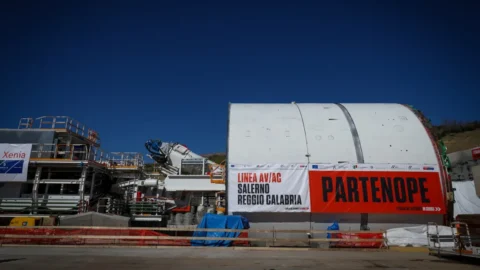
By 2027, new railway infrastructure will gradually come into operation and major technological upgrades will be completed across the entire national network. By early July 2026, The Naples-Cancello section will be activated, a further section of the Naples-Bari high-speed/high-capacity line, which will allow interchange with the Naples Afragola station, thus becoming a fundamental hub for mobility in Campania as well.
During the second half of 2026, at the Genoa hub, The Genoa Principe-Genoa Brignole line will be extended sixfold This will, once fully operational, separate metropolitan and regional traffic from long-distance traffic, increasing service capacity, frequency, and regularity. In Rome, the first phase of work will be completed on the new Pigneto station, which will become a major urban interchange hub between the FL1/FL3 lines and Metro C. In Sicily, the Giachery-Politeama section of the ring railway in Palermo will be operational, while work on speeding up the Battipaglia-Potenza line between Campania and Basilicata will be completed. Furthermore, in the Marche region, the electrification of the Civitanova-Albacina line is expected to be completed.
The technological upgrade of the ERTMS system on the Rome-Naples high-speed/high-capacity line continues.
The Brescia-Verona line, on the Milan-Venice high-speed/high-capacity corridor, is scheduled to open in the first half of 2027. Furthermore, the first four conventional lines equipped with the ERTMS system will enter service: Terni-Sulmona, Lamezia Terme-Catanzaro Lido, Siracusa-Canicattì, and Roccasecca-Avezzano. Finally, in Sardinia, Lot 2 of the Decimomannu–Villamassargia line doubling will be activated.
In Northern Italy activities related to the Brenner corridor continue, with the activation of the first phase planned for the Fortezza-Ponte Gardena section, the first priority section of the southern access line to the Brenner Base Tunnel, intended to increase the capacity and performance of freight and passenger traffic along the Munich-Verona axis.
Here are all the construction sites planned for 2026
Today on the net they are active every day 1.300 construction sites between maintenance and investments, with approximately 272 scheduled interruptions per year required to allow for work to progress. RFI's investment volume increased by 49% compared to 2023, confirming the FS Group as the country's leading infrastructure investor.
Of the total investments, 37% is allocated to maintenance and improvement of the resilience of the infrastructure, while 63% is aimed at major strategic worksAt the same time, the number of interruptions managed by RFI has also increased, growing by approximately 115% since 2023, largely to support the progress of the interventions funded by the PNRR.
To cope with the evolution of construction site activities, we have moved to a model of longer interruptionsConcentrated during off-peak periods, this allows for multiple activities to be carried out simultaneously, optimizing the use of technical and financial resources, and reducing the overall impact on rail traffic in the medium to long term. The new approach also allows for interventions to be concentrated within well-defined time windows, maximizing the effectiveness of operations and minimizing inconvenience to travelers.
Here are the outages scheduled for the coming months
As regards the national railway network, some scheduled interruptions are expected in the next few months which will still guarantee adequate levels of mobility and railway offerings, including through alternative itineraries and service rescheduling:
Milan-Venice high-speed/high-capacity line: August 2-16, 15-day interruption between Verona and Vicenza for the construction of the Vicenza crossing and work at the Montebello station with route diversions;
Florence node: July 5-July 9 and July 26-July 30 for the second phase of the replacement of the Ponte al Pino railway overpass, with travel solutions that include shuttle buses between Florence Santa Maria Novella and Florence Campo di Marte or diversions on the Tyrrhenian line;
Milan-Bologna high-speed/high-capacity line: August 10-17, eight-day interruption between Piacenza Est and Melegnano for switch renovation and alternative solutions on the conventional Milan-Bologna line;
Milan-Genoa line: from June 3rd to September 30th Extraordinary maintenance work is planned for the Po Bridge. Specifically, from July 20th to August 28th, the line will be completely shut down, with alternative solutions and extended travel times being implemented;
Florence-Rome high-speed/high-capacity line: August 10-28Interruption between Chiusi Sud and Orvieto Nord due to maintenance work on the Fabro tunnel and the Paglia viaduct. During construction work, trains will travel on the conventional line, resulting in extended travel times.
Caserta-Foggia line: from June 10th to 30th For the continuation of planned operations on the new Naples-Bari high-speed/high-capacity line. Alternative solutions and bus services are planned.
The planning of the interventions has been defined safeguarding, even in the summer period, the main routes of national tourist mobilityIn particular, the Adriatic and Tyrrhenian routes, Liguria and connections to and from Puglia will remain open, considered strategic for travel during the busiest period.