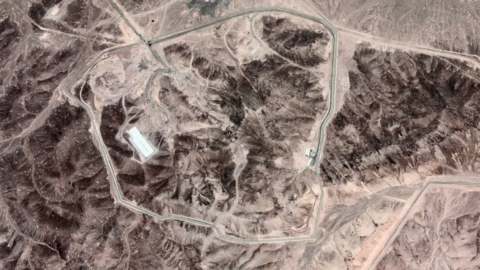
in bowels of the mountain of Kuh-e-Dokhtar, almost 90 meters of depth and 20 kilometers from the holy city of Qom, one of the most coveted military objectives, and so far untouchable, of the war broke out between Israel and Iran on the night between 12 and 13 June 2025: Fordow Nuclear Site.
Built in secret by the Revolutionary Guards e revealed only in 2009, after the denunciations of Western intelligence, the Fordow site is much more than a simple technical plant. Located about 140km south of Tehran it has entered in operation at the end of 2011 and is a center for high-level uranium enrichment, designed to accommodate up to 3.000 centrifuges (currently has 2.700). It is the symbolic and strategic heart of the Iranian nuclear program, designed to withstand any form of attack, whether aerial, cyber or conventional weapons. Its very existence is one of the main reasons for the Israeli intervention, fueled by the fear of a nuclear aggression by Tehran.
The Impossible Challenge for Israel: Hitting Fordow
Ma Fordow is no easy target, despite the continuous bombing. While Israeli forces have already Natanz and Isfahan plants attacked, Fordow (at the moment) he remained unharmed. Its defenses, compact rock, reinforced concrete, access tunnels, make it virtually impregnableThe International Atomic Energy Agency (IAEA) confirmed that the explosions nearby did not damage the main structure.
Israel has bunker buster bombs like the GBU-28, but they are not sufficient to reach similar depths. The only weapon capable of doing it and the GBU-57/B Massive Ordnance Penetrator (Mop), a 13-ton device capable of piercing layers of rock and concrete before exploding. But it is an exclusive weapon of the US Air Force, never shared with allies.
The Gbu-57/B Mop, the super bomb that could annihilate Iran's nuclear program
Il Massive Ordnance Penetrator is a 13 ton bomb designed to drill through layers of concrete and rock before blasting deep below ground. Designed for highly fortified targets like Fordow, is transportable only by B-2 Spirit stealth bombers, also in exclusive endowment to the United States.
The Gbu-57/B Mop it has never been used in combat, but it represents a key element of the American deterrence against underground nuclear facilities. Its possible use against Fordow would signal Washington’s direct involvement and could transform the conflict into a full-scale regional clash.
Beyond the Bombs: Fordow's Resistance
In the past, Israel has Iran's nuclear program thwarted with covert operations and cyber attacks, as the famous Stuxnet virus of 2010. Today however Fordow is physically isolated from the internet and under military surveillance. Even the path of cyberattack therefore appears impracticable.
While not Iran's largest nuclear facility, Fordow is the most protectedIt was conceived for ensure residual nuclear capacity even in the event of a devastating attack. An infrastructure reduced to the essentials, but armored like a command bunker.
According to a May report by the IAEA, Iran has more than 400 kg of uranium enriched to 60%, close to the military threshold of 90%. At Fordow, uranium has already been detected particles enriched up to 83,7%.
Will the United States strike Fordow?
With the war underway, international attention is therefore focused on two unknowns: the next US moves and Fordow's fateIn a speech broadcast on state TV, Iran's Supreme Leader Ali Khamenei he issued a direct warning: “We will never give up. Any US intervention will cause irreparable damage,” he said. ultimatum "unacceptable" sent from Washington. The American president's reply was also harsh Donald Trump"I've lost my patience. Iran must surrender unconditionally. It's too late to negotiate." And when asked if it was a definitive ultimatum, he replied: "You could say that. Good luck." A verbal escalation that fuels suspicions of an imminent attack by the United States against the heart of Iran's nuclear program. According to Kelsey Davenport, analyst at the Arms Control Association, “destroying facilities like Fordow is beyond Israel's reach without direct U.S. assistance.” But an American intervention would risk set the entire region on fire, triggering a chain reaction by pro-Iranian Shiite militias.
A complicate further the painting is the geographical position of the site: Fordow is located near Qom, one of the most important spiritual centers of Shiite Islam. A bombing that hit civilians or religious places could transform the conflict into a religious war, with unpredictable consequences.
Today Fordow is more than a military target: it is the symbol of the Iranian regime's determination to defend its nuclear ambitions and its strategic survival. As long as it remains operational, it will continue to represent a sort of insurance policy for Tehran. And that is precisely why remains the number one target. But the key question is only one, will the United States, or rather, Donald Trump, really want to hit Fordow? And above all, will they be able to do so without unleashing a storm that will engulf the entire Middle East?