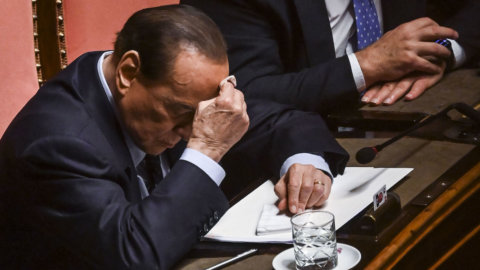
In a few days for at least four large groups of Italian capitalism a lot has changed and who knows what will happen. Before the disappearance of Silvio Berlusconi, then the adoption of the Golden Power for Pirelli, therefore the setback of the Italian management of Tim to the French of Vivendi, finally the growing political and trade union pressure on Stellantis because the Italian interest is protected with the entry into the capital of the Status through CDP. Fortunately, Italian capitalism does not end with these four large groups and the growth of medium-sized family businesses together with that of large public groups, without forgetting banks and insurance companies, has progressively changed their nature. But there is no doubt that the future of Fininvest and above all of Mfe, as the European company that brings together Berlusconi's TVs is now called, that of Pirelli under Golden Power, that of Telecom Italia (today Tim) grappling with the sale of the network with the dissent of its first shareholder (Vivendi) and that of Stellantis, overlooked by a variegated frond stormir, are a crucial passage that will hardly leave everything as before.
Fininvest: what will Silvio's will say and who will have the majority?
The spotlights are obviously concentrated on Silvio Berlusconi's will, on the distribution of his huge assets and above all on the effects on the shareholding structure of Fininvest, the holding company led by Marina Berlusconi which controls the shares in three listed companies: 47,9% of Mfe (Mediaset for Europe which collects the shares in TV, in Mediaset first of all, but also in Mediaset Espana and in the German Prosiebensat), 53,3% of Mondadori and 30% of Banca Mediolanum. Silvio Berlusconi held 61,21% of Fininvest in which both Marina and Piersilvio Berlusconi - the first married children - each have 7,65% of the capital and Barbara, Eleonora and Luigi - the second married children from Veronica Lario - 21,4% divided into three equal shares. Berlusconi never said how his 61,21% would be distributed: equally among his five children or not? If the division were in equal parts and not counterbalanced by other assets of the estate, the majority of Fininvest would end up in the hands of the 3 second-married children who could hold 58% of the capital, i.e. the majority of Fininvest against approximately 40% of the 2 children of first marriage who currently have the most important operational positions. Until now, Berlusconi's five children have always gotten along well and it is likely to think that Silvio had his notaries prepare his will with care to avoid shocks in society, but until the contents are known there are no absolute certainties and the stock market awaits with trepidation.
Pirelli: what will the Chinese do in the face of the Golden Power?
Before the opening of the Stock Exchange on Monday morning, the Government will announce the complete terms of the Golden Power rule which it intends to apply to Pirelli to protect Italy's interests vis-à-vis Chinese shareholders of ChemChina who hold 37% of the tire company. The law does not provide for the freezing of the shares of the Chinese, as the market assumed, but places severe limits on access to sensitive data and establishes that a majority of 4/5 of the board of directors is required for strategic decisions. The recourse to the Golden Power stems from the need to protect Italian interests and to curb the growing invasiveness of the Chinese shareholders in the management of Pirelli in the hands of Marco Tronchetti Provera and the Italian management. But there are two unknowns: 1) how will the Chinese, who hold 37% of Pirelli and are the leading shareholder, react to the restrictions imposed by the Italian government? Will they play well with bad luck or will they think of selling their stake? With what final consequences on the shareholding structure of Pirelli? 2) what connection is there – because it is impossible to ignore it – between the Golden Power in Pirelli and the Silk Road, which the American administration does not like but on which the Italian Government still has one year to decide what to do and to understand how to protect the interests of Italian companies in China?
We will understand it by living but it is clear that we are faced with unknown factors of the first magnitude for Italian capitalism but also for the State.
Tim: how will Vivendi's French react to Labriola's slap and the sale of the network?
The third large group in the spotlight on the Stock Exchange and beyond is Telecom Italia (today Tim), the first Italian telecommunications company that is trying to sell its network to get out of the perfect storm that torments it between high debt, unbridled competition and the need for large and expensive investments. For CEO Pietro Labriola, the only way out is to sell NetCo (i.e. the network plus Sparkle) and reorganize the company, but the French of Vivendi, who are the first shareholder of the company with their 23,7%, oppose because they believe that the two offers received so far – that of the American fund KKR and that of the CDP-Macquarie consortium – which are around 20-21 billion euros are insufficient. The French would like the company to collect at least 31 billion from the sale of the network: a value absolutely above the estimates of all analysts but which would compensate for the losses of 3 billion accumulated by the disastrous Italian campaign of Vivendi which threatens to resort to an extraordinary assembly of Tim to prevent the sale of the network and overturn the balance at the top of the company. However, Labriola showed courage and, after listening to the French, went straight by rejecting their candidate to join the board to replace Arnaud de Puyfontaine, right-hand man of Vivendi's owner, Vincent Bollorè. But it has not escaped anyone that Labriola has moved with determination also because he found the Chairman of Tim, Salvatore Rossi (former General Manager of the Bank of Italy) and the Chairman of the Cassa Depositi e Prestiti (Cdp, which holds 9,9% of Tim), Giovanni Gorno Tempini, who has certainly moved in harmony with the guidelines of the Government. What will Vivendi do now? We will know soon but the Government's appeal to the Golden Power for Pirelli is an unequivocal warning.
Stellantis: the desire for the state that runs through the unions, political forces and perhaps Meloni
The fourth group on which the spotlights of the Stock Exchange, the Government, the trade unions, political forces and public opinion are focused is Stellantis, the large multinational car company born from the merger between Fiat and the French PSA. The widespread belief is that, beyond the equity balance (14,4% to Exor, 7,2% with an option to 8,5% to the Peugeot family and 6,2% to the French state) and the presidency entrusted to John Elkann, the center of gravity of the group has moved towards France and that this could penalize the Italian factories and the activities of our automotive supply chain. This is why a composite frond is coming to the surface, made up of companies in the automotive sector, parts of the union and the left but also the right, which are advocating the entry of the CDP into the capital of Stellantis to protect Italian interests. A somewhat national-populist vision already rejected in recent days by Elkann ("States enter companies when they are doing badly but Stellantis is doing very well") but which is getting stronger, as Stefano Cingolani highlighted in an editorial yesterday on the Foglio, significantly entitled “Everyone against Elkann”, which states: “The siege (Ed on Elkann) has lasted for some time, but it has never been so pressing”. But why? "Retaliation against Elkann, revenge towards the "flight" of Fiat, xenophobic and national-populist campaigns"? Cingolani recalls that during the electoral campaign both Meloni's party and the League toyed with the idea of countering Elkann by allowing the CDP to enter the capital of Stellantis. But what does the prime minister think now, perhaps annoyed by the decidedly anti-government line of Elkann's newspapers? Wise conclusion of Cingolani who asks: "Isn't it better to shrug the headlines of the Republic and think about the nation?". Of course it would be better to think about investments and reforms rather than revenge with taxpayers' money. But of tomorrow there is no certainty.