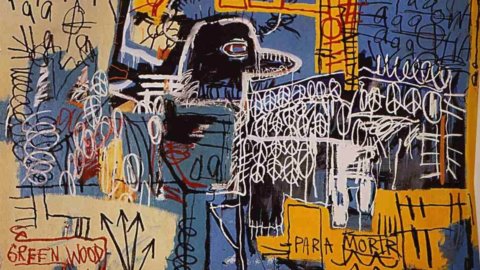
After Milan, almost thirty years after his death, Rome also pays homage to the last of the great maudit geniuses of the international art scene of the last century, that Jean-Michel Basquiat (1960-1988) who managed, in his short existence, to bring Street Art at the level of masterpieces universally recognized by the world's largest art galleries.
And to understand what we are talking about in economic terms, it is enough just to think that one of his works, «Untitled» from 1982, was auctioned by Christie's in New York for 57,3 million dollars (the same canvas 12 years earlier had made a sensation for being sold for $4,5 million at Sotheby's in London). A mind-boggling figure for a former graffiti artist but not an isolated episode since in 2015 72 works by Basquiat were sold for 132,3 million dollars.
The short but incredible parable of this artist, nicknamed the black Picasso, who upset the artistic language of the cultural scene of the 80s, takes place over ten years to end tragically at the age of 28 due to a heroin overdose.
"Dad one day I will become very, very famous." She predicted it and kept her promise. Basquiat had this urgency, the urgency of the sign, of the gesture, of the colour, the irrepressible need to draw, to be an artist. And precisely the walls of New York will be, at the beginning of his career, the canvases on which he will engrave the distinctive and indelible features of his art, walls skilfully and artfully chosen near the most renowned galleries.
Appearing under the pseudonym of SAMO, Basquiat begins with graffiti to become just twenty years old, one of the most famous and celebrated rising stars in the art world. The artists of Soho and TriBeCa became aware of him through his mysterious street poetry, with a vague situationist ancestry, which brings to mind real puzzles. At that time, in the late seventies, he attended the City-as-School, and signed himself SAMO, "The Same Old Shit", the meaning of which was in a typical phrase used in student circles.
Samo's real explosion came in the spring of 1978. His writings, adorned with the copyright symbol, a stylistic element that he will keep in his works from the eighties, began to capture people's attention and strike the imagination.
The "SoHo News" began publishing photos of them. His poems, collected in notebooks, later published by the publisher Larry Warsh, written together with the other young writers on the walls of the streets or subways with a black marker, contain often contracted and obscure verses, syncopated protests, existential declarations, which attest a continuous flow of thought and are the most immediate means to be in the world and to make the world notice him.
Graffiti, artfully distributed even near emerging galleries, such as hand-painted t-shirts and postcards, initially expedients to survive, gradually lead him to the awareness of wanting to be an artist.
His works draw on the most disparate sources, his expressive means create an original and incisive artistic language that points to a very harsh critique of the structures of repressive power and racism. Proud of his African-American origins, Basquiat instills in his works that dramatic character, that energy and that determination of social protest that will pave the way for future generations of black artists.
Basquiat's artistic production synthesizes abstractionism and neo-expressionist figurativism, his feverish and incessant research produces works with a visceral, material, tribal trait. He uses painting, but above all writing, a constant presence in his works, which often constitutes the fabric. Basquiat used and transformed words in context as graphic signs and signifiers as verses that resonate to the rhythm of his inner beat.
The street kid who runs away from home to escape from an abusive father will soon climb all the peaks of fame artistically linking himself to Andy Warhol with whom he had an extraordinary and particular intellectual understanding, John Lurie, Arto Lindsay, Keith Haring and even Madonna .
The exhibition set up in the spaces of the Chiostro del Bramante displays about 100 works including acrylic oils, drawings, some important collaborations with Andy Warhol, screen prints and ceramics, works created between 1981 and 1987 or in a period of time in which almost all the turbulent and painful artistic and existential parable of Basquiat.
In February 1985, the "New York Times Magazine" dedicated the cover to the artist and a long article entitled New Art, New Money: The Marketing of an American Artist which focuses its attention on the role of the media in creating the myths, the weight of marketing and critically evaluate the quality of the artistic production of all those years.
It is the apogee of Basquiat's fame. But, dramatically, his rise unfortunately coincides with his rapid decline, now inevitably corroded by a compulsive and unstoppable use of hard drugs.
The exhibition produced and organized by DART Chiostro del Bramante and Gruppo Arthemisia in collaboration with the Mugrabi Collection and curated by Gianni Mercurio will remain open until 2 July.