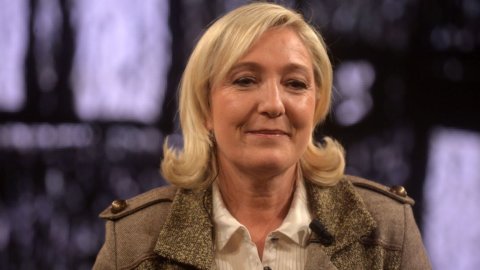
It is a long list of high-sounding names, some better known to the general public, others less so, that of the 25 economists and Nobel laureates who signed on April 18, on the front page of Le Monde, a clear stance against Marine Le Pen and the instrumental use she is making of their economic theories for the purposes of the electoral campaign for the presidential elections in France. Among the best known to have taken the field are the Indian Amartya Sen, the Americans Joseph Stiglitz and Robert Solow, the Anglo-Cypriot Chris Pissarides.
The vote for the first round will be decided on Sunday 23 April but in the meantime the political battle is raging and it is precisely on the anti-European and protectionist tones on which the candidate of the far right relies that the 25 Nobels have wanted to go on the attack and mark a clear and unequivocal distance. In this sense, the appeal serves as a warning not only to French politicians but to all those in Europe or the United States who are riding the populist wind and discontent, a syndrome from which Italy is by no means exempt.
So what do the 25 Nobel Prize winners say? “Some of us – they state in their open letter to Le Monde – have been cited by candidates in the French presidential elections, this is the case of Marine Le Pen and his team, to justify a political program on the question of Europe. The signatories of this letter have different positions on complex issues such as monetary union and recovery policies. However, our opinions converge in condemning this instrumentalization of economic thought in the context of the French electoral campaign".
With this premise, the 25 economists indicate 7 issues that dismantle Le Pen's program:
– “European construction is of paramount importance not only for maintaining peace but also for the economic progress of the member states and for their political power in the world;
– the evolutions proposed in the anti-European programs would destabilize France and call into question the cooperation between European countries which today ensures economic and political stability in Europe;
– isolationist and protectionist policies and competitive devaluations, all conducted at the expense of other countries, are dangerous means of trying to generate growth. They lead to retaliatory measures and trade wars. Ultimately, they will prove detrimental to both France and its trading partners;
– when migrants are well integrated into the labor market, they can be an economic opportunity for the host country. Many, among the most prosperous countries in the world, have been able to welcome and integrate emigrants;
– there is a big difference between choosing not to participate in the euro in the first instance and leaving it after adopting it;
– it is necessary to renew social justice commitments and indeed to guarantee and develop social equity and protection, in line with France's traditional values of liberty, equality and fraternity. But this social protection can and must be achieved without economic protectionism;
– as Europe and the world face unprecedented trials, more solidarity is needed, not less. The problems are too serious to be left to divisive politicians."
The signatures of:
Angus Deaton (Princeton, Nobel prize in 2015), Peter Diamond (Massachusetts Institute of Technology, 2010), Robert Engle (University of New York, 2003), Eugene Fame (Chicago, 2013), Lars Hansen (Chicago, 2013), Oliver Hart (Harvard, 2016), Bengt Holmstrom (MIT, 2016), Daniel kahneman (Princeton, 2002), Finn Kydland (Carnegie-Mellon, 2004), Eric Maskin (Harvard, 2007), Daniel McFadden (Berkeley, 2000), James Mirrlees (Cambridge, 1996), Robert Mundell (Columbia, 1999), Roger Myerson (Chicago, 2007), Edmund Phelps (Columbia, 2005), Chris Pissarides (London School of Economics, 2010), Alvin Roth (Stanford, 2012), Amartya Sen (Harvard, 1998), William Sharpe (Stanford, 1990), Robert Shiller (Yale, 2013), Christopher Sims (Princeton, 2011), Robert Solow (Columbia, 1987), Michael Spence (Stanford, 2001), Joseph Stiglitz (Columbia, 2001), Jean Tyrol (Toulouse School of Economics, 2014).