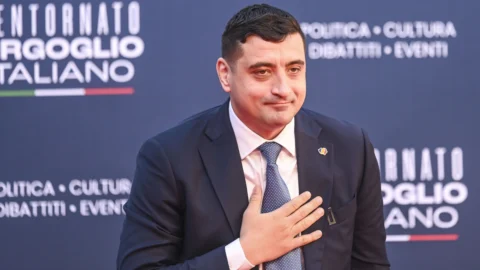
It is a Romania deeply divided that is preparing to choose the next president. If the first round of presidential elections is a reliable indicator, a significant part of the electorate today looks less to Brussels and more to Moscow. George Simion, leader of the nationalist party of far right Aur (Alliance for the Union of Romanians), obtained 40,5% of the votes, clearly distancing all the other candidates. A powerful result, built on the long wave of popular discontent and fueled by an aggressive, identity-based and skillfully orchestrated campaign on social media. But the game is far from over: in the May 18 runoff he will deal with Nicusor Dan, independent mayor of Bucharest, who collected 20,7%, narrowly beating Crin Antonescu, candidate of the government coalition, who stopped at 20,3%. Former prime minister Victor Ponta, also independent but with nationalist positions, obtained 14,6%.
Second presidential election in six months
Sunday's election was not like any other. It is the second time in a few months that Romanian citizens are called to vote, after the Supreme Court had annulled last November's elections for serious irregularities and suspected Russian interference. The one excluded from the new competition was Calin Georgescu, the ultranationalist outsider who won in the first round in 2024 with the explicit support of Moscow. Today Georgescu is under investigation and his re-candidacy has thus been rejected.
An expected result, but with disruptive effects
That Simion would have arrived first it was expected. But the extent of his success – over 60% among diaspora voters – has surprised even the most cautious observers. His party, Aur, is already well established in Parliament and is part of the European Conservatives and Reformists group, alongside Brothers of Italy. The 38-year-old leader has built himself aeffective image: nationalist, anti-elite, eurosceptic. With 1,3 million followers on TikTok and a vast network on Telegram – where pro-Russian accounts abound – he became the face of popular resentment.
During the campaign he slightly softened his tone, trying to attract centrist voters as well, but he maintained his narrative: the Romania as a victim of foreign forces and of a “servile” political class.
“My dear brothers and sisters here and everywhere, together we made history today. We are approaching an exceptional result, far beyond what the system's televisions present to us, which so far have only known how to foment division, spread venom and distort everything we have said... Today the Romanian people have spoken! It's time to make themselves heard!” he said on social media after the victory.
Nicușor Dan, moderate hope
Nicușor Dan's campaign was of a completely different nature. Sober, rational, supported by writers, artists and intellectuals concerned about the rise of extremism. his program, Entitled Honest Romania, focuses on administrative transparency, institutional reforms and full European integration. A 55-year-old mathematician and former anti-corruption activist, Dan He will now have to convince the abstainers and mobilize the moderate, pro-European and civic camp, in view of the second round.
A Country Divided: Between Pro-Russians and Pro-Atlanticists
Even though Calin Georgescu was not in the running, his spirit hovered over the vote. Simion not only took up his electoral and ideological legacy, but showed up at the polling station right next to him, as if to seal a symbolic handover.
The confrontation between Simion and Dan is emblematic of a political and cultural fracture that crosses Romania and the whole of Eastern Europe. Simion embodies identity populism: anti-vax, pro-Russian, hostile to Ukraine, nostalgic for a “traditional” order. Dan represents the reformist and pro-Western, pro-European and civic face. It is the Romanian version of the clash between liberal democracies and illiberal drifts that can be observed from Budapest to Warsaw.
A Romania in deep crisis
The success of the far right cannot be explained only by the strength of its communication or the weakness of its adversaries. It is the reflection of a deep social and institutional crisis: persistent inflation, economic stagnation, growing inequality, distrust in institutions. The anti-establishment narrative has found fertile ground, as in Slovakia, Bulgaria and Hungary itself.
The vote showed a Romania divided between past and future, between attraction to authoritarian models and desire for democratic change. After the Georgescu case, Simion's success marks a new breaking point.
The decisive battle on May 18th
Le The next two weeks will be crucial. Nicușor Dan will have to consolidate a heterogeneous front of pro-Europeans, moderates, environmentalists and liberals. Simion instead will try to consolidate his advantage, accrediting himself as the only interpreter of the “betrayed people”.
Europe's eyes are on Bucharest: the outcome of the runoff could redraw the relationship between Romania and the European Union, with knock-on effects on the entire region.