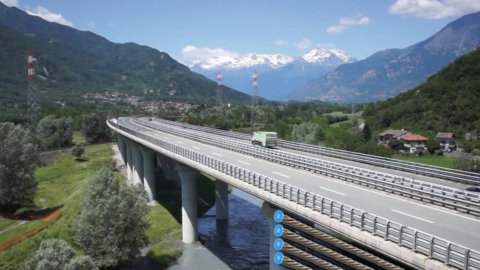
The European system EISAC.it (European Infrastructure Simulation and Analysis Centre) for the control of extreme events that threaten public works, makes its debut in Italy. Although conceived to be applied in all EU countries to guarantee territorial and environmental safety, only in these groups does it start in Italy thanks to ENEA, the National Institute of Geophysics and Volcanology (INGV) and the Ministry of Infrastructure and Sustainable Mobility (MIMS).
The three organizations have signed an agreement to make it operational throughout the country. Thus Italy will be the first country to manage an integrated risk monitoring system of critical infrastructure. The agreement signed by Mario Nobile, Director General for Digitization of MIMS, by the President of ENEA, Gilberto Dialuce and by the President of INGV, Carlo Doglioni it will use highly advanced technologies that can enhance the safety of roads and railways.
Unfortunately, the connection with the tragedy of the Morandi Bridge in Genoa in 2018 does not escape, which perhaps could have been avoided with these systems. It is clear, however, that Italy, which is on its way to the ecological and digital transition, has needed to implement actions of this type for some time now. Fortunately, others are also moving towards maintenance institutions and banks both locally and centrally. Certainly, Minister Giovannini said, “innovation and digitization are valid allies to create an infrastructural system that is increasingly secure”. We will not think only of traditional infrastructures, but of a real info-structure that will allow, through data, to continue on the path of resilience and the digital and ecological transition. A map to understand extreme natural events connected to the entire transport and mobility system exposed to fires, earthquakes, floods, climatic criticalities. On the other hand, the European program with the EISAC.it was born for this.
Collaboration with management bodies
The organizations will work in harmony with ANAS, RFI and with all the private operators under concession. Everyone will have it available the data to also study wear and tear. For two partner organizations of the Ministry, the task is somewhat easier. ENEA, for example, already develops models and analysis systems for electricity, water and gas, telecommunications networks. “We are also developing decision support systems, simulation models of adverse events, effective countermeasures to reduce their impact and efficient crisis management” adds Gilberto Dialuce. As for INGV, its mission is precisely to keep seismic, volcanic and tsunami risks under observation.
Lowering risks in the sign of the digital transition
Among the relevant points of the memorandum of understanding, there is also the management and use of the National Register of Public Works (AINOP), with seismic, hydraulic, hydrogeological and meteorological data. The Registry will be at the center of the new safety management system both as a recipient of the information that will be acquired on the works, and as a supplier of data to lower the risk. Fabio Pistella, who will have the task of coordinating the activities of ENEA and INGV, explains that when we speak of infrastructure we refer to a "one fully interconnected system for which it has become necessary to prepare systemic and no longer vertical protection measures. In this regard, ENEA will provide the platform to support operational decisions to mitigate all types of environmental, climatic and structural risks.