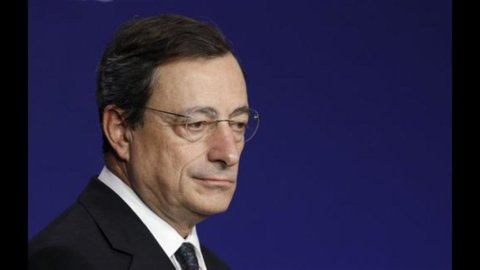
“In the Eurozone, the risks of a slowdown on the economic outlook have increased”. This was the warning issued in the morning by the new president of the ECB, Mario Draghiduring a conference in Frankfurt. The central banker expects activity to “weaken in most advanced economies. This derives from a weakening of various components of demand aggregates, both domestically and abroad. And this is evident both in the surveys and in the more concrete macroeconomic data”.
For this it should strengthen the state-saving fund (EFSF) as soon as possible through financial leverage: “Four months have now passed since the summit which decided to make available the volumes on the EFSF's guarantees on emissions – added Draghi – and four weeks have passed since the summit which decided to strengthen its resources through recourse to financial leverage in ratio of four or five, declaring that the EFSF would be fully operational and that its tools would be fully utilized to ensure the financial stability of the Eurozone. Where is the implementation of these long-established decisions? We shouldn't have to wait any longer".
In any case, the primary objective of the Eurotower remains that of "guaranteeing price stability", making its decisions "in full autonomy". As for the policies that individual countries should set up to ease market pressure, Draghi underlined that the recovery of credibility implies "high social costs", but both the "solid" public finances of the Eurozone countries and the structural reforms of their economies are "crucial" for financial stability. Furthermore, according to reports from Dow Jones, Draghi would have reiterated that the European Union needs common rules on economic governance that are "much more robust".
The Eurotower number one then said he was "aware" of the financing difficulties that banks are experiencing in the euro area. In the ECB there is also awareness of the problems deriving from the differentiation of the maturities of various balance sheet items of the banks, while these find themselves having to increase their capital levels in the midst of a negative phase of market tensions.
A picture that is reflected in the sector of interbank loans, where business “remains subdued and focused on short-term maturities”. This is reflected in the recourse that banks make to refinancing from the ECB and the deposits they leave in custody with the institution.
To prevent banks from running into problems with short-term refinancing, "the most important non-standard measures - said Draghi - are the refinancing auctions at fixed rates and with full allocation of the requests received". In addition, the ECB, through agreements with the US Federal Reserve, also ensured three auctions of refinancing in dollars.
According to Draghi, the principles to be followed in monetary policy are “continuity, consistency and credibility. Continuity primarily refers to our goal of ensuring price stability. Consistency means acting in line with our primary mandate. Credibility means that our monetary policy manages to anchor general inflation expectations”.