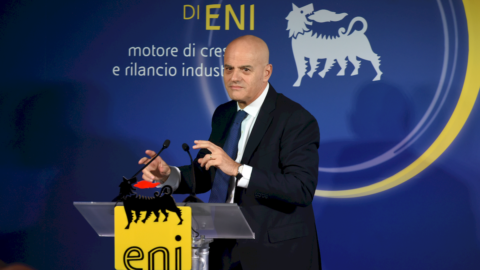
“What we are experiencing is something that has not been experienced in the last 4 energetic cycles, in the sense of since the early 80s. We are experiencing a crisis that did not start now and has resulted in the Persian Gulf crisis. but in the last 5 years we had Covid, and on that occasion the world used the strategic reserves as it is doing now”, then the war in Ukraine and “this third episode, in the Middle East, and still today About 9-10 million barrels of crude oil alone are blocked and I'm not talking about products." This was stated by the CEO of Eni, Claudio Descalzi, in a hearing at the Chamber's Productive Activities Committee on Energy market in Italy and Europe"These events, which we're used to seeing one by one, like episodes, have occurred over the course of five years, and there has been no time or opportunity to recover. Production has been reduced, strategic reserves are being used at an even greater rate than the Covid situation, and the shortages have accumulated and have not been reabsorbed."
Descalzi, Russia and the aftermath of the war in Ukraine
“The tail of the Russia-Ukraine war will lead to a complete stop of gas arriving in Europe” and from January “we will have a supply problem and this will find us in a worse storage situation than last year. This is a concern for Europe which runs on gas”, Descalzi added, who then continued: “As regards thegas supply36 billion from Russia will have to be compensated by the United States or East Asia. This brings us to a further problem starting in January 2027: the aftermath of the war will lead to a complete halt in gas supplies to Europe. And this will leave us with a worse storage situation than last year. Not for Italy which is in line with last year at 71-72%, "It's all negotiated," but "there are European countries that are far below. For gas-powered Europe, it's a concern; for nuclear-powered Europe, like France and partly Spain, it's less of a concern, even though every country still needs to be stable," he added.
Descalzi and the price alarm
Descalzi then continued: “We are in a situation, from an energy point of view, that obviously the price has not yet certified as a major problem because approximately 400 million barrels of reserves have been used, for OECD countries, which have been released onto the market and this has allowed prices to be kept in a range between 90 and 100 dollars”.
And then: “With the signing of the agreement there was a drop to $68"Now we're back to 85," Descalzi said, "obviously because there wasn't any positive follow-up to that signature. Not a single ship has passed through the Strait since the 11th, so there's a new blockade. This changes the order of things, it changes it for Europe, and in this case it changes it more globally."
Descalzi added that "when everything, I hope soon, is over the risk attributed to this area will be completely different, risk means a lot because it means a higher cost of money, especially for insurance, and a very different focus on investment than before. This applies not only to these areas, but all these areas that are closed off by straits, but also for the Red Sea, because in any case there is always the possibility that these restrictions will be used as an increase in blackmail or as an increase in demand to obtain something, and that is what is happening".
Descalzi: There is a shortage of diesel and jet fuel.
"Right now there is a lack of raw, not so high, but an extremely high lack of products, especially for an important market like the European one because Europe has abandoned a lot of refining capacity and therefore our problem is that we import products", declared the CEO of Eni, underlining in particular that there is a shortage of diesel and jet fuel “of which there was a shortage before, but since access to the Russian market was closed, about 60-65% came from the Emirates and in this case the ones compensating now are the United States whose refineries are working at maximum capacity”.