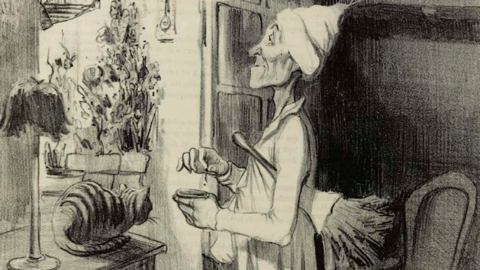
If there is no evidence of a link between Balzac and Daumier, everything suggests that their paths crossed in newspaper rooms and with the publishers with whom they regularly collaborated. This closeness has been underlined several times, in particular by Charles Baudelaire who wrote "the true glory and true mission of Gavarni and Daumier was to complete Balzac, who moreover knew it well, and I esteemed them as auxiliaries and commentators". Goalies, stream jumpers, grisettes, cooks, clerks and small tradesmen thus find a large place both in the Comédie humaine and in Daumier's engraved works. Here as there, observation highlights the defects, the pettiness and the ridiculous, without too much indulgence but with profound care for humanity. The exhibition offers, in the same house occupied by Balzac from 1840 to 1847, around sixty engravings by Daumier but also some of his paintings, thus offering a new dialogue to two works that respond and complement each other. To enrich and update these Parisians' points of view, the route also features drawings by several contemporary caricaturists and illustrators.
Caricature or description?
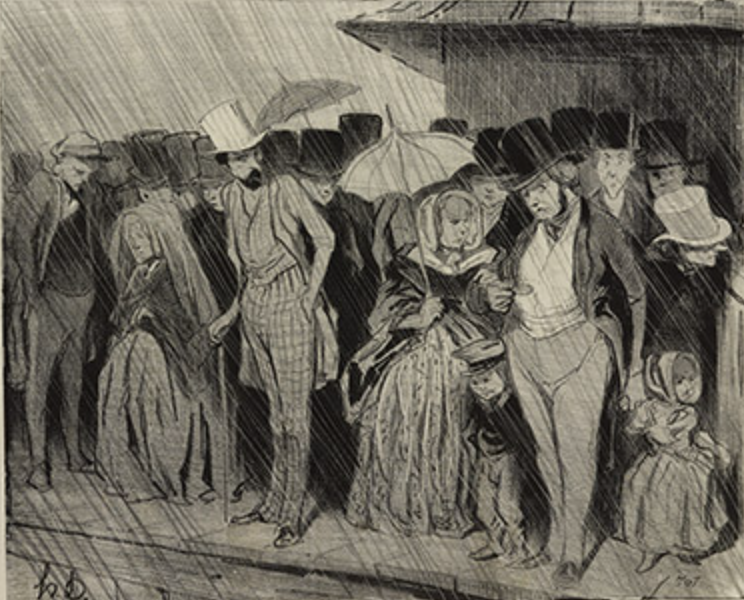
The first part of the exhibition highlights Balzac and Daumier's interest in social classification and the accuracy of their analyses, still relevant, of the daily life of Parisians: uncertainties of urban transport, surprises of nightlife, management of pets or quality random of restaurants.
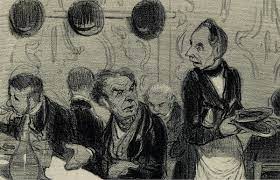
With the Comedie humaine Balzac proposes a classification of "social species" comparable to the work carried out on plants and animals in the previous century. The descriptions that open the novels thus establish types, that of merchant, notary or small income, characterized by an accessory, attitude, expression. These “social markers” – the term did not exist – lead, consciously or unconsciously, to categorize the people encountered, to establish their first impression. Such a process is a caricature and is in this respect similar to Daumier's drawing. With a light and humorous tone, the caricatures and Daumier's descriptions of Balzac they are thus compared.
Parisians of yesterday or Parisians of today?
The exhibition also presents contemporary perspectives on Parisians drawn by today's designers. This part underlines that if Parisians have changed, the glasses worn by Daumier and Balzac still allow us to observe and understand today's society. The drawings of Belom, Coco, Fabrice Erre, Faro, Foolz, Gab, Didier Marandin and Robabée are presented here.
The strong spiritual bond between Daumier and the novelist
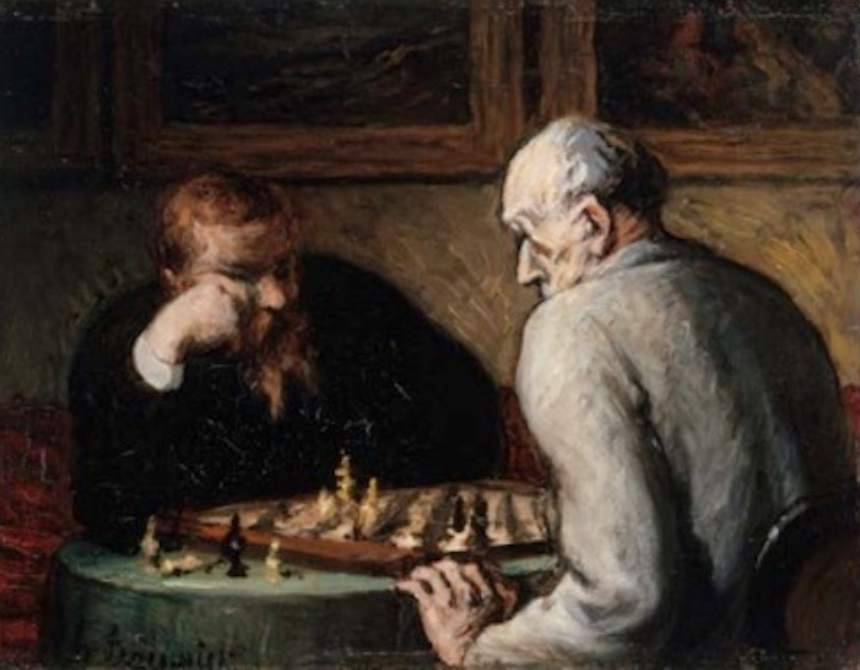
Beneath the caricature, the human Finally, a choice of paintings reminds us that, if Daumier is a great caricaturist, his little-known and rarely exhibited works during his lifetime bear witness to the great psychological depth of his art. In the same way Balzac, if he is sensitive to the importance of first impressions, knows how to explore the human heart. The characters of the Human Comedy are characterized by their humanity. Even the most distinguished characters embody neither perfection nor absolute evil. Certain figures thus reach unparalleled psychological depth. In Daumier, psychological complexity hardly appears in lithographs but imposes itself in his paintings. These latest productions served by a quality of material, construction and color that evokes the old masters (Rubens, Greuze, Fragonard, etc.), testify to a great empathy with the models and a humanity connected to the universal.The small urban inhabitants of Daumier are therefore similar to the peasants represented by Jean-François Millet: the same weight of the figures curved towards the ground, the same depth of the human being, isolated in his thoughts.
© Paris Musées / Petit Palais
On the occasion of this exhibition, an album will be published which will present around forty engravings by Daumier corresponding to Balzac Quotations.
The exhibition is open until March 31, 2024 – MAISON DE BALZAC – 47, rue Raynouard – 75016 Paris
Cover photo: Honoré Daumier, La journée du célibataire (details), lithographie, 34 x 24,5 cm © Paris Musées / Maison de Balzac