La common currency between Brazil e Argentina does it really make sense?
This is it question that they are setting economists around the world, after theidea thrown by ministers of the economy of the two countries and taken up by the Financial Times, which even wanted to see in it the suggestion of a "South American euro".
In reality the "On" (this is the possible name of the virtual currency) it will be none of this, as those concerned have already hastened to clarify: the peso and the real would remain in force and would not be surpassed by the common currency, which would therefore only serve to regulate trade between the two countries (grew in 2022 to $26,4 billion as of November), bypassing so the exchange for the dollar, which is still the reference currency in South America and which especially penalizes Buenos Aires.
Sur: Argentina plus Brazil's interest in the single currency
And that is precisely why among the experts skepticism prevails: the motion it wouldn't help more than that to Brazil, which has astable economy and an exchange rate with the dollar at about 5,2, while 184 Argentine pesos are needed to buy a dollar at the official exchange rate, which becomes almost 400, more than double, at the parallel exchange rate.
it is therefore theArgentina to have more interest in the operation, which on the part of Brazil seems more like a political move by Lula to give an assist to his friend and counterpart Alberto Fernandez in view of next autumn's elections. The "Sur" would give public opinion the hope of a partial economic recovery and the containment of inflation, which closed at 2022% in 95, the worst figure since 1991.
Il Brazil for his part, he claims the project (which is not even new, it has been talked about since the XNUMXs and still recently under Bolsonaro) by focusing on the narration of a greater economic integration of Latin America, also as a shield against geopolitical tensions: "In times of war, emerging countries are more exposed due to the fragility of their currencies", wrote the Brazilian Economy Minister, Fernando Haddad, speaking on the Folha de Sao Paulo.
Sur: boomerang risk
Some economist though, like Samuel of the Fundaçao Getulio Vargas, one of the major academic institutions in Brazil, sees us the boomerang risk: “In this way theArgentine economy it will depend more and more from the Brazilian one, just as Buenos Aires has so far been in the hands of the International Monetary Fund. In the public eye the Brazil could become the new IMF and the relations between the two countries paradoxically worsen”.
Of course it's not this one the intention of two countries which in addition to solid trade relations (Argentina is Brazil's third trade partner after China and the USA), now also share the same political color in government, in a phase in which almost all of Latin America has returned under the banner of progressivism, albeit with contrasting nuances and results.
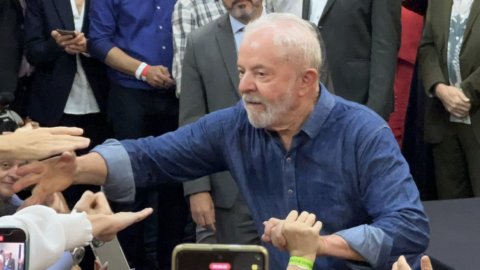
If in fact the return of Lula promises relaxation in international relations even outside the area (will meet shortly Joe Biden and has just received the German president Olaf Scholz, receiving the promise of a 200 million euro loan for the Amazon), the same cannot be said of Peru where Pedro Castillo was deposed in a climate of military coup. Or of Chile itself, where the young socialist Gabriel Boric saw the new Constitution rejected via referendum, or of the Mexico of Lopez Obrador who has already made it known that of a possible common currency of South America he really doesn't want to know, as your country has no interest in freeing itself from the dollar and from relations with the USA.
Sur: how would the new virtual currency work?
The “Sur” would be issued by Banco Central Sul-Americano, with an initial capitalization guaranteed by the international reserves of the acceding countries and/or by a tax on exports outside the area.
According to economists, however, this operation, as well as unbalanced, it is also technically difficult, For same reasons for which it was complex in Europe to establish theeuro: “A major would be needed harmonization with two economies - Said Octavian Canute, former IMF and World Bank – who instead experience very discrepant realities. For example, Argentina's public debt relative to GDP is much higher than Brazil's, and Buenos Aires has no reserves. It would therefore be Brasilia that would have to guarantee them almost totally. Furthermore, we need harmonization at the tax level and above all greater freedom of movement of capital and labour, as Europe did with Shenghen”.
Economists: Mercosur must be implemented
Il Mercosur, the free trade area of South America, is instead a partially creature unfinished. In addition to not having a common currency, it still imposes tariffs on dozens of product categories and limits on the mobility of workers and businesses. That's why many economists, rather than a common currency, suggest theimplementation of Mercosur in all respects, especially through agreements multilateral trade, such as the one with theEuropean Union, which has been in the pipeline for some time and which Lula has promised to close within the first half of this year. The agreement, already ready on paper, is also eagerly awaited by our businesses: it would allow for better protect made in Italy from Italian Sounding and would make it easier to access contracts in Latin America, an area that already today represents the seventh market for theItalian export, for a value of almost 8 billion euros.