From the fifties he was in Rome, where he had the opportunity to witness various contemporary artistic researches, first through contacts with the Informal and then, in the following decade, witnessing the emergence of Arte Povera and Arte Conceptual. Also from these movements Maria Lai will draw an interest in the relationship with materials - both organic and linked to a pre-industrial civilization - and with the gesture understood as processuality, filtering these suggestions through an absolutely individual sensitivity.
Although the sixties were a period of intense collaborations, Maria Lai felt the emergence of an ever greater distance from artistic circles and a deeper closeness to the spheres of literature and poetry, through the attendance of authors such as Giuseppe Dessì, who played a fundamental role in the artist's training, making them rediscover the value of the legends and history of Sardinia. From this moment on, the relationship with the traditions of his land becomes central to the artist's work, in a conceptual framework of an anthropological matrix: in fact, alongside drawing, his production is enriched with subjects and materials close to a millenary and popular culture , as in the case of bread sculptures, in themselves a perishable and poor product, linked to everyday life and women's work.
During the seventies the artist also created a series of central works for the development of his language: the so-called "Frames”, works in which painting and sculpture meet and in which the millenary tradition of weaving opens up to new compositional potential. The very structure of the loom, the yarns and the arrangement of the warp and weft are all elements that the artist interprets and reworks with absolute compositional freedom, thus evoking the intimacy and daily care of a world of female gestures, and producing works in which abstraction and landscape, color and matter, gesture and composition blend together. As far as i Frames are three-dimensional works they rarely leave the dimension of the picture, as in the case of Sew up the world (2008), the work present in the Madre collection: in this, as in other works, the technique and tools of weaving are transformed into a formal language that ideally dialogues with the experiences of artists such as Anni Albers, Louise Bourgeois and Greta Bratescu.
Le Geography and Books are the series to which the artist has dedicated himself since the end of the seventies: in the case of the first, the story is organized around large compositions made with fabrics and embroideries that represent planets, geographies and imaginary constellations, while the Books represent one of the best-known aspects of the artist's production (who, in 1978, presented the now famous Scalp book at the Venice Biennale), of which the work The legend of the Sardus Pater (1990), exhibited in the Madre collection, is one of the most important specimens. Here the link between weaving, embroidery and writing becomes intense and profound, the echo of an ancient relationship that evokes the dawn of storytelling. Throughout Maria Lai's work, the gesture of weaving becomes a meditation conducted in solitude, an intimate reflection on the sense of community, history and tradition, the poetic attempt to reconstitute a link between an archaic past and a present in which memory and its transmission appear to lose value. The community, relational and memorial instance finds a summa in the artist's environmental interventions, as on the occasion of Connect to the mountain (Ulassai, 1981), a work-action that literally united an entire community through thin colored threads, commenting on which the critic Filiberto Menna wrote: "it was the whole town that reconstructed a network of relationships linking house to house, leading to door, window to window and above all person to person [...] here, art succeeded where religion and politics had failed to do the same...".
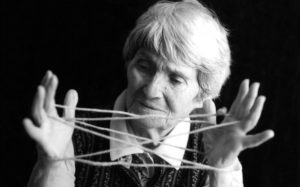
Maria Lai (Ulassai, 1919 – Cardedu 2013)
At the age of three her parents decided to entrust her to her uncles due to her poor health, and Maria would stay with them until the age of nine. After a brief return to Ulassai, he moved to Cagliari where he studied at the college with his sister Giuliana. In 1932 he enrolled at the Istituto Magistrale, where he will have Salvatore Cambosu as a teacher, with whom he will establish a deep and lasting friendship. In 1939 he decided to settle in Rome to study at the Liceo Artistico, where he followed the lessons of Marino Mazzacurati. In 1943, due to the war, he left Rome and moved to Venice to attend the Academy of Fine Arts with Arturo Martini. In 1945 he left Venice and after a short period in Verona he returned to Sardinia, to Cagliari, where from the following year he taught at the Women's Technical Institute until 1949. He exhibited several times in the Sardinian capital and in 1957 at the Galleria L'Obelisco in Rome under the curatorship of Marcello Venturoli. Until 1961 he will receive notable successes and recognitions both in Rome and in Sardinia. Then, for about ten years there will be a phase of silence: he continues to live in Rome but refuses to exhibit despite the constant stimuli of Marcello Venturoli, a great admirer of his work. In 1971 he returned to exhibit his looms in the Capital, at the Schneider Gallery. Thus a very prolific phase of her research begins again for the Sardinian artist: she exhibits in various museums and galleries and at the Venice Biennale in a group show curated by Mirella Bentivoglio. In 1981 he staged in Ulassai "Legarsi alla montagna", the collective performance with which he made himself known to the general public. In 1982 he created the Via Crucis for the church of Ulassai and with Costantino Nivola, Guido Strazza and Luigi Veronesi the "Lavatoio di Ulassai", which was completed in 1989. In 1983 he continued with interventions on the territory in Orotelli with "The poet's hive", a work dedicated to Salvatore Cambosu and "The defeat of the monitor lizards" in Camerino in the province of Macereata. Between 1992 and 1993 he created in Ulassai "The road of the ritual", "The sewn goats" and "The scarp". In 1993 he left Rome permanently and settled in Cardedu. In 1995 he began his collaboration with the theatre company “Fueddu e Gestu” with the performance “Maria Pietra”. From 1999 to 2001 he dedicated himself to the project for the Sabina oil museum in Castel Nuovo di Farfa. Since 2002 he has carried out various interventions in the Ulassai area: "Thoughts on art", "The wall of the tangle" (2004) and "The house of worries" (2005). In 2004 she was awarded an honorary degree in Literature at the University of Cagliari for the strongly narrative and conceptual trait of her work, which is however carried out with traditional, archaic techniques. On 8 July 2006 the Museum of Contemporary Art, the Art Station, was inaugurated in the old buildings of the former Ulassai station, with the donation of about 140 works by the artist, among the most significant of his career. From 2009 is "The capture of the wind wing" at the Ulassai wind farm. In 2011 he won the prestigious "Chamber of Deputies Award for the 150th anniversary of the unification of Italy" with the work "Footprints of laws". In 2012 he participates with his own space in Pulse "International Contemporary Art Fair" in Miami. He died in Cardedu on 16 April 2013.
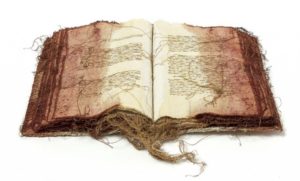
The sea needs figs, 1996
fabric and thread, 25,5×17,5×3,5cm,
photo: Pierluigi Dessi
Basket Market
For a long, too long time, underestimated if not even ignored by Italian and international collectors, the refined work of Maria Lai in recent years has finally been "discovered" by the market and its prices are on the rise. To date, around a hundred auctions have taken place (but almost all in the last three years) with a percentage of sales exceeding 80% and a turnover that exceeded 2017 thousand euros in 20. But already in the first months of 2018 the figures have radically changed also thanks to the excellent work being carried out by its reference galleries and the Maria Lai Archive presided over by the artist's niece Maria Sofia Pisu and supported by Magazzino Italian Art of New York . Indeed, the first auctions of the current year show prices that start at around 10/20 thousand euros and go up to over 100 thousand euros.
Maria LaiLandscape in the wind, 1977
fabric and thread collage, 81x102x3cm
photo: Pierluigi Dessi
His works have entered important museums and public and private collections in Italy and abroad: from the Moma in New York to the Georges Pompidou Center in Paris, from the Mart in Rovereto to the National Gallery of Modern and Contemporary Art in Rome. Since her death, the recognitions of Maria Lai's singular artistic research by Italian and international institutions have multiplied. In 2013 and 2017 her works were exhibited at the Venice Biennale (almost forty years after her first participation). Also in 2017 it was the turn of her prestigious participation in Documenta Kassel. And so on with personal exhibitions at the Man in Nuoro, at the Musma in Matera and at Palazzo Pitti in Florence.
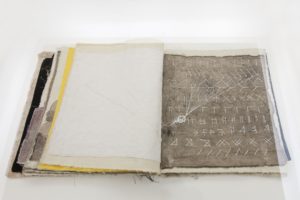
The legend of the Sardus Pater, 1990
Private collection, Monza.
Gallery: Nuovo Morone and M77 in Milan and Studio Miscetti in Rome. Outside Italy, Maria Lai's works are treated by Marianne Boesky from New York.
Pricing: Books with stitching, if made of paper, cost from 15 to 30 thousand euros, while for those in fabric the request varies from 50 to 80 thousand euros. The "geographies" on canvas cost between 50 and 200 thousand euros depending on the size. An investment of around 40 euros is required for the designs from the 50s and 50s. Particularly sought after by collectors are the "Looms" from the 60s, which are very rare and for which galleries fetch up to 300/400 thousand euros.
Top Price at auction"Geography n.2” from 1983, Mixed technique (couture & fil)/toile non entoilée, 147 x 157 cm. it changed hands for 104.400 euros (including royalties) to the Studio d'Arte Borromeo in Milan in April 208
"Renato's Diary" 2007, Mixed technique (stitched sheet, embroidery and black thread/applied canvas/panel), 86,5 x 185 cm. was sold for 32.500 euros at Minerva Auctions in Rome in November 2015