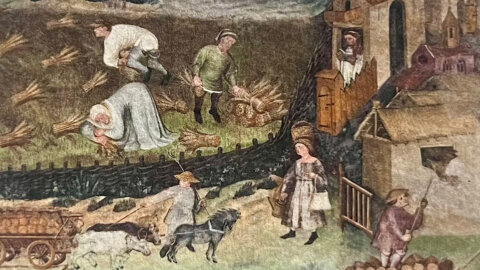
Today we talk about a volume published in 2024 by Leo Olschki by title: Farmers and owners in large Tuscan agricultural companies. Late Middle Ages-early Modern Age edited by Francesco Borghero and Sergio Tognetti. The volume talks about the transformation of the agricultural landscape of Tuscany and the more or less conflictual relationships between farmers and owners. An agrarian universe emerges as the supporting structure of the late Middle Ages and the ancient regime, analyzed thanks to a careful search for notarial and administrative documentation of the inventories and accounting books of the period.
An example are the sources for the land ownership of the Siena Cathedral chapter. A great heritage?
The first question concerns the possibility of including the chapter of the cathedral of Siena among the ecclesiastical bodies of the city and the diocese. To establish the economic weight of the capitular patrimony at the beginning of the 300s, recourse to the Possessions Table. The chapter and the canons of the main church appear to have assets estimated at 8.173 lire, 11 money and 8 denari. (page 82)
Lands and farmers of the Florentine Badia
The monastery of S. Maria in Florence, better known as Badia fiorentina, is an urban place of ancient and prestigious foundation, built within the late ancient and early medieval wall perimeter. It played a central role in the religious, cultural and political development of Florence during the 101,103th, XNUMXth and XNUMXth centuries. Land income was almost three times higher than that generated by urban real estate. The bulk of the land was located in a suburban space that reached up to four-five kilometers from the city. (pages XNUMX)
Peasants on Medici lands
In the twenty years from 1427 to 1449 the investments made by the Medici of the "Cafaggiolo branch" are particularly significant. Starting from the data from the 1427 land registry, the concentration of Medici ownership in a cohesive area of Mugello which covers the gates to a central territory in relations with Florence and its own countryside is highlighted. A territory that we know well also thanks to the fresco of the words of the gods Remember by Giovanni di Pagolo Morelli, where "the most beautiful country that our countryside has" is described from the "domestic level... all worked and adorned with all the goods like a garden" up to the hills and the "vague mountains", and where the The abundance of production included wheat, fodder, fruit, wine, oil, wood, chestnuts, "so much livestock that it is believed that Florence supplies a third of it", as well as cheese, "lamb's cloth" and various game. (page 130)
Owners and farmers on the Serritori farms between Valdarno and Valdichiano in the second half of the 600th century
The presence of the Serritori in Fligine was a very cumbersome presence for a long time, even just from an economic point of view. If the Serritori represented in an exemplary manner, since the 162th century and throughout the modern age, despite the large property in their land of origin they continued to be attracted by land investments also in other areas of the Grand Duchy. Moreover, large landed property continued to be a possible economic business throughout the long 163th century in a phase of population growth and widespread economic crisis. (pages XNUMX-XNUMX)
The authors:
Francesco Borghero (Cagliari, 1992), PhD in Medieval History at the University of
Florence and later a scholarship holder and research fellow at the same university and the University of Siena, he deals with the socio-economic and institutional history of the late Italian Middle Ages, with a focus on the notary profession, on the ecclesiastical and religious institutions of Tuscany and on the institutional and social realities of Sardinia. In addition to articles and reviews in scientific journals and miscellaneous volumes, he is the author of the monograph Ser Lando di Fortino dalla Cicogna. Notary profession and social rise in Florence in the late Middle Ages, Florence, Olschki, 2024. Since 2022 he has been a member of the editorial secretariat of the magazine «Archivio Storico Italiano».
Sergio Tognetti (Florence 1969) teaches medieval history and economic and social history of the Middle Ages at
the University of Cagliari. His studies are aimed above all at the economic history of the late Middle Ages and the Renaissance, with particular attention to the events of commerce, banking and manufacturing. Recently he has become interested in the administrative and accounting management of hospitals and religious bodies. His latest monograph is Observance and double entry. The accounting of the Florentine Badia in the early Renaissance, Florence, Edifir, 2023. He currently coordinates two research projects: “Redde rationem”: order, calculation and reason in the urban societies of late medieval Italy (PRIN) and The wealth of the Church and the “pious places” in Italy from the late Middle Ages to the contemporary age (project financed by the Sardinia Foundation).