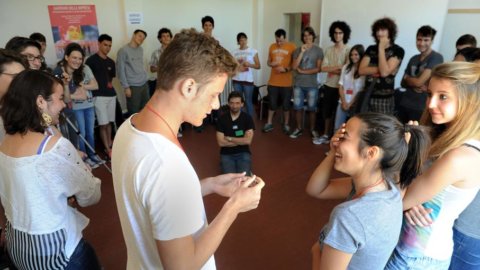
The best among the 430 students from 40 different Italian cities will talk about the results of the work carried out during the school on life sciences (15 June-25 July 2014) proposed by "Scienze in pratica". Science in practice is the project of the Golinelli Foundation to ignite the passion in adolescents between 14 and 19 years for science and technology, through experimentation in the laboratory.
Instead, 59 young people took part in the Business Garden, the informal school of entrepreneurial culture, born in 2013 by the will of the Golinelli Foundation and managed by the Eureka Trust, to stimulate creativity and innovative ideas in young people attending high school. Launched on 30 June 2014 at the Serre dei Giardini Margherita in Bologna – with a summer camp of 60 hours of lessons held by 20 teachers, including scholars, researchers, scientists, journalists and communicators – Giardino delle Imprese concludes the second phase of the first year of activity on November 24 with the announcement of the two projects that will enter the accelerators of the Business Garden to be developed concretely. Called to design a sleep monitoring application to improve the lives of citizens in Smart Cities, the students of 12 high schools in Bologna, Reggio Emilia, Modena and Forlì will present their business idea on which they have been working in the last three months, between 15 hours of lessons and 18 hours of group work. The projects were developed by the students, accompanied and followed along their path by a qualified staff in the spaces of the Foundation. There are eight finalist projects, all of which will receive recognition. There is a total of 22 euros available.
The two best ones will receive funding to become real entrepreneurial experiments and will enter the accelerators of the Business Garden which will offer support, space, training and tutorship for a further 6 months. The committee that selected the entrepreneurial experiments is composed of Riccardo Donadon and Benedetto Linguerri (H-Farm Ventures), Antonio Danieli (general manager of the Golinelli Foundation), Marino Golinelli (founder and president of the Golinelli Foundation), Luca De Biase (editor Nova 24 -Il Sole 24Ore, member of the board of trustees of the Eureka Trust), Donata Luiselli (professor of Molecular Anthropology at the Department of Biological, Geological and Environmental Sciences of the University of Bologna), Matteo Cerri (Assistant of Physiology at the Department of Biomedical and neuromotor skills of the University of Bologna), Cristiano Albonetti (CNR researcher of Bologna, professor at the University of Bologna).
The second edition of the Business Garden will be held from 2 to 10 July 2015, in Bologna. In addition to the partners who have supported the Eureka Trust up to now (H-Farm Ventures, the Municipality of Bologna, the Emilia-Romagna Regional School Office, the Golinelli Foundation) the new edition will be supported by Unindustria Bologna which will make its contribution not only from the point of view economic but also in terms of skills and co-planning. Three sectors of intervention in 2015 for the design and development of ideas to be financed and included in the accelerator programme: mechanics, food and biomedical. Unindustria Bologna and Giardino delle Imprese have identified in these three areas the need to "invent" new ways to encourage and increase the ability of small and medium-sized enterprises to make themselves increasingly known on international markets. In the next editions there will be three funded projects for a total of 21 thousand euros: 10 made available by the Golinelli Foundation, 11 thousand euros by Unindustria Bologna.
“Through the Business Garden, the Golinelli Foundation wants to promote the entrepreneurial culture among young people in schools. It is a long-term project that looks far ahead: we want to prepare the kids to live in an increasingly complex and less and less decipherable future”, he says Marino Golinelli, founder and president of the Golinelli Foundation. “A multipolar world awaits us, in continuous evolution, full of moments of rupture and contrasts. At the same time, however, opportunities are amplifying and it is our task to help young people seize them because only culturally prepared young people will be able to face the global world without fear and with responsibility. We must be able to anticipate the future to manage the complexity of tomorrow by pushing ourselves to reveal at least a century ahead of us. Nassim Nicholas Taleb, our guest at the end of a day that we have called "Research and business: the inventors of tomorrow", studies the absolute unpredictability of the future, an element that primarily frightens the young people who live with us in the chaos of Today. We have to trust them, prepare them for the unpredictable as an opportunity, get them used to living in predictable chaos” adds Golinelli. “Taleb, ideally for us, will pick up the baton left to us last year by the astrophysic Hubert Reeves who, called on the occasion of the 25th anniversary of the foundation of the Golinelli Foundation, unveiled some ways to imagine tomorrow. We must focus on the creativity and desire for change of young people: and this desire is central to the Business Garden where young people can begin to experience a culture of doing. But we are well aware that just doing, unaware, is not enough: we must also be clear about the direction of travel, the road to take to build a future that still contemplates, in its foundation, a newfound trust in man and in the dignity of him. We cannot enter a new story that lies before us with closed eyes. A frenetic and blind action will not bring us development and happiness: it is therefore necessary, in order to build an aware future, to know in order to be able to progress”, concludes Golinelli.
“Accompanying talents from the earliest stages of school to form tomorrow's executive class is one of the most widely used educational models abroad, which is the basis of a meritocratic society. The Golinelli Foundation's project not only has the advantage of filling a void in our country, but goes further, testing the abilities of children beyond books, stimulating ingenuity and creativity, in very specific sectors, which together we have identified such as mechanical, food and biomedical. For this reason, we strongly support the Giardino delle Imprese and invite all young people to get involved: we need your ideas”, declared Tiziana Ferrari, General Manager of Unindustria Bologna.
The appointment of 24 November will end with the intervention of Nassim Nicholas Taleb, introduced by the vice president of the Golinelli Foundation, Andrea Zanotti. Taleb spent 20 years of his life as a stock trader before becoming a philosophical essayist and mathematical probability researcher. He is currently Distinguished Professor of Risk Engineering at NYU's School of Engineering. He mainly deals with processes (perceptual, social and cognitive) of uncertainty, probability and knowledge, i.e. the study of a map and a protocol on how one should live in a world that one does not understand. He is also interested in studying systems that can handle chaos. Taleb is the author of Uncertain (The Black Swan, Played by chance, Antifragile, published by Saggiatore), a multi-volume essay on uncertainty that has been translated into 35 languages. He has also published academic papers in physics, statistical mathematics, political science, philosophy, ethics, finance, international affairs, and economics, all around the notion of risk and probability.
Taleb will talk to children, parents and teachers about various topics: the importance of the relationship between doing and knowing how to do, the connections between scientific and humanistic culture, the strategic role of "informal learning" paths, the need for experimentation and of the validity of mistakes, the courage of the entrepreneur, the renaissance of Italian manufacturing, the great strength of small and medium-sized Italian enterprises, education in entrepreneurship.