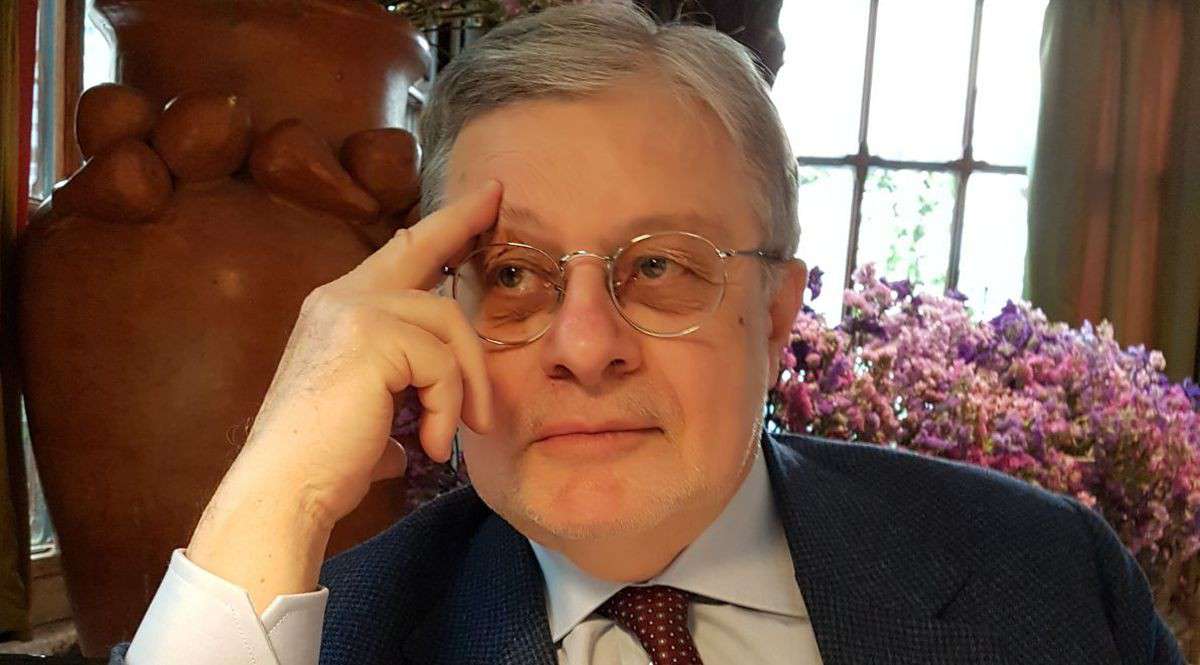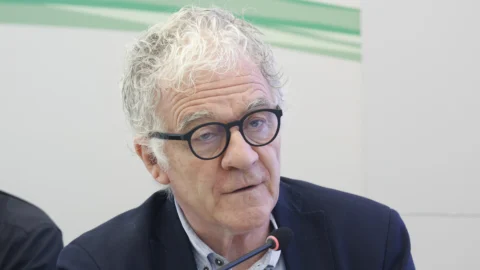
"The legal minimum wage is not the right way to increase workers' wages, just as the Flat Tax is not: it would be much better if, in an organic tax reform plan, the Government took the way, suggested by Confindustria, of a robust cut in the tax wedge by allocating 100% of the resources freed up to workers”. Who speaks is Maurizio Stirpe, vice president of Confindustria for trade union relations and owner of a medium-sized company of plastic components for cars and motorcycles - Prima Sole Components - born in the heart of Ciociaria but which today has 12 plants and 3.200 employees in Italy and around the world and which aims to become a multinational family on a global scale or through alliances or by raising capital by going public. His all-encompassing interview with FIRSTonline is full of surprises and wisdom and reveals that Stirpe is an entrepreneur who goes against the tide, who does not love luxury but does not hide his passion for football and for his home town of Frosinone, for which he has built at his expense a state-of-the-art stadium. Here is his thought.
President, is it true that as a boy you wanted to be a researcher at the Bank of Italy and that it was only for family needs that you became an entrepreneur?
“Yes, it's true, after university studies and a degree in law from the Sapienza University of Rome I would have liked to deepen my knowledge of the macro-economics and the banking system either at the University or at the Bank of Italy, but my father had ideas and different needs for my future and convinced me to become an entrepreneur in the small family business of plastic components for vehicles”.
Given the growth of your company, Prima Sole Components, which in the 80s – when you joined – was a small factory with 12 workers and now has 3.200 employees with 12 factories in Italy and around the world, there is no doubt that it has been lucky choice and it seems to understand that now you really like being an entrepreneur.
"Yes, I have certainly not regretted having been an entrepreneur and I still thank my father who with great foresight pushed me to do a job for which I immediately discovered that I had a strong inclination and a lot of passion".
Your company has remained the only multinational in the Frusinate area: is doing business in central-southern Italy and in a quiet but somewhat peripheral province like Frosinone easier or more difficult than doing it in large industrial centres?
“It is certainly more difficult to do business in the Centre-South and especially in an area like Frusinate which had undergone massive industrialization in the 60s and 70s as a result of the Cassa del Mezzogiorno but which, once the incentives and tax relief, has lost almost all the multinationals and left the field to a few native entrepreneurs who have had to face the harshness of change with their own means. However, we are a group which, in addition to its historical roots in the Frusinate area, has acquired the privilege and the dimension to do business also in the Centre-North where the environment is more favourable”.
But what was the secret of your entrepreneurial success and is yours a business model that can be replicated elsewhere too?
“It is a model that is difficult to replicate because the context from which we started has changed and because now the business world – at least in our sector – is aiming for economies of scale of large dimensions and the consolidation of companies. When I started everything was simpler, even if we were just a micro-company, but in those days growing up was easier. The secret of success? A mix of factors: from product innovation for car air conditioning to the earthquake collapse of the Fiat components plant in Naples which prompted Fiat itself to look for alternative suppliers and, again, from the existence of systemic players to all intents and purposes to the importance of teamwork and highly communicative union relations, which have always been a feature of our company”.
Some time ago you made unusual statements in the business world claiming that "you have always considered the company's interest not perfectly coinciding with that of the entrepreneur and that you have always believed that the entrepreneur should be at the service of the enterprise and not vice versa”: in practice, does this mean separating the ownership from the management of a company and not being obsessed with control?
“Yes, this is exactly what I think and what we practice in our company, according to a far-sighted philosophy that my father had prepared in time and which is mainly based on two pillars: the development of the company and the selection always come first. of corporate governance must be based on merit alone”.
Is there also a listing on the Stock Exchange in the future of your company or not?
“You go to the Stock Exchange if you have a project and we have a very ambitious growth plan which will certainly require us to achieve a capital strengthening which can take place with financial and industrial alliances but whose arrival point – within 3 or 4 years – is also the listing on the Stock Exchange.
What is your business growth plan and why isn't the listing on the stock market for today?
It's a two-step plan. Between 2019 and 2020 we will complete the first step, namely the implementation of the investments planned in Eastern Europe and Brazil. Then phase 2 will kick off, which means: 1) financial strengthening with alliances or with stock market listing, which is prodromal to future development objectives; 2) completing the ring of our globalization: today we are already strong in Europe and South America but to be a global player, as we want to become, we must grow – also with alliances – in North America and Asia. In figures this means that, compared to the 3.200 employees we have worldwide today, we will have to continue to hire and we will have 4.300 by 2020 with the aim of being to all intents and purposes a medium-large company capable of operating on a global scale ”.
By producing plastic components for cars and being a supplier to all the major automotive groups, you are seeing the crisis and the difficult transition of the sector towards electric cars and self-driving cars up close: how does Italy fit in this transformation process and how likely is it to come out on its feet?
“In the transition to the new world of the car, not only Italy but all of Europe is lagging behind China and the Far East and it is particularly serious that there are no European champions of electric batteries. If those who are behind like Europe experience the industrial transition badly, it is clear that those who are even more late like Italy are worse off and have to pay for greater jolts from the change in a sector that today is in great fibrillation and in strong transformation".
What do you think of the merger project between FCA and Renault which, after the first stop, seems to be able to regain share?
“It is a positive project which, if implemented, would lead to the strengthening of all the players in the field: from FCA to Renault and Nissan. It is to be hoped that they will overcome the current difficulties and manage to achieve the objective of the merger”.
As vice president of Confindustria with responsibility for trade union relations, didn't you be surprised by the fact that the protest of the recent metalworkers' strike was not directed so much against the entrepreneurs but above all against the government? Is this a sign that relations between companies and unions have improved or that even the unions consider the action of the current government ruinous?
“Both considerations are valid. Relations between Confindustria and the trade unions have certainly improved after the stipulation of the Pact for the factory with the consequent reciprocal commitments on the bargaining model, on corporate welfare, on training, on safety in the workplace and on the participation of workers in the company's choices . The trade union protest against the Government, on the other hand, stems from the awareness that growth and employment are the central problems of economic policy, but in relation to which the Government's action is insufficient and moves away from the objective of an adequate reduction of the tax wedge on all advantage of the workers which, yes, this could mark a turning point for the country".
The Government, on the other hand, is thinking of the Flat Tax even at the cost of breaking through the European budget constraints: what is your opinion?
“I don't believe in the goodness of patchy fiscal interventions because I think it is necessary to reform, as the Governor of the Bank of Italy also recommends, the entire Italian tax system with a balanced and well thought-out organic reform that redraws the relationship between direct taxation and indirect taxation and which shifts the tax levy from work to income and from work to consumption".
As an entrepreneur, what worries you the most about the current economic and political situation? Economic stagnation with a window on the recession, the increasingly exorbitant size of the public debt, the absence of public investments and a development policy or the permanent conflict with Europe that places us dangerously one step away from Italexit?
“The questions raised by the question are all legitimate concerns of every entrepreneur, but the most critical point is the lack of an industrial policy. We are the second largest manufacturer in Europe but there is not even a shadow of targeted policies to support the industry. The Industry 4.0 program has ended up on the back burner and what is most striking is that in Italy there is no longer a favorable climate for doing business. Unfortunately, a thousand acts and behaviors of public authorities bear witness to this”.
Are you also referring to the legal minimum wage of 9 euros an hour that the government would like to introduce?
"Yes of course. If they do, contracts are blown and labor costs skyrocket, as even the unions acknowledge. For Confindustria, such a direct criticality does not exist, given that just about 15% of the national contracts stipulated have minimum wages below 9 euros, but the problem would be devastating for the commerce and craft sectors with chain repercussions on the whole system productive. If contracts in small and very small businesses are broken up, the damage doesn't stop there, but affects the entire supply chain".
However, in a recent interview with Corriere della Sera, you seemed to go against a wall and also opened a glimmer of the minimum wage, arguing that if the 9 euros an hour also included holiday accruals, thirteenth salary and severance pay the music could change: is it a compromise proposal?
“It can only become so on condition that the Government and the trade unions share the principle that the legal minimum wage can never be higher than 40% of the median wage, as happens in good European practices, and that the Government undertakes not to intervene ope legis on a matter that belongs exclusively to the role played by the social partners. But I repeat: for us the best way to increase wages is the one that passes through the cut of the tax wedge and the consequent full distribution of the resources freed up to the workers”.
But would the probable approach of early elections be a risk or an opportunity for businesses to hopefully reverse the course of economic policy?
“It will depend on what this government wants and knows how to do. If unfortunately it should not be able to implement a credible and coherent program with our commitments with Europe, it would be better to go to early political elections”.
President, you are known as a person of great sobriety: no one has ever seen you on a yacht or in a pharaonic villa and in Confindustria you have even given up the use of the elegant office that you were entitled to as vice president to occupy a smaller one in the heart of the Industrial Relations Directorate. But her love for football is equally well known, which led her to the presidency of Frosinone and to build one of the most beautiful stadiums owned by her football club at her own expense. How much does your passion for football cost you every year?
“It costs a lot, but I've never done anything crazy and even in football I use my family assets with balance, without ever overdoing it. Certainly the relegation to Purgatory of Serie B, which we have remedied this year, will cost me more than when we played in Serie A because the resources circulating for the cadet championship are very few".
These days, however, football is giving you one more reason to be bitter about the rumors coming from Spain about the possible involvement of four Frosinone players or managers in the new betting scandal: what do you think?
“I don't comment on facts that are not well known, but we wait confidently to know how things really are in order to organize a possible defense as the injured party. It's true that you can never put your hands on fire for anyone, but I find it hard to imagine the involvement of any of our people in illegal betting rounds. Let's wait and see, hoping that clarity will be made as soon as possible ".