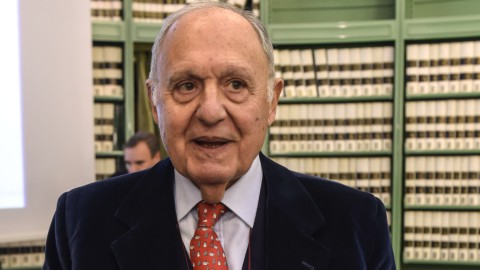
The Bitcoin genius has come out of the bottle. And let's not delude ourselves that he can go back there alone. “The authorities won't be able to bring him back inside – he warns Paolo Savona – because it acts in the immaterial sphere or infosphere that can be controlled only by changing the information exchange protocol, ie by fragmenting the unity of the world market and thus reducing the rate of international competitiveness”. Thus the alarm sounds Consob, even more heartfelt and vibrant than the one launched in the recent past by Christine Lagarde or Jerome Powell.
"The pyramid of bits, the unit of measurement of information technology, has grown enormously and has penetrated the market of traditional tools, losing the territorial contact implicit in their treatment on legal bases," said Savona. And yet, continues the president, “Consob has canceled more than 400 sites that proposed unfair savings solicitations mostly through cryptocurrencies. Based on the internet we know that they exist in circulation from four o'clock five thousand cryptocurrencies (in the forms of stable coin, but largely floating) which operate more or less undisturbed. If we apply the experience made in a short time by Consob in shutting down hundreds of websites in Italy that illegally collected savings, the resulting picture appears worrying”, explained Savona. It is an avalanche that spills an impressive amount of more or less truthful data onto the web every day: an amount equal to 10 to the eighteenth of a bit, something that escapes any subsequent transparency control.
Faced with these numbers, the scenario that preceded the 2008/09 crisis risks becoming topical again, except that this time the risk, transferred from derivatives to cryptocurrencies, is even higher. In exchange, however, there is faith in the greater sensitivity of the markets and regulators, in addition to the fact, of course, that this time the alarm was sounded in time. But let's not delude ourselves: current rules are not enough. “It is no longer possible to distinguish, with technical and legal certainty, what money and financial products legally consist of today, a content that is interrelated due to the connection guaranteed by the conversion platforms between virtual and traditional instruments. The market uses a different yardstick from that of the existing legislation, which needs to be integrated into it".
The match, then, does not only concern speculative activities and the moral hazard but it is triggered in a wider conflict between democracy and widespread lawlessness leading to terrorism and in the use of technologies by unscrupulous dictatorships. “The activity in securities that takes place in the infosphere – explains the president – is increasingly interfering also with international relations and geopolitical balances, the stability of which plays an important role for monetary and financial exchanges, above all following the growing weight that they have in a political habitat that is no longer at the best of the results of peace and prosperity achieved in the last thirty years of integration and cooperation between States”.
Savona, unlike other regulators or bankers of high lineage (think of Goldman Sacsh or the most important Swiss banks) does not feed any indulgence on the new that is advancing. "The current system of encrypted instruments is based on the dominant conventions between private individuals, which ignore the central role that the legal nature of money plays in the proper functioning of the market as the only means of exchange and debt relief".
Of course, technological innovation is a conquest, but the favorable attitude towards new techniques must be accompanied “with clear rules on the birth and exchange of cryptographic instruments and on their links between traditional monetary and financial assets/liabilities, whether they are already digitized or not, as an indispensable guide for operators who manage liquidity and savings”, indicated the number one of Consob.
The alarm is not exaggerated if one thinks of the advantage accumulated by the diffusion of virtual instruments “with the birth of technological platforms that allow access to payment and trading services in securities faster and less expensive than those offered by banks: the custody and exchange functions have evolved to accommodate increasingly articulated and complex operations, including the granting of loans guaranteed by one's own or others' virtual instruments or the signing of contracts derivatives using cryptocurrencies as collateral. Hence an alarm that, in reality, echoes the attitude of the Chinese authorities in the face of the risk represented by the boom in Alibaba's Ante”.
“These new segments of the market are rapidly evolving and the experience prior to the 2008 crisis seems to be repeating itself, when derivative contracts grew to a size of ten times global GDP, taking on complex forms that received a high rating. Even with the due distinctions, it is foreseeable that something similar is happening in the market for virtual monetary and financial products, especially cryptocurrencies".
In short, Professor Savona took the opportunity of the annual report (this time remotely, hoping to return to Piazza Affari as early as next year) to leave the imprint of his personality as a scholar who looks ahead rather than dwelling on the market as it is today: the president limited himself to ensuring "careful monitoring" of the integration of Borsa Italiana into Euronext without conceding anything to the concerns of the Five Stars.