Also for 2024 the objective - already promoted with the 2021 edition - is to obtain the "carbon neutrality" certification achieved in 2023 for all the activities planned by the Biennale: the 80th Venice International Film Festival, the Festivals of Theatre, Music and Dance and, in particular, the 18th International Architecture Exhibition, which was the first major exhibition of this discipline to experiment in the field with a tangible path for the achieving carbon neutrality, itself reflecting on the issues of decolonization and decarbonization.
The exhibition will be divided between the Central Pavilion in the Giardini and the Arsenale in two nuclei: Contemporary Nucleus and Historical Nucleus
Particular attention will be paid to outdoor projects, both in the Arsenale and in the Gardens, and to a program of performances during the pre-opening days and in the last weekend of the 60th Exhibition.
“The title of the 60th International Art Exhibition of the Venice Biennale is taken from a series of works created since 2004 by the Claire Fontaine collective, born in Paris and based in Palermo. The works consist of neon sculptures of different colors bearing the words “Foreigners Everywhere” in an increasing number of languages. The expression was in turn taken from the name of a Turin collective of the same name which fought racism and xenophobia in Italy in the early 2000s. Claire Fontaine's series of neon sculptures currently includes 53 languages, Western and otherwise, including several indigenous languages, some of which are effectively extinct: this year they will be exhibited at the Biennale Arte in a new large-scale installation in the emblematic construction sites ships of the Gaggiandre at the Arsenale." Adriano Pedrosa, Curator of the 60th Exhibition
"The autonomy of the artistic directors is the best guarantee that the Venice Biennale formula continues to work and produce sometimes surprising effects, even on a diplomatic and political level.” Roberto Cicutto, President of the Venice Biennale
Contemporary core
«The Italian term “straniero”, the Portuguese “estrangeiro”, the French “étranger” and the Spanish “extranjero” are all connected on an etymological level respectively to the words “strano”, “estranho”, “étrange” and “extraño”, or to the stranger. Sigmund Freud's Das Unheimliche comes to mind, The Uncanny in the Italian edition, which in Portuguese was translated as “o estranho”, the strange which, deep down, is also familiar. According to the American Heritage and the Oxford English Dictionary, the first meaning of the word “queer” is “strange”, therefore the Exhibition will develop and focus on the production of further related subjects: the queer artist , who moves within different sexualities and genders and is often persecuted or banned; the outsider artist, who finds himself on the margins of the art world, just like the self-taught or the so-called folk or popular artist; the indigenous artist, often treated like a stranger in his own land. The production of these subject paintings will be the fulcrum of this edition and will constitute the Contemporary Nucleus".
«Indigenous artists will have an emblematic presence and their works will welcome the public in the Central Pavilion, with a monumental mural created by the Brazilian collective Mahku on the facade of the building, and in the Corderie, where the Maataho collective from Aotearoa/New Zealand will present a large installation in the first room. Queer artists will be present in every space and will form the focus of a large section in the Corderie, as well as an area dedicated to queer abstraction in the Central Pavilion."
«The Contemporary Nucleus will host a special section dedicated to the Disobedience Archive in the Corderie, a project by Marco Scotini who since 2005 has been developing a video archive focused on the relationships between artistic practices and activism. The presentation of Disobedience Archive in the Exhibition is designed by Juliana Ziebell, who also worked on the exhibition architecture of the entire International Exposition. This section, divided into two main parts specifically conceived for the Exhibition, entitled Diaspora Activism and Gender Disobedience. Disobedience Archive, will include works by 39 artists and collectives created between 1975 and 2023."
Historical core
«The Historical Core is composed of 20th century works from Latin America, Africa, Asia and the Arab world. Much has been written about global modernisms and those of the South of the world, which is why in some rooms works from these territories will be exhibited, as if to constitute a sort of essay, a draft, a hypothetical curatorial experiment aimed at questioning the boundaries and definitions of Modernism. We know all too well the history of Modernism in Euroamerica, but the modernisms of the Global South remain largely unknown. […]. European Modernism itself traveled well beyond Europe during the twentieth century, often intertwined with colonialism, just as many artists from the Global South traveled to Europe to exhibit their work. […]". The Historical Core includes three rooms in the Central Pavilion: the room entitled Portraits, the room dedicated to Abstractions and a third room dedicated to the Italian artistic diaspora in the world throughout the 20th century.
Among others, this section includes artists from Korea and Singapore, who in the past were part of the so-called Third World, or indigenous Maori artists of historical relevance such as Selwyn Wilson and Sandy Adsett, from Aotearoa/New Zealand.
«A third room of the Historical Center will be dedicated to the diaspora of Italian artists who have traveled and moved abroad, integrating into local cultures and building their careers in Africa, Asia, Latin America as well as the rest of Europe and the United States; artists who often played a significant role in the development of Modernism narratives outside of Italy. In this room the works of 40 first or second generation Italian authors will be exhibited, placed in glass and concrete easel displays by Lina Bo Bardi (an Italian who moved to Brazil, winner of the special Golden Lion in memory of the 2021 Architecture Biennale) ».
Il President of the Biennale, Roberto Cicutto, also recalled that «Adriano Pedrosa is the first curator of the Art Biennale from Latin America, chosen to bring his point of view to contemporary art by rereading different cultures as if it were a cinematic reverse shot».
The Exhibition will be accompanied by 90 National Participations in the historic Pavilions in the Giardini, the Arsenale and in the historic center of Venice
There are 4 countries present for the first time at the Art Biennale: Republic of Benin, Ethiopia, Democratic Republic of Timor Leste and United Republic of Tanzania. Nicaragua, the Republic of Panama and Senegal are participating for the first time with their own pavilion.
The Italian Pavilion at the Tese delle Vergini in the Arsenale, supported and promoted by the Directorate General for Contemporary Creativity of the Ministry of Culture, is curated by Luca Cerizza, with the project Due qui / To hear by the artist Massimo Bartolini, which includes contributions specifically created by musicians and writers.
The Pavilion of the Holy See, promoted by the Prefect of the Dicastery for Culture and Education of the Holy See, Cardinal José Tolentino de Mendonça, will take place this year in the women's prison in Venice on the Giudecca. The exhibition is entitled With my eyes and is curated by Chiara Parisi and Bruno Racine.
The Municipality of Venice participates with its own Pavilion, the Venice Pavilion, in the Gardens of Sant'Elena
Furthermore Collateral and Special Events: The 30 Collateral Events approved by the Curator and promoted by public and private non-profit organizations and institutions, are organized in numerous locations in the city of Venice and offer a wide range of contributions and participations. While the Special Projects created by the Venice Biennale – Polveriera Austriaca, Forte Marghera, Mestre. Ten works by the Italian artist Nedda Guidi (Gubbio, 1927 – Rome, 2015), present in competition in the International Exhibition, will be exhibited in Forte Marghera inside the building called Polveriera Austriaca.
– Pavilion of Applied Arts, Arsenale, Sale d'Armi
Brazilian artist Beatriz Milhazes (b. 1960), known for her work that overlaps Brazilian cultural imagery and references to Western modernist painting, will present seven paintings and as many large-scale collages. The Pavilion project, this year curated by Adriano Pedrosa, has reached its eighth edition and is the fruit of the collaboration between La Biennale and the Victoria and Albert Museum (V&A) in London.
BIENNIAL COLLEGE ART
Agnes Questionmark, Joyce Joumaa, Sandra Poulson, Nazira Karimi are the authors of the finalist projects of the 2nd edition of Biennale College Arte 2023/24, which will access a contribution of 25.000 euros for the creation of the final work. Their works will be presented, out of competition, as part of the 60th Exhibition. Over 150 young emerging artists under 30 from 37 countries around the world signed up to the call for participation.
GOLDEN LIONS FOR LIFETIME ACHIEVEMENT
The Golden Lions for Lifetime Achievement at the Biennale Arte 2024 were awarded to Anna Maria Maiolino, a Brazilian artist (Italian by birth), and to Nil Yalter, a Turkish artist (resident in Paris). The award will be presented on Saturday 20 April 2024 during the awards ceremony and inauguration of the 2024 Art Biennale at Ca' Giustinian, home of the Venice Biennale.
BIENNALE SESSIONS, the project for universities
For the thirteenth consecutive year, La Biennale dedicates the Biennale Sessions project to universities, academies and all institutions operating in research and training in the fields of the arts, architecture and related fields. The objective is to offer facilitation for three-day visits organized by them for groups of at least 50 students and teachers, with the possibility of organizing seminars in exhibition locations offered free of charge and assistance in organizing travel and accommodation.
Official website of the Biennale Arte 2024
Official hashtags: #BiennaleArte2024 #StranieriOvunque #ForeignersEverywhere
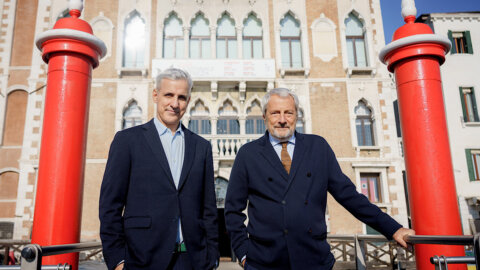
Cover image: Adriano Pedrosa, Roberto Cicutto_Ph. Andrea Avezzu'