
It is no longer possible to do without a delimitation of the areas of contractual effectiveness within which to measure the representative capacity of the negotiating agents.
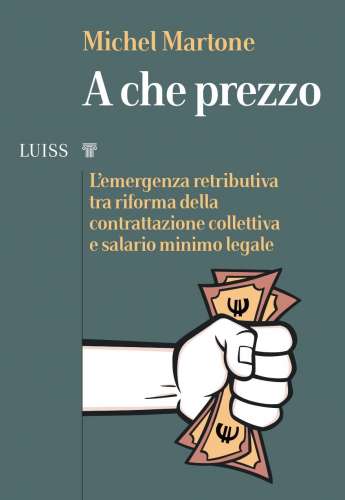
This is, in a nutshell, the conclusion of the investigation work carried out by Michel Martone, who was Deputy Minister of Labor in the Monti Government, on the wage emergency in our country and who has recently published the book “A che prezzo” on the subject, published by Luiss University Press.
Many questions awaiting an answer, many reflections of the author who, at the end of the text, also makes suggestions in order to finally be able to progress and untie this dispute between the reform of collective bargaining and the statutory minimum wage that has been dragging on for decades now.
Martone wonders how it is possible that, in the Italy of the third millennium:
• To support himself at the University, a young student delivers pizzas at home, perhaps by bicycle and in the rain, for a fee that barely touches 3.5 euros per delivery.
• Even though a worker works full-time, he is no longer able to put aside what is necessary to buy a house in a lifetime.
• Public employees have had to suffer a freeze on collective bargaining, and therefore on salaries, which lasted more than seven years.
• An immigrant picking tomatoes earns just over 2 euros an hour.
• A couple in their thirties cannot afford, adding up their salaries, to support more than one child.
• In the last 10 years, more than 244 young people, of which 64 per cent with a medium-high educational qualification, have left the country and this migratory phenomenon is not given due prominence.
The liberalization of international trade, the adoption of the euro, the creation of the single market have put an end to the protectionist economic policies, based on competitive devaluations, customs duties and public debt, which for decades have preserved the national production system from the consequences tougher than international competition.
And so today in the global market, to satisfy an increasingly demanding consumer, we end up "sacrificing workers' wages in a vicious circle made even harder by the authority imposed by the financial markets and by the unscrupulous policies of those multinationals that buy healthy companies with financial problems to close and reopen them in neighboring countries".
For Martone this represents the worrying consequence of a liberal policy in the economic field but sovereign and closed in terms of social rights.
Suffice it to consider, the author reminds the reader, that, while over the last 30 years international treaties managed to unify the markets and currencies to affirm the new Lex mercatoria, even today there is a lack of binding rules of supranational law capable of influencing the determination of wages and that the last Oil convention on wages dates back to 1970.
The same mistake was also made at the European level. Once the market and the currency were unified, wage levels also had to be brought together to avoid downward competition between workers from different European countries.
Acknowledging this clear economic policy direction, "the strongest, most advanced and far-sighted countries" have begun to curb wages to boost investments in technological innovation and increase business productivity, as happened "with the German economy now close to to full employment". For their part, however, the economically more backward countries
they continued to practice low wage policies to attract investment. The Mediterranean countries, including Italy, with their unsustainable public debts, "were forced to adopt highly restrictive wage policies with even more drastic measures than those practiced by the countries that had moved in time and only after having lost significant shares of target markets".
In the European Union, the legal minimum wage goes from over 10 euros in Luxembourg to the scarce 2 euros practiced in Lithuania, Romania or Slovenia.
An obviously unsustainable situation, also denounced by the new European Commission chaired by Ursula Von der Lyen.
In the text, Michel Martone underlines how the current Italian system, despite the high number of contracts, is no longer able to represent millions of outsiders. The same system in which the definition of salary levels for insiders is the result of a process of continuous negotiation at different levels and between multiple players who must, "in the exercise of their autonomy, agree on the economic policies to be implemented and on the characteristics of the contractual system necessary to achieve them".
Since the beginning of the Great Crisis, the wages of Italian workers, which were already significantly lower than many of their foreign colleagues, have been overwhelmed by a veritable wave of impoverishment which has further increased inequalities among the few who profit from the globalization of markets and the financialization of the economy and all the others. And this for the author has also had negative consequences in terms of economic growth, by virtue of the fact that, in times of austerity, the best way to encourage recovery is the reduction of inequalities, not the other way around, to allow for an increase the propensity to consume of a greater number of people, as also demonstrated by the performance of the Philips curve.
This resilient economic crisis, on the other hand, risks swallowing up the whole middle class, in particular those middle-class professionals carried out largely by thirty-year-olds whose salaries have been affected more than all by the effects of the crisis. Suffice it to recall the ever-growing number of the so-called working poor, i.e. those who, despite working, are unable to make ends meet. Martone affirms that he is aware that this is an uncomfortable and difficult truth to face, which requires commitment and complex solutions, but which does not mean that it should continue to be postponed, ignored, belittled. For the author, in fact, most of the political parties have simply tried to remove it, unloading the blame for the growing uncertainty that is now spreading among Italian workers on immigrants, the financial markets or Europe. Perhaps even worse, Martone believes the interventions put in place with the declared intention of improving the situation but which, in his opinion, will only subtract further economic resources from the wage emergency. In particular, he refers to quota100 and basic income.
Despite the efforts made over the past twenty-five years, "our economic system is losing the challenge of labor productivity". In fact, by assuming the cost of labor per unit of product as a parameter for measuring the competitiveness of the production system, Martone invites us to reflect on the fact that, since the birth of the single market, Italy has lost almost 30 percentage points compared to Germany and almost compared to the Euro area average. Naturally this depended on multiple factors (investments in product and process innovation, tax wedge, public investment in infrastructure, energy...), but it is equally true that governments and social partners "have failed to promptly restructure the contractual system to promote labor productivity through contractual decentralization”.
If, in fact, the inter-union legal system continues to consider second-level collective bargaining as an almost exclusively ameliorative complement to the broader process of wage negotiation that takes place at the national level, the state legal system, with the decisive endorsement of the jurisprudence, seems to want to assign it, due to the "proximity", an autonomous role e
equal in the regulation of salary and management flexibility, also in derogation from the law and the national collective agreement, in order to allow it to promote a more competitive labor cost per unit of product.
A difference that Martone underlines is of no small importance. Above all of a cultural matrix, destined to divide the union organizations and to weigh especially if the much desired generational change of union cadres does not take place.
A new culture that should take note of the functional specificities of second-level collective bargaining, to enhance its potential, "rather than castrating its development".
Because, if company bargaining represents the elective ambit for regulating productivity and related rewards, territorial bargaining lends itself to effectively fulfilling functions similar to national bargaining and could prove to be a useful tool for trying to adjust wages in relation to the cost of life of a specific territory with high unemployment to attract productive investments and even to counteract the wage dumping practiced between geographically neighboring realities.
For the author it is useless to hide: the wage issue is eminently economic, because it primarily concerns the amount of resources that governments are able to allocate to reducing the tax and social security burden on wages.
With the arrival of the economic recession and the increase in spreads, "the game of redistribution becomes negative sum" which, due to the interest on the debt, reduces public economic resources to the point that, if one wants to support pensions or the citizen's income, "it is necessary to increase taxation, direct or indirect, whether on consumption, income, profits or assets".
In this context, having taken note of the growing difficulty in finding public resources to structurally reduce the high level of tax and social security contributions, proposals are multiplying in favor of the establishment of a legal minimum wage which, by replacing the contractual one, "would put production crisis the responsibility to protect workers' wages". Also for this reason, according to Martone, the awareness is growing at the same time, among workers and within companies, that if we want to avoid a law on the legal minimum wage, it is at least necessary to carry out an effective reconstruction of the contractual system, also through the enactment of a law to support more representative collective bargaining.
The post-constitutional experience to which the author refers would have taught that, especially in times of economic emergency, the strategy that has proved to be the most effective is that of legislative support for the most representative union, "which is generally also the most responsible, as the broad doctrinal debate now in favor of a trade union law”.
There are no constitutional obstacles to a legislative intervention to reform the pay system. Nonetheless, it is easy to foresee that any legislative interventions on the matter, if they were not to be supported by effective social concertation, would risk conveying more problems than solutions to the system. Also for this reason, the author points out, the projects for the reform of the remuneration system seem to gather greater consensus, which instead propose to assume as a valid parameter for the purposes of art. 36 of the Constitution, the minimum wages identified by the most representative national collective agreements.
As, for example, proposed by the bill 658/2018 first signed by Catalfo which establishes, among other things, that:
• The remuneration, proportionate and sufficient to the quantity and quality of the work performed, cannot be lower than the total economic treatment identified by the collective agreements signed by the most representative employers' and workers' associations
for the purpose of appointing representatives to the Cnel.
• The overall economic treatment envisaged by the contracts identified in this way cannot be less than nine euros per hour including social security contributions.
However, according to Martone, not even these proposals are able to solve "the atavistic problem of the delimitation of the ambit within which to measure the representativeness of trade unions, workers and employers", and therefore select the collective agreement to which it agrees " the responsibility, or the privilege, of identifying the remuneration parameter valid erga omnes".
The analysis conducted led the author to conclude in the sense that it is no longer possible to do without a delimitation of the areas of contractual effectiveness within which to measure the representative capacity of the negotiating agents, and represented an opportunity to record some significant convergences that could be placed at the basis of a possible reform of the remuneration system which:
• Assume the minimum economic treatment envisaged by the most representative collective agreement as a parameter of fair remuneration for the entire sector, according to the model already considered constitutionally legitimate for that of cooperatives.
• Transpose by legislative means the system outlined in the 2014 Consolidated Act on Representation, to measure within the perimeters of effectiveness of collective bargaining the representative capacity of the various trade unions, companies and workers, according to the scheme recently proposed by the bill 788/2018.
• Delimit the sectors of effectiveness of national collective bargaining, at least in terms of wages.
• Recover, albeit with all the necessary adaptations, the model governed by art. 2070 of the civil code, in order to allow the jurisprudence to oversee those perimeters by avoiding competition between companies on labor costs.
• Structure collective bargaining, strengthening second-level bargaining on the basis of the model of organized decentralization, also in derogation from the law, in order to prevent downward tensions on labor costs, for example caused by the explosion of company crises , flow back to the national one.
• Introduce a minimum hourly wage, around nine euros, which functions both as a floor for collective bargaining and as an applicable parameter in sectors where the latter does not deploy its effects.
• Provides that this minimum threshold can be derogated (opting out) in specific economic sectors.
• Reduce the tax wedge that weighs on wages in order to give relief to the middle class who, with their work, had to bear the brunt of an economic crisis that made the world's third public debt unsustainable.
It is no longer possible to act in random order, according to the logic of save those who can. According to Martone it is instead necessary that collective bargaining, at least in terms of wages, takes place within a system of rules which, by contrasting downward competition on labor costs, also requires companies to act on the ground of process innovation and product, rather than on the reduction of labor costs.
Martone hopes that the times are ripe in Italy because, very often, in terms of reforms, timing turns out to be a determining factor.