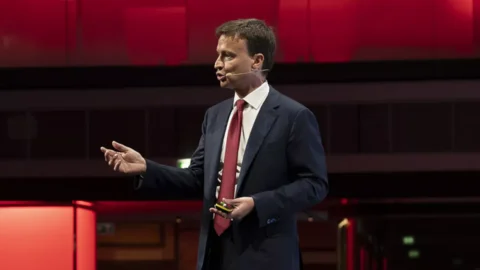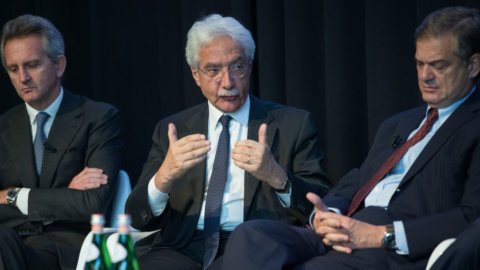
Italy does not ease the tension on the reduction of public debt, while supporting growth, and on the banks greater coordination between the various EU instruments and the ECB is needed. These are the key concepts of the speech by Economy Minister Pier Carlo Padoan at the conference on banks organized by Bloomberg in Milan, at the Feltrinelli Foundation. “There is no room for relaxation”, warned Padoan speaking to an audience which was also attended by several Italian bankers, from Carlo Messina of Intesa Sanpaolo to Alberto Nagel of Mediobanca, up to Lorenzo Bini Smaghi of Societe Generale, Sergio Ermotti of UBS and Salvatore Rossi, general manager of the Bank of Italy.
In the EU framework, Padoan said, there is "enough flexibility to save deposits and jobs". But better coordination is needed: “The cases of Banca Marche, Etruria, Cariferrara and Carichieti have revealed that the BRRD (Bank Recovery and Resolution Directive, i.e. the EU directive on the resolution of banking crises) it needs to be better coordinated with EU rules on state aid“. Even the MPS case, underlined Padoan, "showed the need for better integration" of banking rules within the European legislative framework. “The recapitalization of Mps – explained the minister for example – showed that there is a need to improve the relationship between the ECB and the EU because it was necessary to delay the solution, to clarify the legal framework”.
On banks Padoan also spoke of NPLs, whose market this year according to Banca IFIS analysis will exceed 100 billion, starting towards the end this phase of restructuring of bank accounts, weighed down in recent years by impaired loans: "The flow of non-performing loans decreased in 2014, also thanks to the economic recovery. In the second quarter of 2017, NPLs reached a value similar to the pre-financial crisis level. In 2016, 8 billion were sold on the market and the same amount was transferred to vehicles. Sales of more than 66 billion are expected between the end of 2017 and the beginning of 2018. These developments have also been accelerated by government provisions”.
Going back to current political affairs, the Economy Minister said that “in Europe, political uncertainty risks halting reform efforts. For Italy, it is crucial to find a balance between debt reduction and growth support. This economic policy can be defined as a narrow path: the debt issue must be addressed but the recovery must be sustained and strengthened. Efforts in this direction have been made in recent years and will be made in the next Budget Law. Growth in Italy is accelerating albeit more slowly than in other EU areas, and this due to the low productivity, still to be improved. Structural efforts are needed and obstacles to investment need to be removed”.
The bankers then spoke on the stage of the Feltrinelli Foundation. Among the first speeches that of the CEO of UBS Ermotti, in the midst of a discussion on the future of banks and the growing need for digitization. First of all, the CEO reiterated the need to change the customer experience and thus create a structural synergy through the integration of digitalisation. “It is an opportunity to be embraced without fear”, added Ermotti who also placed the emphasis on the use of data.
Then he spoke Carlo Messina of Intesa Sanpaolo, bluntly launching the assault on the insurance market: “Our main objective is to become one of the leading Non-Life insurance companies in Italy, on the Vita we are already unquestionably number one. We want to enter the Protection, Property and Casualties and Non-Life sector and on this basis we will be able to become one of the first companies in the next 4 years and the first in the following 4 years. A very important project that is based on strengthening the product factory and hiring people to support the sales flow on our network”, added Messina. “If we replicate what we have done in Life and asset management, we can become the leaders in Italy”.
Returning to the banks and their future, Messina also spoke on the issue relating to Brexit and the flight of large financial institutions from London: “If other big banks continue to exit the UK, Intesa Sanpaolo would be ready to enter”, said the CEO. Wide-ranging speech by Lorenzo Bini Smaghi: "In Europe we have to make choices: what kind of model we want to have as a European system and how to promote it". The manager of Société Générale also admitted that "the end of QE will not help European banks" and that the role of banks in the recovery is fundamental: "After the crisis, people must recognize that banks help the economy grow and banks must help their customers”.
Everyone agreed on the need for an effective banking union, including Alberto Nagel of Mediobanca: “We don't have a single market like in the USA. In the United States, there are four banks in the investment banking sector, have government backing, then yes, American banks can be profitable. Loans with QE (in Europe, ed) are not convenient, not even for good companies". "There is a need for aggregation", confirms Bini Smaghi in question and answer, even if Messina then immediately returns to the point: "Creating synergy is difficult, in addition to the difficulties given by the regulations".
Salvatore Rossi's speech, on the other hand, was all about the blockchain and bitcoin, answering the question "Are there more opportunities or risks?". “Cryptocurrencies – said the general manager of the Bank of Italy – are just one of the applications of the blockchain. There are both risks and opportunities that need to be carefully studied by regulators and central bank policy makers. Bitcoin, for example, is nobody's money."