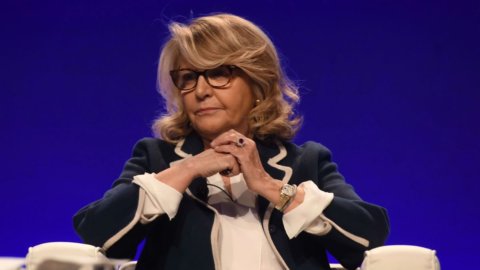
Pnrr, capital market, tax and justice reform, European industrial policy, demography. These are the topics addressed by Patrizia Grieco, re-elected to the presidency of Assonime, in the Report to the biennial assembly of the association, an event which was also attended by the President of the Republic, Sergio Mattarella. Also present were the Speaker of the Chamber, Lorenzo Fontana, the Deputy Minister for Economy Maurizio Leo, the Minister for European Affairs Raffaele Fitto and the EU Commissioner for Economy Paolo Gentiloni.
Grieco: "Do not reduce the ambitions of the Pnrr"
In her Report, the president of Assonime also spoke of the National Recovery and Resilience Plan, asking on behalf of the companies gathered in the association of "don't reduce your ambitions" on the Pnrr. Speaking of the Plan, Grieco stated: "Since the beginning, some critical issues have emerged related to the increase in the cost of raw materials, compliance with stringent deadlines and the feasibility of different investments programmed. We look forward to knowing what the possible adjustments to the Plan proposed by the Government will be, to be agreed with the European Commission, as well as the necessary integrations with the projects to be financed with RepowerEU. Shifting resources from the most difficult projects towards automatic incentive tools for companies on the energy frontgreen and digital transition it seems to us the most promising way to remodulate our Pnrr with healthy pragmatism. It is essential, however, that the ambitions of the Pnrr are not reduced in any way above all to those reforms that must be able to unlock and accelerate investments and the expense.
Grieco: "Lost 50 billion of capitalization of the Italian Stock Exchange, the capital market needs to be relaunched"
“It takes a collective effort to counter the decline of the Borsa Italiana market small, with low capitalization and low free float” which “reduces the visibility of Italian companies in the allocation choices of institutional investors”, said the president of Assonime in her report to the biennial assembly of the associations. According to Grieco the capital bill is a first step in the right direction but it is not enough.
The president then outlined a gloomy picture: "the chronic underdevelopment of our capital market has contributed significantly to limiting the development potential of businesses and to limiting the productive use of the huge household savings - she said - the ratio of capitalization to GDP of Italy is equal to half of that of Germany, but also half of that of Spain, just a quarter of that of the United Kingdom, Holland and France”.
“The Italian problem has ancient roots, but the gap has widened in the last 10 years – continued Grieco, underlining that – The balance between entries and exits from the regulated market has been strongly negative, with a loss of about 50 billion of capitalization. A small stock market, with low capitalization and little free float, reduces the visibility of Italian companies in the allocation choices of institutional investors: Italy weighs 3% in the main European index of listed companies, compared to 12% in Germany and 17% in France”.
Grieco added that: “approaching the Stock Exchange costs money, increases the weight of compliance and gives few results on valuations and the possibility of raising significant capital. The increase in the critical mass of the stock market Italian is therefore an unavoidable and priority objective”. According to the president of Assonime “the tax levy it can represent an important tool for creating an adequate incentive system. It is necessary to eliminate improper charges, such as the Tobin tax, and define a coherent and stable system of concessions which encourages both the offer and the demand for risk capital, encouraging entrepreneurs to return to favoring the Stock Exchange”.
Grieco: "Italy should promote the strengthening of industrial policy in the EU"
“Today more than ever, one is needed new conception of industrial policy in Europe that goes beyond the vision prevailing in recent decades which had as its almost exclusive objective the implementation of a level playing field in the internal market and a bland mainstreaming of industrial demands in a policy agenda wholly governed by environmental demands", underlined the number one of Assonime.
“We think that Italy can promote a proposal to enhance a truly common instrumentation to achieve the European industrial policy objectives", said Grieco, explaining that: "A first instrument to be strengthened is, in our opinion, the Ipcei, i.e. important projects of common European interest, which currently constitute the only aid scheme that allows interventions to support first industrial deployment projects in 9 strategic value chains for Europe”.
It is a field in which to act urgently because today we must note “the modesty of the common tools for achieving these objectives. In essence, all the investment and support effort - truly titanic - is left to the Member States, some of which will be able to move with more room for maneuver - thanks to the different fiscal capacity of the individual countries - through the generalized relaxation of the rules on state aid opening, deep fractures and inequalities in the single market”.
Tax reform and justice
On the tax reform, Grieco spoke today of a "ambitious delegation, of an overall revision of all aspects of the tax system, not neglecting the long-felt need for an overall codification”. In the report, the president then added: "More generally, the delegation intends to create a simpler and more attractive tax system because it is more certain to apply to businesses". From this point of view "the progressive reduction of the dimensional threshold for accessing the collaborative fulfillment system and the recognition of special benefits also to those companies which, precisely due to dimensional and organizational limits, cannot access this regime and which, however , adopt an effective tax risk control system”, added the president, who then signaled: “The principles of delegation do not always clearly identify the direction of the interventions that the delegated legislator will have to implement. It will therefore be essential that the adequate involvement of businesses, economic operators and the associations that represent them is ensured in the implementation phase. Finally, a further important issue concerns the fate of the'IRAP".
The delegation provides for its progressive elimination and replacement with a surcharge to be paid only on joint-stock companies with a taxable base corresponding to that of IRES, but gross of losses. “This surtax – he said – will tend to be equivalent, in terms of revenue – as anticipated by Deputy Minister Leo – to the IRAP currently payable by IRES taxpayers; therefore the elimination of the IRAP on the other subjects should be implemented with autonomous resources to be found gradually”.
Sulla Justice, Grieco praised the interventions implemented to date thanks to the resources of the Pnrr and hoped for "an improvement also in the territorial management and organization of Italian justice", with interventions aimed at "guaranteeing a homogeneous level of digitization in the various courts and the diffusion of the best organizational practices followed by the most productive offices. A careful assessment of the demand and supply of justice in the area should also guide a further effort to reorganize the judicial geography”.
Grieco: "A demographic emergency is underway, incentives for 2 million women who can work"
"A real demographic emergency is underway – Patrizia Grieco affirmed forcefully – The resident population in Italy as of 1 January 2023 fell below 59 million units, about 180 thousand less than the previous year”
According to the president of Assonime “we also need policies that allow for an easier reconciliation between work and family life: I am referring to flexible working hours, nursery schools (a very important target envisaged by the Pnrr that we risk missing) full-time schools, summer camps, and last but not least, care services for the elderly. But above all we need more awareness of a fundamental fact: the countries with the highest birth rates are those with the highest female employment”.
“It is evident – declared the number one of the association for Italian joint stock companies – that ithe support of the birth rate it is important, but realistically in the next twenty or thirty years it will make a dent in the problem. Therefore, today the way forward to partially compensate for the decrease in the workforce can only be that of especially to encourage women's employment in Italy, where there is a lack of around 2 million women who could work (and have more children) and, at the same time, welcome and train an adequate number of regular foreign workers”.
The Assembly re-elects Grieco and appoints the new Governing Council
The private assembly of Assonime, which has re-elected Patrizia Grieco president for the two-year period 2023-24. he named the members of the Governing Council. It will include: Alberto Giovanni Aleotti, Sergio Balbinot, Lorenzo Bini Smaghi, Alberto Bombassei, Marco Emilio Boroli, Michaela Castelli, Carlo Cimbri, Matteo Del Fante, Fabrizio Di Amato, Gianluca Ferrero, Aldo Fumagalli Romario, Luca Garavoglia, Gioia Ghezzi, Nicoletta Giadrossi, Gian Maria Gros-Pietro, Pietro Guindani, Giuseppe Lavazza, Andrea Munari, Pier Carlo Padoan, Corrado Passera, Stefano Pontecorvo, Salvatore Rossi, Pietro Salini, Dario Scannapieco, Paolo Scaroni, Andrea Sironi, Maurizio Stirpe, Marco Tronchetti Provera, Giuseppe Zafarana, Laura Zanetti.
The meeting also appointed Franco Bassanini as honorary member of the Governing Council, who thus supports Carlo De Benedetti and Enrico Salza in the same position. Finally, the Past Presidents Luigi Abete, Innocenzo Cipolletta, Vittorio Mincato and Maurizio Sella are ex-officio members of the Governing Council. The Assembly then appointed lthe Board of the Association and the Board of Auditors.
During the meeting, Assonime explains in a note, the Council report coordinated by Corrado Passera on "The evolution of the administrative body between sustainability and digital transformation" with the director for financial affairs and OECD companies, Carmine Di Noia, who gave a presentation on the new OECD Corporate Governance principles approved at the beginning of June.
In accordance with the statute, the assembly finally approved the estimate of expenses and revenues for the two-year period 2023-2024. The private assembly, the note concludes, was preceded by the Association council, which approved the 2022 budget, which records a management surplus of 165.286 euros.
Gentiloni, Leo and Fitto at the Assonime meeting
Speaking at the biennial assembly of Assonime, the Deputy Minister for the Economy, Maurice Leo he assured that the Government will not make "leaps forward" on the tax review.
We will do everything with the necessary covers. It is clear that if the resources are not there, reforms cannot be carried out, but we are confident that there will be". "The employee must be helped, we look at the employee with the same attention with which we look at companies and the self-employed" - he added, explaining that ""in addition to deductions for training and fringe benefits, for which we have raised the ceiling and we will stabilize it, we are trying to make the cut of the wedge structural", he said, also indicating "the reduction of the tax on overtime, production bonuses and overtime that exceeds a certain threshold".
“Italy has a good level of growth in the first quarter of 2023, of 0,6%, and can maintain a decent level for 2023″. instead said the EU commissioner for the economy, Paolo Gentiloni, adding that "the uncertainty fueled by the war" remains. "The economic situation in which we find ourselves in Europe is better than what we expected last summer, but it is slightly less encouraging than what was expected three-four months ago", he added, underlining that "growth will continue in 2023 but will be more contained”. Gentiloni explained that “we had two quarters of stagnation, due to the contraction especially in the first quarter of 2023 of two large European economies, such as the German and Dutch ones. This – he commented – leads to growth that will continue in 2023 but will be more contained than in previous forecasts ”.