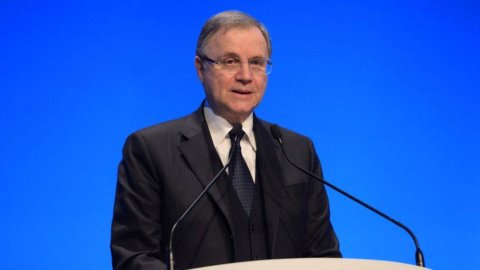
The Greek emergency and the bad bank will certainly be at the center of Governor Ignazio Visco's final remarks at the Bank of Italy meeting which is being held today ahead of the traditional appointment of 31 May.
What to do to avoid both bankruptcy and Greece's exit from the euro and what the repercussions would be on Italy, on the entire Eurozone and on the financial markets is the topic that dominates the economic and financial scene these days and on which the Governor's words are particularly awaited.
But, as always, the Final Considerations will not fail to outline the economic prospects and also to take stock of both the ECB's monetary policy after the positive start of Mario Draghi's Quantitative Easing and the Renzi government's economic policy.
Visco has already had the opportunity to appreciate the effort launched by the Government to reform and modernize the country and will not fail to encourage him to continue courageously along the path he has taken.
But, as always and as is within his direct competence, the Governor will reserve an important chapter of his Final Considerations for the Italian banking system both in the light of the new European rules and of the reforms of our country such as the one long advocated by the Bank of Italy and finally reached, of the popular banks, not to mention the banking foundations and the CCBs.
Visco's attention will focus in particular on the worrying problem of bank non-performing loans which gross now approach 190 billion euro and which constitute a ballast for our banks. The Governor has repeatedly called for public intervention even if the creation of a bad bank has not yet passed the examination of the EU which he fears could be configured as state aid prohibited by European legislation. Perhaps the ideal solution would have been the Spanish one which prompted Madrid to submit to Brussels' conditions but to agree beforehand on Europe's intervention in support of the banks, thus solving the problem that our previous governments did not feel they wanted to tackle in the same way.
Certainly today's Shareholders' Meeting of the Bank of Italy, due to the particular moment in which it falls, will not be ordinary administration and the Governor will not fail to stimulate the Government, businesses and trade unions to roll up their sleeves to resume the path of development increasing the productivity and competitiveness of the economy with an eye to investment (also and above all in human capital) and reforms.