Marisa Merz (Turin 1926) was the only female representative of the Arte Povera movement and protagonist of the Italian art scene from the end of the 1966s. , which oppose the rigor of minimalism with a metamorphic, enigmatic, airy image. These installations - reads the official website of the Merz Foundation - made up of several elements that interact together, are conceived according to the specific place that hosts them and are subsequently re-proposed in different settings. Based on an interest in the quality of materials and essential planning, these early works prepare the artist's official participation in the Arte Povera movement.
In 1968, on the occasion of the collective Arte Povera + Poor Actions curated by Germano Celant at the Arsenals of the Ancient Republic of Amalfi, Marisa Merz exhibits blankets rolled up and packed with copper wire or scotch tape on the beach (Without title, 1966) and works related to the childhood of her daughter Beatrice made of nylon, copper or wool thread. The artist introduces techniques traditionally considered artisanal or the prerogative of women's work into the language of contemporary sculpture, however subverting their destination and attributing full artistic dignity to the procedures and materials adopted from time to time. Collecting the lesson of the assemblages of Pablo Picasso [1881–1973] and the Mobile by Alexander Calder[1898–1976], the work introduces the notion of play and pleasure into sculpture, further marking the artist's distance from the primary, rational and self-referential structures of minimalism.
Even with respect to the Arte Povera group, however, Marisa Merz already shows an eccentric sensibility. The temporal component already intimately present in the knitting works acquires a decisive value in the subsequent installations, in which Marisa Merz proceeds to collect, combine and redefine her previous works. As it happens in Boards: two rectangular tables on which the rolled up blankets from 1966 are placed and a wooden desk full of objects collected over time by the artist, a work presented for the first time at the L'Attico gallery in Rome in 1969 and then exhibited in 1970 at the Museum Civico di Bologna for the III International Biennial of Young Painting. Or as happens in 1972 at the XXXVI Venice Biennale, where the artist presents With closed eyes the eyes are extraordinarily open (1975), which brings together the sculptures in copper wire, the Bowl of salt (1967) Bea e Shoes (1968). Used to compose ever new discourses, these works maintain a close dialogue with each other, creating a force field punctuated by the presence of different temporalities: the objective one of the present and the affective one of voluntary memory (when it includes pieces of the artist's private existence) and involuntary (when it shows archetypes related to the female world).
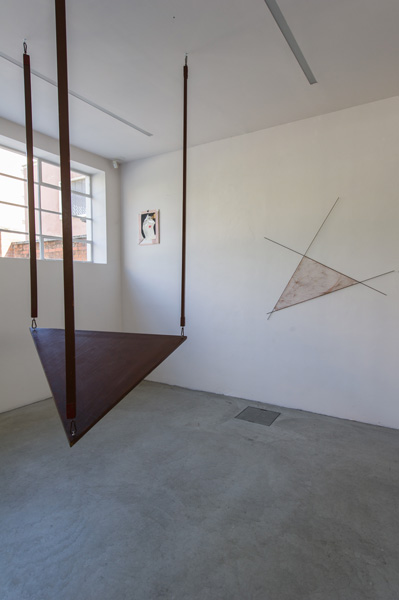
Wood, iron
Photo: Andrea Guermani
Courtesy the artist
After participating in the collective exhibition in 1973 Aesthetic research ordered from 1960-1970 in the Palazzo delle Esposizioni in Rome as part of the X Quadriennale Nazionale d'Arte, Marisa Merz's interventions acquire a fully environmental character in the series of "rooms" that the artist simultaneously creates in complementary spaces: the open and public of the gallery and the underground and private one of the cellar (1977) or of one's own studio (1979). Spaces that the artist transforms into a large mosaic of which she herself is the central figure and the animator. This continuous movement from the personal to the public dimension, according to an oscillation of forms and works which from time to time find their own specific and always different exhibition dimension, constitutes one of the main interpretations of Marisa Merz's work. Since then, the artist has exhibited her works only on the occasion of important group exhibitions, such as the XXXIX Venice Biennale in 1980, where she was invited by Herald Szeemann in the exhibition The art of the seventies; Identity Italian. The art en Italie from 1959, curated at the Center Georges Pompidou in Paris by Germano Celant in 1981; Vanguard. Trans-avant-garde curated by Achille Bonito Oliva at Palazzo delle Esposizioni in Rome (1982). At Documenta 7 in Kassel, in 1982, Marisa Merz articulated a small room parallel to Meret Oppenheim, inaugurating an exhibition modality of a dialogic type to which she would resort several times in the following years.
Invited to numerous editions of the Venice Biennale (2013, 2001, 1986, 1980, 1976; 1972), in 2013 she was awarded the Golden Lion for Lifetime Achievement. In 2017 the exhibition “Marisa Merz: The Sky is to Great Space" created by the Metropolitan Breuer of New York and the Hammer Museum of Los Angeles in collaboration with the Merz Foundation.
Exhibition activity and presence in the collections.
1966
First exhibition, in his atelier
1969
Museum Folkwang, Amsterdam
1972
II International Biennial of Young Painting, Civic Museum, Bologna
1973
X Rome Quadrennial, Palazzo delle Esposizioni, Rome
1980
Venice Biennale
1981
Center Georges Pompidou, Paris
1982
Palace of Expositions of Rome
Documenta 7 Kassel
1983
Los Angeles Maritime Museum, Harbor Museum, Los Angeles
1985
Venice Biennale
Rivoli Castle, Turin
1986
bedroom , Municipal Museum of Contemporary Art, Ghent
1988
Venice Biennale
1989
Museum Ludwig, Cologne
1992
Documenta 9 Kassel
Musée d'art contemporain de Lyon
1993
Venice Biennale
1994
Center Georges Pompidou (monographic)
Guggenheim Museum, New York
1995
Kunstmuseum Wolfsburg
Kunstmuseum Wintherhur, Switzerland (monographic)
1996
Stedelijk Museum d'Amsterdam (monograph)
2001/2003
Venice Biennale: Special Prize of the spécial jury (2001)
Zero to Infinity: Tate Modern, London
Walker Art Center, Minneapolis
Los Angeles Museum of Contemporary Art
Hirshhorn Museum, Washington, DC
Kunstmuseum Wintherhur (monographic)
2007
Fortuny Palace, Venice
DonnaREgina Museum of Contemporary Art, Naples (monographic)
2008
Sydney Biennial
2010
2011
Rivoli Castle, Turin
2012
Merz Foundation, Turin (monographic)
2012/2013
MAXXI – National Museum of XNUMXst Century Arts
Venice Biennale: Golden Lion, Special Jury Mention (2013)
2017
The Metropolitan Museum of Art, New York (retrospective)
His work is present in the most prestigious Italian and international public and private collections, from the Tate Modern to the Walker Art Center at the Castello di Rivoli.
Market and prices
Marisa Merz, the only woman among the exponents of poor art, for a long time has been identified more as Mario Merz's wife than as an artist with her own voice. After more than half a century of little attention, in recent years, international critics have begun to recognize the value of her research, making her emerge as the most lively artist of the movement inaugurated by Germano Celant. But let's talk about recent history. In fact, if we go back just five years to Art Basel 2013, despite the recent awarding of the Golden Lion at the Venice Biennale, the market's attention to Marisa Merz's work was still weak. A sculpture of her from the 70s was sold by the Bernier/Aliader Gallery for 60 euros. But among her insiders the conviction was growing that her shares were destined to "grow in the short term". And in fact towards the end of the same year, after the success of the great exhibition staged at the Serpentine gallery, the artist's first solo show in Great Britain, at Frieze Art Week in London, the Monica de Cardenas gallery retraced the fifty years of activity by Marisa Merz through paintings, drawings, sculptures and installations with prices ranging from 45 to over 200 thousand euros. It was in 2014, with her debut on the auction market (until then no work by Marisa Merz had gone to auction) that Marisa Merz's work began to capture the attention of large international collectors. That same year - according to Artprice - her auction turnover was close to $500. Since then, about fifteen works by the Turin artist have gone up for auction (especially on the London market) with a percentage of unsold close to zero and realizing respectable figures (see chapter on top prices at auction). Naturally, prices have also risen on the primary market and currently, to buy them in galleries, an average investment ranging from 50 to over 300 euros must be foreseen. Just to give an example, in 2017 at Miart, the Gladstone Gallery was offering a work by Marisa Merz “ undated” at 225 euros, attracting “strong interest”.
Top Price at Auction: Untitled, 1988 - Graphite, charcoal and acrylic/paper 165,5 x 150 cm. – changed hands for €273.603 (including royalties) at Christie's London in June 2015. At more than double the estimates. Untitled, 1977 - Construction (lead, wax violin, copper wire, gauzes, electric motor and water) 30 x 100 x 50 cm. - at Cristie's in London, in February 2014, nearly 250 thousand euros. Untitled, 1986 – a sculpture of small dimensions: 20x20x20 cm Creta (unbaked) – in October 2017, stopped the auctioneer's hammer at Phillips London at 182.170 euros, against a maximum estimate of less than 40 thousand euros.
Gallery: His historical reference gallery of Marisa Merz is Barbara Gladstone of New York (gladstonegallery.com). However, her works can be found in leading Italian and foreign galleries such as Bernier / Eliades gallery with offices in Brussels and Athens ([email protected]); Tucci Russo of Torre Pellice (0121 953 357) and Monica de Cardenas with offices in Milan, Lugano and Zouz (02 290100689).