You will have noticed that many Italian banks have recently recorded a "rally" on the stock exchange (a period of price growth). Is it still worth continuing to invest in Italian bank shares?
An element that probably caused the good performance of the banks is "Basel III”. The Basel Committee, made up of regulatory bodies from the G10 plus Luxembourg, stipulates the guidelines on capital requirements of banks for the purpose of pursuing the monetary and financial stability. As you may have read in recent days, the Basel Committee recently reviewed the so-called “liquidity coverage ratio” (LCR).
Don't be scared: it's an index that obliges the banks to have full coverage of their jobs in the event of liquidity crisis. More precisely, it requires banks to maintain a certain level of readily liquid assets to cover at least 30 days in case of unexpected outflows that could occur in a stress scenario. The goal is to ensure that the banking system can withstand the impact of financial and economic crises.
This obligation obviously met with the opposition of the banking system which, following significant pressure, managed to obtain a "lighter" version than the initial version:
1 - the LCR was postponed to 2019 , with the constraint of the application of 60% of the requirements by 2015,
2 – have been softened the minimum requirements obligations that can be set aside to deal with stressful situations,
3 – the hypotheses that characterize the stress scenario have been softened
It is intuitive that the "light" version of the LCR is especially suitable for European banks, and Italian ones in particular, already in fairly "stretched" capital conditions, even if some of the major Italian banks, including Intesa Sanpaolo and the Ubi group, have announced that they already be in a financial position in line with Basel 3.
It may therefore be that the rally of Italian banks is attributable to Basel III: commercial banks are favored as more resources would be freed up for business credit (highly desirable at this stage) and investment banks which have important assets in the prime brokerage and derivatives.
Maybe there is another element? And if the performance of Italian banks is closely linked to the narrowing of the BTP spread against German bonds?
We know that Italian banks have a belly full of government bonds, it would not be illogical to think that the trend on the stock exchange is affected in some way by "country risk".
Let us therefore try to verify the sensitivity of Italian banks with respect to the spread, for example with respect to that of other banks and countries in the rest of the Eurozone. The analysis certainly does not claim to be exhaustive, it is only a quick empirical finding.
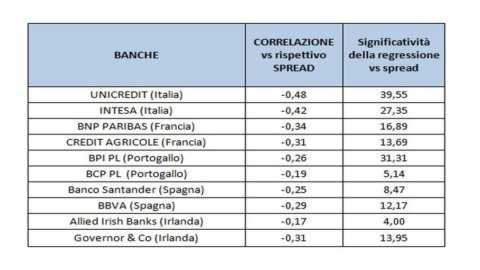
In the image (enlarge the photo to see the table) we propose, for the main banking shares of Italy, France, Portugal, Spain and Ireland (we considered very representative banks, therefore for Italy the choice fell on Intesa Sanpaolo and unicredit):
the correlation of performances with the respective national spreads: or the ratio between the change in the price of the bank share and the change in the spread,
the significance of the regression: i.e. an analysis of the data series which aims to test the hypothesis and model a relationship of dependence between the performance of the bank share and the spread of the government bond.
How do you read the table? Let's take the value of the correlation between Intesa Sanpaolo and the spread: -0,42. The "minus" sign indicates that when the spread goes up, the bank's quotations go down (and vice versa). The size of the number, which in absolute value oscillates between 0 and 1, gives a measure of the intensity of the relationship, which in this case is quite important.
Regression is another way to measure the link between banks and spreads. The table shows the value of a statistic representative of the goodness of the relationship as a whole (the F test): the higher this value is, the more relevant the relationship is.
Conclusions
Basically three things can be deduced from the table.
1 – The hypothesis is verified: there is a relationship between the performance of bank stocks and the respective national spread and is always statistically significant.
2 – The data show that, as the stress on government bonds decreases and therefore the spread with respect to ten-year German bonds, Bank share prices tend to rise (and viceversa).
3 – Last but not least, the study shows that it is the Italian banks that are most closely tied to the trend of the spread.
Dear investors and savers, if you consider including Italian bank shares in your investment portfolio, you not only have to keep an eye on the spread, but you also need to get an idea of where this now famous indicator will stand in the next 6 months, 1 year or 5 years! Is there a way to follow the spread of the various Eurozone countries and also the trend of bank stocks? Yes and it's free! Access the site and browse the "Search tools" section to access all the information on the shares you want and build your investment portfolios.
You can also browse the Market Analysis / Financial Globe section, always free, here you will find updated daily:
- the gross effective return upon maturity of the government bond
– the historical performance of the bonds,
– the spread of European countries,
– the historical performance of the shares
– the risk by country.
Happy surfing!