A In August 1945, Japan was a country at its last gasp.The war in Europe was already over, but on the other side of the world, fighting continued. Japanese cities had been battered by American bombings for months, and in just three days, the country had experienced something no one had ever seen before: Hiroshima had been destroyed by the atomic bomb on August 6, Nagasaki hit by a second device on the 9th.At the same time, the Soviet Union also entered the war against Tokyo.
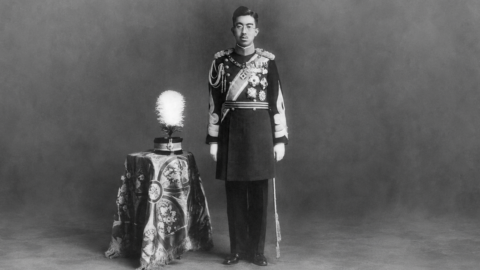
Japan was now defeated, but surrender remained almost unthinkable. It was in this climate that, noon on August 15, 1945, millions of people gathered around the radios. From the device came a low, distant, disturbed voice. For many, it was the first time. It was the voice of theEmperor Hirohito.
It was not usual to hear him speak. For most Japanese the emperor was a distant figure, surrounded by a sacredness that placed it above everyday life. And that very man, whom almost no one had ever heard directly, was telling the country that the war was over. Or almost. Because Hirohito never uttered the word "surrender." He said, rather, that "the war situation has not necessarily developed to Japan's advantage" and announced that the government would accept the terms set by the Allies.
The formal surrender would have been signed only on September 2th, aboard the USS MissouriBut for those who listened to that radio, August 15th was the day when the World War II really ended.
Hirohito speaks on the radio: a voice difficult to understand
The speech would go down in history as Gyokuon-hōsō, the “Transmission of the Voice of the Jewel.” It lasted just over four minutes, but even those who listened to it from beginning to end did not always immediately understand what had happened. Hirohito spoke with the ancient and formal language of imperial proclamations, far removed from everyday Japanese. The recording didn't help either. The emperor's voice was low, and the audio was unclear.
So, as Japan was hearing the announcement of its surrender, Many Japanese did not immediately understand that their country had surrendered.. One sentence, however, remained imprinted: it was necessary to "bear the unbearable and suffer the unbearable“It was Hirohito’s way of asking a people who had been educated for years to war and sacrifice to accept something that had been presented as almost inconceivable.
Hiroshima, Nagasaki and the Emperor's Decision
In his speech Hirohito also mentioned the atomic bombHe spoke of "a new and more cruel device", capable of causing incalculable destruction and killing many innocent people. The two Hiroshima explosions and Nagasaki had accelerated a crisis that was already evident. 26th JulyWith the Potsdam Declaration, the Allies had already demanded Japan's surrender. Tokyo continued to resist. Then, within a few days, came Hiroshima, the Soviet Union's entry into the war, and Nagasaki.
Even then, however, not everyone at the country's top leadership was ready to stop. Meetings continued without reaching an agreement, and some of the military still favored continuing the conflict. It was Hirohito who broke the stalemate and accepted the Allied conditions.A choice that not everyone was willing to accept.
The night they tried to stop the emperor's voice
Hirohito's speech it was not broadcast liveThe emperor recorded on the evening of August 14th, just hours before Japan heard it on the radio. But that recording almost never reached the country's radio stations. During the night, while Tokyo slept, a group of officers led by Major Kenji Hatanaka attempted a coup to prevent the surrenderThe rebels occupied the imperial palace and began searching for the discs on which the emperor's voice had been recorded, with the aim of destroying them before the broadcast.
The chamberlain saved them Yoshihiro Tokugawa, who hid them in a closet in the offices of the Empress's secretariat. Captured and threatened, he did not reveal their whereabouts. Without the support of the military hierarchy, the coup failed In the early hours of the morning. Hatanaka tried again to reach the radio to explain the reasons for the uprising, then committed suicide. An hour later, at noon, the recording he had attempted to destroy entered Japanese homes.
Defeated Japan and the beginning of another story
The reactions were very different. In Tokyo a crowd gathered in front of the Imperial PalaceMany people cried. Some officers chose suicide rather than accept surrender. For years, the military establishment had fostered the idea that death was preferable to capitulation. An extreme reading of the ideals of the bushido, the ancient code associated with the samurai, had helped transform surrender into something almost inconceivable. For this very reason, Hirohito's words carried enormous weight. If the emperor himself ordered the decision to be accepted, continuing the war became much more difficult to justify.
Not everywhere did the guns stop immediately. In Asia, fighting continued for several more days, and for some soldiers it was hard to believe that Japan had truly lost the war. Some continued to hide for years. The most famous case would be that of Hiroo Onoda, which surrendered only in 1974.
The formal surrender came on 2 September 1945, when the Foreign Minister Mamoru Shigemitsu signed the deed aboard the Uss MissouriFrom that signature and that speech a profoundly different Japan emerged from the one who entered the war. It was followed by theAmerican occupation, then the new Constitution and, with theArticle 9, the renunciation of war as a tool for resolving international disputes. A few years later, with the Korean War, the country became a strategic ally of the United States in the Asia-Pacific and its economy received a decisive boost. From there began one of the most impressive transformations of the postwar period. Japan went from rubble to miraculo economico, becoming in the space of a few decades an industrial power and the second largest economy in the world.
All of this, however, was still far away on August 15, 1945. That day, there was only an exhausted country gathered around the radio and a voice almost no one had ever heard. In a matter of minutes, a people who had practically never listened to their sovereign had heard Hirohito announce the end of an era. Behind that low, static-filled voice on the radio were Hiroshima and Nagasaki, a defeated empire, cities reduced to rubble, and millions of dead. It wasn't a triumphant voice; it was low, difficult to understand, poorly recorded. But it announced the end of the war and, at the same time, the end of the Japan that had fought it. From those ruins another country would have been born.