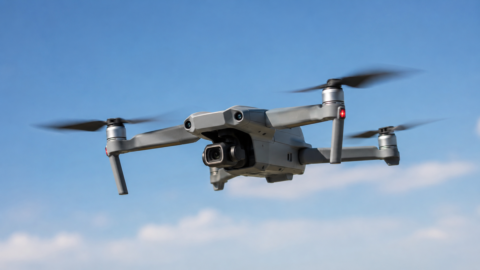
The United States they raise a new commercial wall around an increasingly strategic technology. Donald Trump signed an order which introduces duties of up to 100% on drones and on some imported components, with the stated goal of reducing America's dependence on foreign supply chains and strengthening domestic production. This measure doesn't directly cite Beijing, but it is part of Washington's growing pressure on the Chinese drone industry.
The White House views these systems as increasingly important not only commercially, but also for national security and military operations. The Department of Commerce has concluded that the United States is “too dependent” on foreign supplies of drones and components, identifying risks related to both industrial dependence and data security.
100% tariffs on the most sensitive drones
The squeeze will come in effective from 3 September 2026 and provides for arate of 100% for drones with a maximum take-off weight over 25 kilograms, for those equipped with thermal imaging systems, for docking stations, and for some components considered critical. For drones with a maximum take-off weight up to 25 kilograms the duty will be 25%The same rate will also be applied to other components, but in this case the entry into force has been postponed by 180 days, until February 9, 2027, to allow American industry time to increase domestic production.
The decision is based on the investigation conducted by the Department of Commerce pursuant to Section 232 of the Trade Expansion ActAccording to the findings reported in the presidential proclamation, drones are considered “essential” to American national and economic security and represent a “key technology in modern armed conflicts”, destined to play a central role in future U.S. military operations. The document also highlights their widespread use in activities ranging from law enforcement to scientific research, from agriculture to emergency management, and even the protection of critical infrastructure.
Drone tariffs: China targeted, but allies will pay less
Pure without expressly indicating China, the measure comes after a series of interventions by Washington directed especially against Chinese producers. According to the Financial Times, the aim is also to prevent that components made in China can continue to enter the United States through more complex assembly or production chains.
For some allies Washington has provided significantly more favorable treatment. Products from the European Union, Japan, South Korea, Taiwan, Switzerland, and Liechtenstein will be able to subject to an overall rate not exceeding 15%, while for the United Kingdom the cap will be 10%, provided that the critical components and technologies meet U.S. origin requirements.
The order also arrives after Washington had already limited access to the US market of new models from Chinese manufacturers. In December, the Federal Communications Commission blocked the new authorizations required to market drones and components from countries considered adversaries.
The DJI case and the battle over data security
Dji remains at the center of the conflictDJI, the world's largest drone manufacturer and a dominant presence in the American commercial market. The Chinese company has challenged US restrictions and in February filed a lawsuit challenging the FCC's decision to block the authorization of new models and components. DJI maintains that its products do not pose a security risk. In a letter to US lawmakers in May, the company reported that an audit conducted by an American cybersecurity firm found "no evidence of data transmission outside the United States" or "backdoors or unauthorized remote access mechanisms."
Washington, however, maintains a contrary assessment. The order signed by Trump states that some foreign-sourced drones and components can present cyber risks because the installed software may allow data to be sent to the manufacturer in another country, with the possibility that this information could be exploited by local authorities.
Washington aims to bring production back to the US
Tariffs are only part of the strategy. Trump has authorized the Department of Commerce to to create an onshoring incentive program, intended for companies investing in new US facilities to produce drones and related components. Companies with approved projects will be able to obtain tariff reductions on the import of components and equipment needed during the construction of the facilities, provided they make specific commitments to expand US production capacity.
The White House thus aims to address trade, security, and industrial policy simultaneously. According to the administration, the current dependence on foreign-produced engines, lithium-ion batteries, electronic systems, and other components constitutes a strategic vulnerability, especially in the event of geopolitical crises or conflicts.