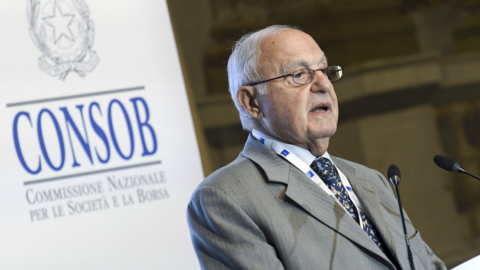
It's time to put one in the pipeline new institutional architecture of the Supervisory Authorities distinguishing the monetary part from the financial part. A “new architecture” that also passes through the movement of bank deposits by central banks to a single financial control authority as Consob or Esma are today. The proposal comes from the president of Consob, Paolo Savona, in the annual meeting with the market which coincides with the Authority's 50th anniversary.
Consob, here is Savona's recipe
Savona suggests a "specialization" overcoming the current mutual constraint in the institutional architecture which would put an end to the "subordinate position of financial stability to monetary stability". There proposed reform it would have "a single financial control authority - precisely - also for bank deposits".
The new architecture, adds Savona, it does not “preclude” the use “of operational capacity and cultural prestige” of central bankers for stability tasks as long as it is carried out with due operational independence". Savona adds that banks should not worry: "They would not lose market space in payment, credit and savings management systems." The advantage of the reform? Making possible "an economic policy that eases pressure on state accounts and reduces the burden of taxation and of public debt to GDP".
The reform is necessary, observes Savona, to advance the process of dematerialisation, based on the DLT, of money and financial activities and therefore "an institutional distinction between the creation of money at an official level and that in the form of bank deposits would act as a starting point , reunifying the latter under the jurisdiction of financial supervision, whose activity would produce, in a position of equality, a public good complementary to that of monetary supervision". With the reform of the Authorities proposed by Savona "the main advantage of the introduction of the institutional specializations and technological innovations indicated would be that the choices of monetary stability of quantity and interest rate they would develop independently of the needs of banking stability, overcoming the mutual constraint in the current institutional architecture; the historically subordinate position of financial stability to monetary stability would cease, which originated in the preponderant role played by banks on the savings market compared to other intermediaries, including stock exchanges".
With the reform of the institutional architecture of the Authorities, "the channeling of savings towards the financing of productive activities" would be favored. Savings, observes the economist and former banker in his speech to the financial market, “care should be given equal to that reserved for money and other new financial instruments, to prevent it from becoming a variable for adjusting the imbalances created by other factors".
Dividing the Authority for monetary control from that for financial control, concludes Savona, would make it possible to "respect savings investment plans, based on the life cycle needs of individuals and their families, entrusting financial intermediaries with the task of managing them in a rational way and for the organs of democracy to decide on a fair distribution of the resources produced". Savona does not hide the fact that it will take a long time. “The implementation of these institutional changes – which are intrinsic to the evolutionary nature of technologies and markets – will require time and obvious application precautions; However, it would not be rational behavior if we continued to proceed with partial realizations without knowing where the monetary and financial system is moving towards, because the uncertainty of the future would continue to prevail, increasing the complexity of governing mixed public and private economies, increasingly involved in the remembered changes in the geopolitical scenario".
Greetings from Mattarella
He also takes note of the ongoing transformations the President of the Republic, Sergio Mattarella, who in his greeting read at the beginning of the Milanese meeting said he was "certain that the Commission will now be able to face the new challenges that arise for finance from the application of technology and artificial intelligence in terms of rules and organisation, as well as from the evolution of European markets, which are increasingly integrated with each other and which require consequent supervisory structures".
The Italian Authority itself needs to be reformed, underlines Savona convinced that "the effectiveness and efficiency of Consob would improve if it were removed the obligation to approve the main operating decisions with a qualified majority of four votes out of five, quorum not foreseen for other independent authorities operating in Italy". We can go even further, his predecessor suggests Mario Nava, which would reduce the number of commissioners to just two.
Consob, it's time to take stock of numbers and sanctions
While waiting to experience a new decade that Savona defines as "short", due to the initial speed of technological innovations, the Commission meanwhile takes stock not only of the first 50 years with the publication of a book, but also of last year's activities when the fines imposed by the Authority dropped to a minimum of 3,4 million euros, which increasingly makes use ofArtificial intelligence to combat illegal behaviour. While the stock market regained the 2024 million capitalization threshold in the first months of 800, the number of listed companies remained virtually unchanged.
For stem the delisting a contribution can be made by Dl Capitali which facilitates the quotation of small businesses. On the most controversial point of the provision, relating to lists of the board of directors, instead "the market will provide an answer", reports the number one of the Authority.