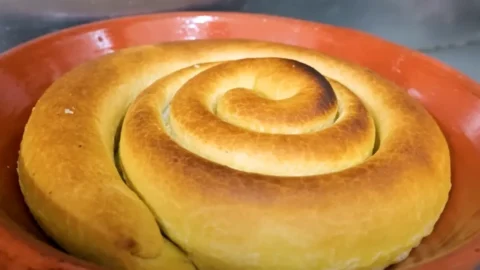
In the heart of the Murge plateau lies a small gastronomic treasure that tells the story of centuries of history and peasant culture: the Sammichele's book-shaped focaccia from Bari, said in local dialect shit in books and a Slow Food Presidium which restores value to an authentic tradition, made of ancient gestures, local raw materials and rituals deeply rooted in the territory.
A distinctive feature of this focaccia is the use of “poor” and genuine ingredients, closely linked to the territory: flours from locally grown soft wheat — such as maiorca, risciola and bianchetta —, salt from the salt mines of Margherita di Savoia, extra virgin olive oil produced with native cultivars (ogliarola barese, cima di Mola, racioppa, cazzinicchio), wild oregano from arid and sunny areas, and natural yeast obtained from the sourdough of the previous dough.
What is book-shaped focaccia?
The focaccia has a crafts unique, similar to a snail. It starts with a disk of dough 30-35 cm wide and about 3-4 cm thick. After being generously seasoned with extra virgin olive oil, salt and oregano, the dough is folded several times on itself, rolled up and arranged in a spiral. The result is a compact roll that resembles the shape of a snail.
This technique is not just aesthetic: the spiral traps scents e flavors, giving a unique consistency that alternates an external crunchiness, with a brownish color, with an internal softness, fluffy and white. The focaccia a libro is sold both in whole forms, from the smallest of about 130 grams to the largest of 600-700 grams, and in pieces.
Ancient origins and ties to the territory
La Story of the focaccia a libro is shrouded in mystery, but its roots go back to antiquity. It is assumed that a similar version was already present in Roman times, during the conferratio, a marriage rite reserved for patricians that involved sharing a spelt focaccia (or bread). In this context, the spouses broke the bread to symbolize the beginning of married life and the offering to Jupiter Farreo (Iuppiter Farreus). It is therefore possible that in the Sammichele area this tradition evolved over the centuries to become the current focaccia a libro.
As for the specific introduction to Sammichele, the sources are few and intertwine historical documents with oral testimonies. Some attribute the origin to Miguel Vaaz, Count of Mola, Portuguese of Jewish origins, who in 1609 purchased the fiefdom of Casamassima, including today's Sammichele. Others maintain that the focaccia a libro appeared at the end of the XNUMXth century, with minimal leavening, sufficient only for the time needed to recite ten prayers.
A Garrison to Protect Her
Like many local specialties, the focaccia a libro has also risked disappearing, overwhelmed by industrial production and imported raw materials, which have weakened the bond with the territory. The Slow Food Presidium is committed to regenerating that authentic relationship between growers and artisans of taste, bringing the short supply chain, local agriculture and the true identity of the product back to the center.
Sammichele's focaccia a libro is just one of the Apulian gems protected by Slow Food. Going south, we find the curly candy of Francavilla Fontana, a roasted almond covered in brown sugar and made with local cultivars; Manduria il dove, sweet filled with almond paste and cream, decorated with apricot jam; and in the Salento la Ionian goat, an ancient breed protected to revive pastoralism and traditional cheeses.