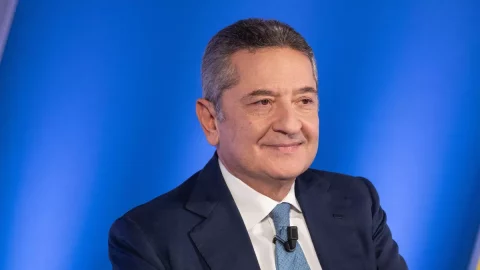
In Europe “we have signs of weakness in the European economy more persistent than we expected". This was stated by the governor of the Bank of Italy Fabio Panetta speaking with the Italian bankers gathered in the Executive of theAbi. “We expected a recovery in consumption that has not occurred; in the composition of production” and “industry is suffering above all and for problems that are only partly cyclical, more structural”, he stated in a video link.
In his analysis of the economic situation, adds the number one of Bankitalia, "some signs of weakening also from the labor market” which is not surprising: “when the economy stops, and after two quarters of almost zero growth in the euro area, companies draw their conclusions, also due to tensions in manufacturing”.
In Italy, beware of credit shortage
In Italy, signs of this are emerging "here and there" credit shortage in Italy especially for SMEs Even though the main reason for the “persistent” reduction remains the lack of demand from businesses, Panetta said “When there is a persistent, prolonged reduction in credit we must be more careful even if the issue is the weakness of demand, nothing pathological“. The Governor adds “the persistent decline particularly concerns small businesses which are important in terms of employment”. Among the reasons for the situation of low credit demand, Panetta also indicates the action of the ECB which in recent years “with targeted financing operations has stimulated the supply of credit perhaps with some excess that needs to be reabsorbed and therefore the contraction of credit is less anomalous”.
Inflation: “Back to 2% underway, but risks from energy and a slow-growing economy”
The Governor of the Bank of Italy summarizes and returns to talk about inflation after his speech at the Assiom Forex financial operators' congress on Saturday.The return to 2% price stability is underway, inflation is decreasing, r have emergednew risks for energy"a sector, he recalls, where supply and demand factors are at work, but also the choices of a cartel of producers: "oil and gas prices have increased since the beginning of the year and are now falling and all this tells us that in this path of monetary policy we need to be a little careful about these emerging risks". Panetta recalled that the main risk continues to come “from the economy that doesn't grow”.
Panetta: “EU simplification to respond to US deregulation”
Faced with the challenge of deregulation launched by Trump in the United States, Europe can react by focusing on "simplification" in the financial sector. Panetta said he had sent a letter to the European Commission “together with other colleagues to suggest that it is time for simplification, it does not mean deregulation but to make an overall assessment to evaluate whether there is an excess of regulatory burden” in the Old Continent. According to Panetta, the re-regulation carried out in the last 15 years after the global crisis should not be wasted “a race to the bottom is not desirable, it risks ruining the work done after the financial crisis”.
Panetta: “Banks protected from disasters caused by crypto”
Le Banks have so far been safe from the “disasters” caused by cryptocurrencies thanks to the fact that “the two worlds have been wisely kept separate,” Panetta said, adding that after Trump’s presidential order on crypto in late January, “we can’t assume that will happen in the future.”
The Governor explains that it will be necessary to understand well what the actual US deregulation will be after the announcements. Panetta finally underlines Trump's strong opening on crypto "also indicating that financial intermediaries can have access to trading values, to crypto exchange systems that are not known in the world for being the most regulated and those most subject to supervision".
Bankitalia: “With AI we examine the requirements of banks' boards of directors”
An interesting piece of news also comes today from the deputy general manager of Via Nazionale, Alessandra Perrazzelli which, an interview included in the “Supervision Newsletter” published on the ECB Supervision website, explains that the Bank of Italy has developed technological applications based on'artificial intelligence to assess the requirements of board members (fit and proper). “Here at Banca d’Italia – he adds – our staff contributes to SSM projects and we are also ready to share our Suptech tools. We have put into production several tools to help supervisors carry out their tasks. For example, we have developed an innovative tool for assessing the professionalism and integrity requirements of the members of the board of directors of the company’s managers, which uses artificial intelligence to analyze the profiles”.