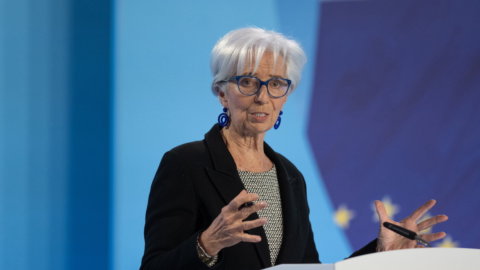
"There is no commitment” on the path to follow for the rate cut, indeed it will be “a bumpy ride”. She repeated it several times Christine Lagarde during the press conference following the June meeting in which the ECB cut rates by 0,25%. “There is a strong possibility that a phase of rate moderation has begun,” she acknowledged, adding however that at current levels “monetary policy remains restrictive”. In short, for the moment the ECB has only reduced the tightening, but it will take time to talk about a real easing. “It will depend on the data” reiterated the president of the ECB on the day in which the Eurotower experts raised their inflation estimates.
Lagarde on rate cuts: “We have not entered a reduction phase”
“We decided to cut rates today because our confidence in the future path of inflation has grown in the last month,” Lagarde said at a press conference in Frankfurt. “We analyzed the two phases we went through – he explained – the first phase saw a robust and rapid increase in the cost of money with 10 consecutive increases from July 2022 to September 2023. Then a waiting phase began until today and if I look back at these phases, we have reduced inflation by half at each phase.
The French economist also underlined the council's confidence in the reliability of the ECB staff's projections. “Based on this solidity of the projections we decided to cut rates but we did so with the premise that we will remain dependent on data and we will decide from meeting to meeting."
What data convinced the ECB? “Based on an updated assessment of the inflation outlook, underlying inflation dynamics and the intensity of monetary policy transmission, it is now the degree of restriction should be moderated of monetary policy after nine months of unchanged interest rates,” the president said. In short, after three years of tightening and eight years after the last cut, the time had come to cut rates, a decision shared by all governors except one. There is therefore not, even if by a hair's breadth, the much desired unanimity.
"We cannot say that we have entered a definite phase of reduction of the cost of money. It's very likely but we will remain strictly data dependent and we know that there will be obstacles along the way“, Lagarde warned, adding that we are still in a phase of restrictive monetary policy although with today's cut slightly less than previous months. “The next few months will continue to be complicated", It reaffirmed.
Lagarde on the ECB's next moves: "The speed and timing of the reduction remain uncertain"
“The speed and timing of the reduction in the level of monetary tightening remain uncertain,” continued the number one of the ECB, highlighting that for the next few months “a bumpy ride” is expected as inflation is proving stickier than expected especially when it comes to wage growth, especially in countries like Germany.
“The Governing Council – he said – is determined to ensure the timely return of inflation to its medium-term target of 2% and will maintain key rates at sufficiently restrictive levels for as long as necessary to achieve this aim”.
Lagarde on inflation and wages
The ECB's new estimates speak of inflation at 2,5% in 2024, 2,2% in 2025 and 1,9% in 2026, while core inflation is expected to be 2,8% in 2024, 2,2% in 2025 and 2,0% in 2026.
“Inflation will fluctuate at current levels for the rest of the year”, declared the number one of the European Central Bank from Frankfurt, adding that prices should then start to fall. “Despite the progress made in recent quarters, strong domestic price pressures persist as wage growth is high; inflation will likely remain above target until much of next year,” she added.
Speaking of the wages, Lagarde explained that growth will take a downward path "especially during 2025", but in the short term wages will remain in higher growth than initially expected and this is leading to an increase in prices in the services sector.
As regards the GDP instead, after quarters of stagnation, in the first quarter of this year the Eurozone's gross domestic product grew by 0,3% with an expansion of the services sector and a stabilization of manufacturing at low levels. “Support for the economy will come from wage growth and the contribution of foreign trade,” she added.
The market reaction
Audrey Childe-Freeman of Bloomberg Intelligence pointed out that in the ECB statement there's not quite a "dove" tone, or rather today's one has been defined “a hawk's cut”, while Mark Wall, chief economist for Europe at Deutsche Bank, explained that the European Central Bank “probably provided fewer indications than one might have expected about what comes next” this first step.
“The future trajectory of monetary easing remains uncertain, given the positive momentum recently recorded by indicators relating to inflation and economic activity, as well as cautious comments from the ECB,” summarizes Goldman Sachs, while according to Sylvain Broyer, EMEA chief economist of S&P Global Ratings, it seems “The ECB is unlikely to make more than two rate cuts solo before the Fed starts this year.” Furthermore, it predicts “that the Fed's rate cuts will continue until 2026, well beyond the completion of the cuts by the ECB”.
Comments that seem to be shared by the markets, which move - prudently - accordingly. After Lagarde's press conference l'EUR remains substantially stable at 1,088 to the dollar, while the spread between BTP and Bund it rose by two points compared to a few hours earlier, from 129 to 131 basis points, with the yield on the Italian ten-year benchmark at 3,86%.
They travel upwards, but without jerks, the Bags, with the Ftse Mib rising by 0,87% to 34.808 points, achieving the best performance in Europe driven by the acceleration of banking stocks. In fact, Frankfurt marks +0,38% like Paris, Madrid is up by 0,66%, Amsterdam by 0,44%.