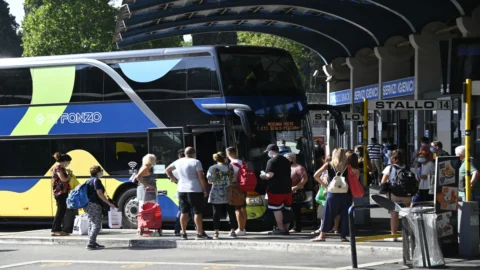
Il long-distance bus transport It has become one of the invisible infrastructures of Italian mobility. It connects large cities, medium-sized centers, small towns, and tourist areas, meeting a demand that has grown in recent years thanks to market liberalization, reduced average ticket prices, and improved fleets. Flixbus case, the leading operator in Italy with over ten million passengers transported on its national network, photographs the size reached by the sector: the bus is no longer a low cost or residual solution, but a backbone of intercity travel, capable of serving even areas less covered by other modes of transport.
This growth, however, has not been matched by a homogeneous leap in quality of infrastructureThis is highlighted by a study conducted by Professor Andrea Giuricin, which analyses the role of bus stations in the development of the sector and compares the Italian framework with some of the main European experiences. A two-speed photography: demand is growing, while terminals can't always keep pace.
Le bus stations, physical access point to the service, in many cases they remain the Achilles heel of the systemSafety, comfort, intermodality, passenger services, and operator facilities represent the true competitive frontier of medium- and long-distance road transport today.
The bus station knot
Bus stations are no longer simple places to get on and off. They are urban nodes, gateways to cities, interchanges, and service areas for millions of residents and tourists. Their quality directly impacts the travel experience and the overall perception of bus transportation.
The problem is that in Italy the picture remains very fragmentedAlongside well-located and relatively well-equipped facilities, there are weak terminals, inadequate stopping areas, and cases where service is still managed through simple poles. This model is inadequate for a sector that moves significant volumes and, in some cities, records traffic two or two and a half times greater than the resident population.
The most sensitive issue remains the of your digital ecosystem. , especially in the evening and nighttime. Lighting, video surveillance, assistance and security staff are not technical details, but crucial conditions for making the service accessible and credible. The perception of insecurity weighs particularly heavily on the elderly, students, tourists, and occasional travelers, influencing their choice of transportation.
Distance, intermodality and services change the game
La location of bus stations It is one of the elements that most influences demand. In many European cities, traffic reduction policies in historic centers have pushed the terminal towards peripheral or semi-peripheral areasA choice that can ease urban pressure, but which risks making the service less attractive if it is not accompanied by rapid and frequent connections with local public transport. The case of Colonia It's emblematic. Moving the bus terminal to the airport area has resulted in an estimated 30% reduction in demand, demonstrating how sensitive passengers are to the location of their departure and arrival points. The further away the terminal, the greater the travel time, modal shifts, and travel complexity.
For this intermodality becomes the heart of the new modelA good bus station must communicate with regional and high-speed trains, subways, trams, city buses, park-and-ride parking, and shared mobility solutions. Dedicated space for buses isn't enough. An urban hub capable of integrating with the entire mobility system is needed.
The topic also concerns the operation managementThe reduction in bus parking spaces and rest areas, already observed in cities like Stockholm and Copenhagen, creates inefficiencies, increases downtime, and can have the opposite environmental impact than desired, with more vehicles forced to circulate while waiting for available parking. Passenger loading and unloading areas must also be adapted to actual traffic flows, especially in tourist areas and for users with reduced mobility.
Italy at two speeds
To measure this gap, the study edited by Professor Andrea Giuricin constructs a Bus station evaluation index based on six dimensions: stop location, intermodality, passenger services, operator services, security, and accessibility for people with reduced mobility. The weighting gives significant weight to intermodality, services, and safety, while accessibility for people with reduced mobility completes the quality picture.
From the application of the index emerges aItaly is very heterogeneous. The ranking sees in the upper part Rome Tiburtina, Naples FS Park Central Station, Bari, and Brescia, all with above-average scores. Rome Tiburtina is the strongest Italian terminal, thanks to its connections to high-speed rail, regional trains, the subway, and buses, as well as the presence of user services, driver amenities, 24-hour security, video surveillance, and accessibility for disabled persons. However, the general redevelopment of the area and traffic management, especially at night, remains an open issue.
Milan Lampugnano It offers good services and subway and bus connections, but suffers from a more decentralized location and a security system limited to certain hours. Naples, thanks to its location near the Central Station, benefits from excellent rail and urban accessibility, although infrastructure improvements are needed. Bologna boasts a solid profile in terms of location, connections, and services, with 24-hour security and accessibility for disabled people, but it too is in need of redevelopment.
Other cases are more problematicFlorence Villa Costanza is well connected by tram but is located outside the city center and lacks dedicated services for drivers. Venice Mestre, Genoa Principe, and Verona Porta Nuova have more limited facilities, especially in terms of continuous security and operator services. Turin, despite its central location, has basic services and operational deficiencies.
The most relevant fact is that the country has important terminals not only in large citiesSiena, Bergamo, Venice, Aosta, Florence, and Bologna are among the top tier in terms of traffic intensity relative to the area served. Long-distance buses thus support Italy's municipalities, intermediate cities, and widespread tourist destinations, contributing to a connectivity that extends beyond the major railway lines.
The European comparison raises the bar
Il European benchmarking shows the gap to be filledThe average score for the European bus stations analyzed is 4,09, compared to the Italian average of 3,24. Munich leads the comparison with 4,5, followed by Prague at 4,25, Stockholm and London at 4,05, Wroclaw and Lisbon at 3,95, and Frankfurt at 3,9. Among the Italian stations, Rome Tiburtina scores 4,25, Naples at 3,8, Bologna at 3,65, Milan at 3,25, Florence at 2,75, Turin at 2,7, and Venice Mestre at 2,3.
The comparison doesn't penalize Italy uniformly. Rome Tiburtina Airport maintains the same level of performance as the best European airports, but the national system as a whole suffers from much greater variability. It's this fluctuation in standards that creates the problem. Travelers can find a well-connected, well-served, and staffed terminal, or a poor, unsafe infrastructure lacking basic services.
Munich is a model for its central location, connections to trains, buses, and the metro, passenger services, and operational features such as sewage disposal, parking, and a driver's lounge. Prague combines centrality, integration with the metro, trains, trams, and buses, comprehensive services, and enhanced security with private security, video surveillance, and a nearby police presence. Stockholm, London, and Wroclaw confirm the value of centrally located, well-connected terminals equipped with waiting areas, restrooms, refreshment areas, and security systems.
Even peripheral cases can work, provided they are part of a strong intermodal network. Lisbon, though far from the city center, benefits from integration with the metro, trains, and buses, and its proximity to the airport. Amsterdam demonstrates a different model, based on the redistribution of tourist flows outside the historic center and the use of public transportation to complete the final leg of the journey. Peripherality, therefore, is not in itself a limitation. It becomes one when an efficient connection is lacking.
We need a national plan
The medium and long-distance bus sector it has grown more than the infrastructure that hosts itTo bridge the gap, a National bus station plan, capable of setting minimum standards, identifying priorities, supporting local authorities, and encouraging structural investments. The parallel with the airport sector is significant. In recent years, Italian airports have strengthened their position thanks to targeted investments, improving the quality of services and traveler ratings. Bus stations can follow a similar trajectory, transforming from often marginal areas into recognizable, safe, modern, and integrated hubs.
Interventions should focus on safety, intermodality, passenger and driver services, universal accessibility, digitalization, and infrastructure for alternative traction vehicles. A recent study presented by Anav at the NME estimates that €300 million over a multi-year period is needed to bring the Italian system closer to European standards.
The challenge isn't just about transportation. It's about the country's development. Wherever a long-distance bus arrives, an economic, tourist, and social connection arrives. But for this network to realize its full potential, bus stations must stop being the weak link in the supply chain and become central infrastructure for national mobility.