A signature dish of Adriatic seafood cuisine, especially in the Marche region, but also in the Veneto, Romagna, Abruzzo, Termoli, Trieste, and Friuli regions. It's even found in Croatian cuisine under the name brodet, and in Greek cuisine (Corfu) under the name bourdeto. Fish broth, the king of summer tables along the entire Adriatic coast, found on the tables of starred chefs as well as in more modest trattorias, isn't a dish born in noble courts, but on sailors' boats and homes. When they returned from fishing, the most valuable and marketable fish was destined for the market, while the "waste" fish, which was difficult to sell due to its poor quality, or the size of the fish—too small, damaged, or less marketable species—the fishermen kept for their sustenance, even using, when the fish was too small, pieces of rock with seaweed and mollusks attached to them, resulting in a nutritious and tasty meal, ideal for replenishing energy after a day at sea.
Many types of fish were used, at least nine or ten, which varied according to the season: red mullet, sole, dogfish, monkfish, scorpionfish, cod, skates, gurnards, weever fish, John Dory, cuttlefish, squid, corn on the cob (in Venetian “canocie”, in Romagnolo “canocchie”), crabs, clams and mussels.
Its success is due to its authenticity, its ability to tell the story of a region and its people, and, of course, its unmistakable flavor, reminiscent of the sea, tradition, and passion. Hence, many variations are found, tied to the region. There's the Sambenedettese version, born in the "U Labirinto" neighborhood of San Benedetto del Tronto, with a predominant use of bluefish and olive oil as the main condiment. In Porto Recanati, it stands out for its use of green tomatoes, vinegar, and red and yellow bell peppers. Brodetto alla Vastese is distinctive for its use of tomatoes from the traditional earthenware dish, the "tijielle di craite," and a particular cooking technique. Then there's brodetto alla Romagnola, whose roots are traced back to the Greek populations who landed in Italy.
But above all, it is the Brodetto all'anconetana that stands out. Chef Daniele Tantucci, born and raised in Senigallia 53 years ago, has been a cooking teacher for over 25 years and is President of the Provincial Chefs Association of Ancona (FIC). His recipe for Brodetto all'anconetana won him the title of Champion in the national fish soup competition at the Brodetto Fest 2024 in Fano.
Historically, he explains, this fish was cooked in a "guazzetto" made of seawater, oil, vinegar, and tomato paste. The vinegar was used to dampen the strong odors of fish stored without refrigeration; the tomato was used to create a sauce for dipping bread and creating a hearty meal.
The Marche region's coastline, he adds, is a Mediterranean basin characterized by a predominantly sandy seabed, which slopes gently without ever reaching great depths. A key characteristic of this sea is its high level of eutrophication, meaning the significant presence of nutrients, capable of supporting abundant biomass and rich biodiversity. The dish has historically undergone increasingly refined evolutions, gaining well-deserved fame throughout the country and becoming an undisputed prerogative of the Marche region. Its secret lies in the beautiful fusion of flavors simmering together, the slow and delicate cooking, and the final, well-compressed consistency. The flavor, he emphasizes, is rich, balanced, and irresistible, like the essential "mopping up" of the fish, because it's in the sauce that everything comes together. Almost 13 varieties of fish with distinct flavors combine to create the harmony of Brodetto all'anconetana. And now we come to his philosophy: Brodetto is the epitome of the concepts of Local, Fresh, and Seasonal: the essence of cooking the best the sea has to offer. I dare say it would be better not to be tied to the number of fish available. Our beloved sea is already suffering serious attacks from climate change and pollution, to which the selective fishing of prized species is adding further challenges. Therefore, I believe that promoting smaller varieties and small-to-medium sized fish is a worthy endeavor, allowing us to offer our customers authentic flavors while maintaining high levels of sustainability.
The ideal pairing, the chef suggests, is with a good unsalted bread from the Marche region and a nice glass of white wine, of which there is a wide choice in the Marche region, from Verdicchio dei Castelli di Jesi to Verdicchio di Matelica, from Bianchello del Metauro to Falerio from the Ascoli hills.
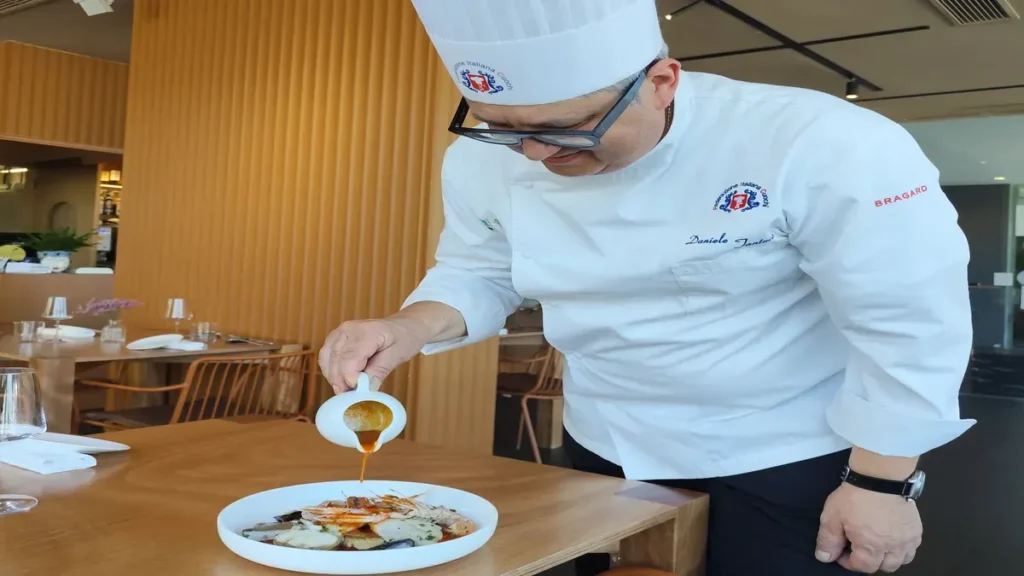
The recipe for Ancona-style Brodetto
According to tradition, 13 different types of fish and shellfish are needed for a perfect broth!
The typologies can be:
1. cuttlefish
2. squid or troffello
3. mantis shrimp or mantis shrimp
4. scampi
5. prawns
6. race
7. weever or spider fish
8. priest fish or hollow mouth fish
9. head
10. anglerfish
11. dogfish or dogfish
12. red mullet or red mullet
13. wild mussels or mussels from Portonovo
in the absence of others, you can also use sea bass, sole, hake and crabs
For each person you need at least 300g of cleaned fish.
To make the sauce for 4 people you will need:
100ml of extra virgin olive oil, half a golden onion, 2 cloves of garlic, a
piece of chilli pepper, 40ml of white wine vinegar, a bunch of
parsley, 400 g of tomato puree, salt, freshly ground pepper,
8 slices of Marche bread
The procedure
Slice the onion, chop the parsley leaves and reserve the stems.
Cut and portion the fish and shellfish. Shell or remove the
Shellfish, removing the legs. Lightly salt and pepper the fish. Make a broth with all the fish heads and trim.
Season with parsley stalks, salt and pepper. Cook for
half an hour, filter and crush.
• In a large pan, fry the onion, garlic and chilli pepper,
Add the cuttlefish. After a few minutes, add the tomato and the strained broth. Cook for 15 minutes, covered. Add all the fish one by one, starting with the toughest ones like weever, gurnard, and monkfish. Then, after at least 5 minutes, add the whitebait, skate, dogfish, and squid. After another 5 minutes, add the shellfish, mussels, and tender fish like red mullet or hake.
Add the parsley and cook until you get a nice sauce
Conversely, if necessary, add fish broth.
Serve one piece of fish of each type, drizzled with
generously with the sauce and slices of bread.